

With the booming development of the food delivery economy and the accelerated pace of life, disposable plastic clear food togo boxes have become an indispensable catering packaging tool in modern life. Statistics show that my country's food delivery market has exceeded 600 billion yuan, with over 500 million users and an average daily order volume exceeding 40 million. In this huge market, plastic clear food togo boxes, with their advantages of being "lightweight, durable, and low-cost," occupy more than 70% of the food delivery and fast food market. However, as consumers become more health-conscious, the safety of disposable plastic clear food togo boxes is receiving increasing attention, with one core controversy being: are more transparent containers safer?


Market research shows that 70% of consumers believe that "transparent clear food togo boxes are safer," while only 23% of users actively check the material label on the clear food togo box. This cognitive bias reflects a misconception among consumers regarding the safety of plastic clear food togo boxes and highlights the necessity of in-depth research into the relationship between transparency and safety. In fact, the relationship between transparency and safety is not a simple positive correlation, but rather involves the combined effects of multiple complex factors such as materials science, toxicology, and processing technology.
I. Material Basis and Transparency Mechanism of Disposable Plastic clear food togo boxes
1.1 Main Material Types and Their Transparency Characteristics
The core materials of disposable plastic clear food togo boxes mainly include PP (polypropylene), PS (polystyrene), and PET (polyethylene terephthalate). They differ significantly in terms of transparency, heat resistance, and safety.
- PP (polypropylene), currently the mainstream clear food togo box material used in the takeout and catering industries, has good heat resistance and can be used for extended periods within a temperature range of 100-120℃. It also has high chemical stability, good resistance to acids, alkalis, and oils, and high strength and rigidity. Uncolored PP material is white and semi-transparent with a waxy texture. It is lighter than polyethylene, has better transparency than polyethylene, and is more rigid. Through modification with nucleating agents, the light transmittance of PP can be increased from approximately 60% to over 90%, and the haze reduced to below 10%, achieving a transparency effect close to PET and PS.
- PS (polystyrene) boasts excellent transparency; it is transparent when uncolored and produces a clear, metallic sound when dropped or tapped. Its excellent gloss and transparency resemble glass. PS material has a light transmittance exceeding 90%, approaching glass-like quality, clearly showcasing the color and shape of food inside, offering excellent visual appeal, and making it ideal for food packaging where visual visibility is crucial. However, PS has poor heat resistance, only tolerating temperatures between 70-90℃; exceeding this range will cause it to soften, deform, and release harmful substances. It is also prone to brittleness at low temperatures.
- PET (polyethylene terephthalate) is characterized by extremely high transparency, high hardness, and impact resistance, making it suitable for long-term food storage. However, it has poor heat resistance (only tolerating temperatures below 60℃; it easily deforms at high temperatures) and cannot be microwaved. PET's molecular chains are formed by ester bonds connecting terephthalic acid and ethylene glycol, creating a relatively regular and highly symmetrical molecular structure. This regular molecular structure allows PET to partially crystallize under certain conditions, although the crystallinity is low.

1.2 The Physicochemical Nature of Transparency
The transparency of plastics essentially depends on the degree of light scattering caused by the material's internal structure. Two conditions are necessary for plastic products to be transparent: first, the product must be amorphous; second, although partially crystalline, the particles must be small, smaller than the wavelength range of visible light, and not obstruct the transmission of visible and near-infrared light in the solar spectrum.
For crystalline polymers, crystallinity is the key factor affecting transparency. Higher crystallinity results in lower transparency because light scattering occurs at the interface between crystalline and amorphous regions. For example, completely amorphous polystyrene (PS) films have extremely low haze, while highly crystalline polypropylene films with larger crystal sizes will exhibit significantly higher haze. By controlling the crystallization process and reducing the spheroid size to below the wavelength of visible light, light does not refract or reflect, and even with crystallization, the polymer's transparency remains unaffected.
Quantitative indicators of transparency mainly include light transmittance and haze. Transmittance (Tt) is the percentage of luminous flux transmitted through the sample to the incident luminous flux, reflecting the material's total light transmittance. Haze (H) is the percentage of scattered luminous flux transmitted through the sample to the total transmitted luminous flux, reflecting the degree of blurring or turbidity of the material. According to the national standard GB/T 2410-2008 "Determination of Transmittance and Haze of Transparent Plastics," the transmittance of transparent materials should be ≥90%, and the haze should be ≤0.5% to ensure visual clarity.

1.3 Key Factors Affecting Transparency
Besides the crystalline characteristics of the material itself, the following factors affect the transparency of plastics: Molecular structural regularity is the fundamental factor determining transparency. Aromatic ring rigid-chain polymers (such as PC and PS) contain benzene rings in their main chain, which hinder molecular chain rotation, forming high-strength, high-transparency (PC transmittance 90%) materials, but with high internal stress and a tendency to crack. Amorphous polymers, due to their disordered molecular arrangement, are often more transparent than semi-crystalline polymers. For example, polystyrene (PS) is an amorphous polymer, often used in transparent packaging due to its high transparency. Processing parameters significantly impact transparency. Temperature, cooling rate, stretch ratio, and demolding method all cause changes in internal stress within the material during processing, thus affecting optical transmission properties. For example, in the injection stretch blow molding of PET, the stretching process orients PET molecules, increasing bottle transparency by 30% (transmittance exceeding 90%), while simultaneously increasing impact strength by 40%.
The use of additives is a crucial means of improving transparency. Nucleating agents induce the formation of finer, more uniform spherulitic structures in polyolefin molecular chains during melt cooling, significantly reducing material haze and increasing light transmittance. Novel nucleating agents, at extremely low addition levels (typically 0.1%–0.3%), can significantly increase the crystallization temperature of PP (by 8–15°C) while drastically reducing haze (down to below 5%), resulting in light transmittance exceeding 90%.


II. Consumer Choice Perspective: Transparency Preference and Cognitive Misconceptions
2.1 Actual Consumer Preference for Transparency
Consumers' preference for the transparency of disposable plastic clear food togo boxes primarily stems from their "visualization" advantage. Research shows that consumers' decision-making time is reduced by an average of 30% when purchasing food with transparent packaging; "being able to see" has become one of the basic requirements for food packaging today.
For ordinary households, the most practical advantage of transparent disposable plastic boxes is "visual storage." Braised pork and cold dishes in the refrigerator, stored in a transparent box, can be clearly seen in their appearance and remaining quantity without opening the lid. This eliminates the need to repeatedly open and search through packaging, preventing cold air loss from affecting the preservation of other foods and allowing for the timely detection of soon-to-expire ingredients, reducing waste.
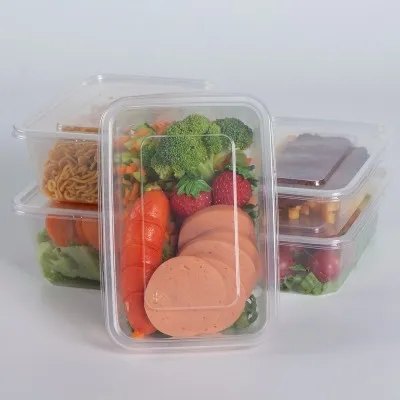
In the catering scenario, the biggest intuitive advantage of transparent plastic boxes is their fully transparent display effect. With a light transmittance of over 90%, the food is clearly visible inside the box. Transparent plastic boxes are mostly made of food-grade PP material, which combines flexibility and hardness and has excellent impact resistance. Small transparent containers (such as those for 6 strawberries) are suitable for single-serving meals, allowing consumers to choose according to their needs; larger transparent containers (such as those for 1kg of pre-cut vegetables) are suitable for family meals, with clear capacity markings printed on the container, allowing consumers to intuitively understand the portion size and reducing hesitation about "not having enough to eat."


2.2 Consumer Misconceptions about the Relationship between Transparency and Safety
While transparency brings convenience, consumers have serious misconceptions about the relationship between transparency and safety. Surveys show that 70% of consumers believe "transparent, clear food togo boxes are safer," while only 23% of users actively check the material label on the clear food togo box. This cognitive bias is mainly reflected in the following aspects:
- The misconception that "transparency = safety" is the most common. Many consumers believe that transparent plastic clear food togo boxes are made of pure plastic materials and are therefore safer. However, many transparent containers on the market are made of PP5 or lower grade materials, only suitable for refrigerated or room-temperature food. They will soften or even deform at high temperatures, releasing toxins. In reality, the color of plastic is not necessarily related to its safety. At high temperatures, transparent PE material is not necessarily safer than black PP material.

- Ignoring material labeling exacerbates safety risks. When purchasing disposable plastic clear food togo boxes, consumers should first check for the "QS" mark and production license number on the packaging. If these are not present, do not purchase them. Choose disposable plastic clear food togo boxes with a smooth, even surface and uniform color, and opt for products without decorative patterns and that are colorless and transparent. However, in reality, most consumers lack knowledge about plastic materials and often judge safety solely by their appearance, ignoring the inherent risks of the material itself.
- Insufficient awareness of high-temperature risks is another significant misconception. Many people judge the safety of takeout containers by their transparency, sturdiness, and lack of odor, which is a major misunderstanding. PET (No. 1 plastic), commonly found in beverage bottles, has a heat resistance of only 70℃, making it easy to exceed safety limits when used for hot soup. PS (No. 6 plastic), the brittle, transparent type, has a heat resistance of only around 60℃, and can release harmful substances quickly when used for freshly cooked food.

2.3 Consumer Choice Behavior Regarding Different Types of Clear Food Togo Boxes
Consumer choice behavior regarding different types of clear food togo boxes exhibits clear scenario-based characteristics. In food delivery scenarios, containers are subject to bumps (prone to leakage), long-term storage (requiring insulation), and may involve microwave heating (some users require secondary heating). Therefore, it is recommended to prioritize PP plastic containers (heat resistant to 130℃, microwaveable) or PLA/PBAT biodegradable containers (heat resistant to 90℃, environmentally friendly). These containers should have a snap-on sealing lid (to prevent spills) and an anti-slip bottom (to prevent slipping during delivery).
In fast food packaging scenarios, consumers prioritize the display effect provided by transparency. Transparent rigid plastic boxes (polycarbonate PC) have good heat resistance (120℃) and are the most common and relatively safe material for takeout clear food togo boxes. The boxes are semi-transparent/pure white and flexible. PS material has high transparency and low cost, and is often used for cold or chilled foods such as salads and sushi, but it deforms easily when heated and should be avoided for hot food.
In microwave heating scenarios, consumers are more cautious in their choices. PP (polypropylene) is the only plastic that can be microwaved, with a heat resistance of 120℃. It is certified safe by the EU and FDA. The "5" mark on the bottom of the box is key; it is recommended to choose transparent, odorless products. PS foam clear food togo boxes soften at 95℃ and have styrene release levels exceeding the standard by 3 times; they should absolutely not be microwaved.
In refrigerated storage scenarios, transparency and functionality are equally important. PET material has good low-temperature resistance, is suitable for refrigerator refrigeration, and does not contain harmful substances such as BPA and plasticizers. Food storage containers can adapt to low-temperature environments and will not crack or deform due to excessively low temperatures in the freezer, ensuring the safe storage of food in a frozen state. They can generally adapt well to the low-temperature environment of the freezer compartment and can usually be used normally at around -20°C.

III. Product Development Perspective: Balancing Transparency Enhancement Technology and Safety Risks
3.1 Material Formulation Design for Different Transparency Levels
In product development, achieving different transparency levels mainly involves three technical routes: using catalysts to produce transparent PP, modifying PP with transparent nucleating agents, and blending with other resins to produce transparent PP.
Using catalysts to produce transparent PP is the most direct method. Industrial production of ethylene-propylene random copolymer PP using Z-N catalysts involves thoroughly mixing propylene and ethylene gases, using the catalyst to obtain comonomers and various monomer polymerization segments, forming PP molecular chains through chain growth and chain transfer, ultimately obtaining random copolymer PP with a transmittance exceeding 94%, essentially approaching the transparency of transparent polyethylene. Metallocene catalysts have a superior transparency-enhancing effect compared to Z-N catalysts. In the synthesis of transparent PP, they can control crystallinity, precisely control molecular weight, and control the comonomer embedding method, producing syndiotactic, atactic, and isotactic PP mixtures with high transparency and high strength.
Adding transparent nucleating agents is the most commonly used modification method. Transparent nucleating agents are processing modifiers that alter the crystallinity of incompletely crystalline polymer resins and accelerate crystallization. Their core functions include improving the transparency of materials such as polypropylene (PP), refining the crystalline structure, improving the physical properties of products, and shortening processing cycles. Third-generation sorbitol-based products (such as NA-21 and DMDBS) can increase the initial crystallization temperature of PP by 17°C, and an increase in transparency can be achieved with the addition of 0.1%-0.3%. Fifth-generation products (such as NHS-9999) further broaden the processing temperature range and enhance mechanical properties.
Blending with other resins is another feasible approach. Blending increases transmittance by using one or more polymers with a refractive index similar to PP and a dispersed phase particle size smaller than the wavelength of visible light. By leveraging heterogeneous nucleation, the crystal size of PP is reduced, increasing the product's transmittance. Studies have shown that low-density polyethylene (LDPE) and ethylene-propylene-diene copolymers are suitable blending agents. Adding 10% of a blending agent can reduce the crystal size of PP, increase crystallinity, and improve the light transmittance of the product.


3.2 The Dual Impact of Additive Type on Transparency and Safety
While additives improve transparency, they may also pose safety risks and require careful use. Nucleating agents are the most important type of additive. Their mechanism of action is to provide a large number of uniform nucleation sites, transforming the large and disordered crystals formed by PP under natural cooling into numerous, fine-sized, and uniformly distributed microcrystalline structures. This uniform microcrystalline structure greatly reduces light scattering, thereby significantly improving the light transmittance of the product, greatly reducing haze, and simultaneously giving the product excellent surface gloss.

However, some additives may pose safety hazards. For example, traditional sorbitol-based nucleating agents may release aldehyde compounds during processing. Although third-generation products have solved this problem, their cost is relatively high. Furthermore, to reduce costs, some companies may use recycled materials or industrial-grade additives. These materials may contain harmful substances such as heavy metals and plasticizers, seriously affecting product safety.
The use of fillers has a significant impact on both transparency and safety. The filler used in polyolefin filler masterbatches is primarily heavy calcium carbonate, followed by inorganic fillers such as talc, kaolin, and calcium powder. The impact of fillers is mainly reflected in three aspects: first, it affects product quality, primarily by reducing toughness; second, it increases the product's specific gravity; and third, it affects the color of the product. Even transparent filler masterbatches will have some impact on transparency, and the greater the amount added and the thicker the product, the greater the impact.

Transparent powder is a special type of filler. When the refractive index of the inorganic powder is close to that of the plastic (1.5%), the filler will have good transparency. Highly transparent fillers are generally light gray in the base plastic. If the filler has only a single refractive index and it is close to the refractive index of the base plastic, as long as the surface of the filler particles can be completely wetted by the base resin, the filler material will be transparent. However, it's important to note that the impact of different inorganic additives on gloss is in the following order: glass microspheres < precipitated barium sulfate < barite < kaolin < calcium carbonate < glass fiber < talc < mica.
3.3 Influence of Processing Technology on Transparency and Safety
Controlling processing parameters has a decisive impact on the transparency and safety of the final product. In injection molding, temperature control is a critical factor. The barrel temperature is typically set according to a "gradient increase" principle, gradually increasing from the hopper to the nozzle to accommodate the material's transition from a solid to a molten state. The injection molding stage involves parameters such as injection speed, injection pressure, holding pressure and holding time, and cooling time. These parameters directly affect the product's geometry, dimensional accuracy, and surface quality. For injection molding of transparent products, the following points require special attention: Excessive temperature may cause plastic decomposition or discoloration, while insufficient temperature may result in opacity or the formation of bubbles; injection speed determines the flow rate of the molten plastic, and both excessively fast and slow speeds can affect the product's transparency and quality; if the melt contains bubbles or the injection speed is too fast, bubbles may appear inside or on the surface of the product, reducing the transparency of transparent products.

3.4 Balancing Cost Control and Safety Performance
In product development, there is a complex balance between cost control and safety performance. From a material cost perspective, PP holds approximately 55% of the market share due to its good heat resistance and controllable cost, while PS and PET have relatively lower costs but poorer heat resistance.
Specifically regarding product prices, basic traditional plastic disposable lunch boxes cost approximately 0.1-0.3 yuan each, while lunch boxes made from sugarcane, corn starch, etc., cost approximately 0.4-0.6 yuan each. Biodegradable shopping bags of the same size cost approximately 1.5 yuan each (7 times more expensive than traditional bags). Through large-scale production, disposable transparent clear food togo boxes, primarily made of PET or PP, feature high transparency, strong heat resistance (up to 120℃), and good impact resistance. Simultaneously, large-scale production keeps the cost per container within the range of 0.3-0.5 yuan, 10%-15% lower than similar products on the market.
In the technological pathways to improve transparency, different methods have significantly different costs. Using metallocene catalysts is the most expensive but yields the best results; adding nucleating agents has a moderate cost and good results; blending methods are relatively inexpensive but may affect other material properties. Companies need to find the optimal balance between cost and performance based on product positioning and market demand.
 Improved safety often means increased costs. For example, using food-grade raw materials, strictly controlling additive dosages, and adopting more advanced processing technologies all increase production costs. However, in the long run, products that prioritize safety are more likely to gain consumer trust, which is beneficial for brand building and market expansion. Therefore, companies should prioritize safety performance in product development and optimize cost structure while ensuring safety.
IV. Regulatory Compliance Perspective: Standards System and Transparency Requirements
4.1 Latest Requirements of China's GB 4806 Series Standards
China's regulation of disposable plastic clear food togo boxes is becoming increasingly stringent. On September 6, 2024, my country officially implemented the "National Food Safety Standard - Plastic Materials and Products for Food Contact" (GB 4806.7-2023), replacing the previous GB 4806.6-2016 and GB 4806.7-2016 standards, marking a new stage in my country's management of food contact materials.

The main changes in the new standard include: expanded scope of application, adding starch-based plastics (starch content ≥40%) and unvulcanized thermoplastic elastomer materials; clarification that plant fiber products must be managed as additives; upgraded technical requirements, adding total migration testing of aromatic primary amines with a detection limit of 0.01 mg/kg (EU limit is 0.002 mg/kg), reducing the bisphenol A (BPA) limit from 0.6 mg/kg to 0.05 mg/kg, and prohibiting its use in infant products; simplified labeling, no longer requiring the labeling of complex Chinese names of resins, only compliance with the general requirements of GB 4806.1 (such as labeling "plastic PP").
Regarding chemical migration limits, the standard stipulates that plastic clear food togo boxes must not release harmful substances under intended use conditions (including temperature, time, etc.), the migration of relevant chemical substances must meet safety limits, and the maximum operating temperature must be clearly marked on the product. Specific limits include: total migration ≤ 10 mg/dm² (all simulants), meaning no more than 10 mg of migration per square decimeter of clear food togo box surface area; phthalates: DBP migration ≤ 0.3 mg/kg, BBP migration ≤ 30 mg/kg, DEHP migration ≤ 1.5 mg/kg; primary aromatic amine migration: total PAA migration ≤ 0.01 mg/kg, aniline migration detection limit ≤ 0.001 mg/kg.

Regarding transparency requirements, although the standard does not directly specify a transparency value, it does impose requirements on sensory performance: plastic products should be odorless, free of foreign matter, and without a significant color difference. This means that products with poor transparency, impurities, or cloudiness may fail sensory testing.
4.2 Comparison of Standards in Major International Markets
Standards for disposable plastic clear food togo boxes vary across different countries and regions. Understanding these differences is crucial for product export and international trade.

The EU market implements the strictest standard system. The European Union Regulation (EU) No. 10/2011 established the "Union List," which clearly outlines the categories of substances that can be used in food contact plastics, including monomers, additives, and polymerization auxiliaries. It specifies the conditions of use, specific migration limits (SMLs), and other restrictions for each substance. Regarding migration limits, the overall migration amount must not exceed 10 mg/dm² or 60 mg/kg (applicable to small-volume containers), the specific migration limit for bisphenol A (BPA) must not exceed 0.05 mg/kg, and the detection limit for primary aromatic amines is 0.002 mg/kg, which is stricter than Chinese standards.
The US FDA regulates substances through 21 CFR regulations and the GRAS (Generally Recognized As Safe) list, focusing on the total migration amount, monomer residues, and the safety of specific chemicals (such as BPA). The US FDA's Office of Food Additives Safety (OFAS) states that oligomers with a molecular weight of 1000 Da or less can migrate into the food matrix and be absorbed by the intestines.
In addition to the general requirements of the European Union, German LFGB requires additional testing, including sensory evaluation and heavy metal leaching, with particular attention to hazardous substances such as azo dyes and formaldehyde.

Regarding transparency requirements, international standards primarily control this indirectly through optical performance testing. International standards such as ASTM D1003 "Determination of Transparency of Plastics" and ISO 13468 stipulate that transparent materials should have a light transmittance ≥85% and a haze ≤3%. These standards provide unified technical specifications for the global market.
4.3 Regulatory Differences Between Materials with Different Transparencies
Although regulatory standards do not directly classify materials by transparency, there are practical differences in regulatory compliance for materials with different transparency levels.

High transparency materials generally indicate the use of purer raw materials and more advanced processing techniques, making it easier to meet regulatory requirements. For example, food-grade PET boxes have extremely high transparency, like glass, allowing clear visibility of the food inside without any cloudiness, spots, or impurities; while inferior PET boxes may contain recycled materials, have a hazy surface, scratches, and even visible fine particles under light. This quality difference directly affects whether a product can pass regulatory inspection. The use of additives has a significant impact on regulatory compliance. The use of anti-reflective nucleating agents must comply with GB 9685, "Standard for the Use of Additives in Food Contact Materials and Articles," which specifies the permitted types of additives, their scope of use, and maximum usage amounts. For example, while third-generation sorbitol-based nucleating agents are highly effective, it is essential to ensure that they do not release harmful substances during use.
Material labeling requirements are a crucial component of regulatory compliance. The new standard simplifies labeling requirements, no longer mandating the use of complex Chinese names for resins, but basic information such as "plastic PP" is still required. For transparent materials, the maximum operating temperature must be clearly indicated on the product, which is particularly important for transparent materials with poor heat resistance, such as PS and PET.

4.4 Status of Standard Development for Biodegradable Plastics
With increasing environmental awareness, the standard system for biodegradable plastic clear food togo boxes is being rapidly established and improved. Regarding basic general requirements, my country has formulated and issued eight national standards, including "Requirements for Degradation Performance and Labelling of Biodegradable Plastics and Products" (GB/T 41010) and "Definition, Terminology and Labelling of Bio-based Materials" (GB/T 39514).
For disposable tableware, GB/T 18006.3-2020 "General Technical Requirements for Disposable Biodegradable Tableware" has replaced the relevant content on biodegradable tableware in the original GB/T 18006.1-2009. This standard sets specific requirements for the degradation performance of biodegradable plastic lunch boxes: a biodegradation rate of ≥90% within 180 days under specific conditions (composting at 58℃, humidity 50-60%).

For starch-based plastics, the state is organizing the formulation of relevant industry standards to improve the standard system for biodegradable plastic products. The "Starch-Based Plastics" standard will set specific requirements for starch content, degradation performance, and safety of use, providing standardized guidance for industry development.
Regarding transparency requirements, biodegradable materials face unique challenges. Because biodegradable materials typically contain natural components, their transparency is often lower than that of traditional petroleum-based plastics. However, with technological advancements, the transparency of biodegradable materials is continuously improving through the addition of transparency enhancers and optimized formulations.
