


1. What is MFPP?
Although MFPP is not as popular as PLA and pulp, its superior performance and environmentally friendly performance have made it one of the new generation of eco friendly to go containers wholesale materials by more and more manufacturers.
Definition and Composition of MFPP
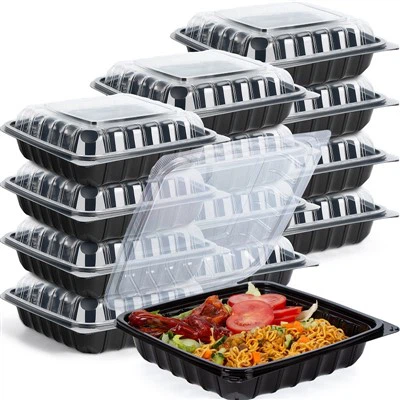
MFPP, the full name of which is Mineral-Filled Polypropylene, is a material that adds mineral fillers such as calcium carbonate to traditional PP. This not only reduces the amount of plastic used, but also has a certain degree of degradability. It is also more heat-resistant and structurally stable than traditional PP materials.

Interpretation of MFPP's Environmental Attributes
MFPP is not a compostable to-go container type product, but it has a certain degree of degradability and does not cause as much harm to the environment as PP. In addition, MFPP has good recyclability, can be reused many times, and is not easy to break. It is a very practical eco friendly to go containers wholesale, especially for catering brands that want to balance environmental protection and performance.
The Application Advantages of MFPP
MFPP has good thermal stability and can be used directly as microwave to go containers, which is very suitable for heating lunch boxes and take-out packaging. Its structure is stronger than ordinary PP, and it is oil-resistant, water-resistant, and not easy to deform, making it very suitable for use in various catering industries. In terms of price, MFPP has a moderate cost and is increasingly being used in customized, brand eco-friendly to go containers wholesale.
2. PLA
The catering industry favors PLA for its biodegradability, but the actual degradation conditions and usage limitations are essential knowledge, especially for customers looking for cost-effective, eco-friendly to-go containers for wholesale food packaging.
Analysis of PLA's Environmental Performance
PLA (polylactic acid) is mostly made of corn starch, cassava, or sugarcane, which is environmentally friendly from the source. The food containers made of it can be completely degraded under industrial composting conditions, and are typical compostable to-go containers. However, the degradation of PLA depends on high-temperature and high-humidity industrial composting facilities. Ordinary families cannot create a composting environment, and in the natural environment, the degradation cycle may be as long as several years.
Advantages and Limitations of PLA in Use
PLA has a relatively transparent appearance, no granularity on the surface, and is extremely smooth. It is a common choice in the high-end catering industry. However, it does not perform as well as MFPP in microwave heating. It is usually easy to soften and deform at high temperatures, and cannot meet the functional requirements of microwave to go containers. And PLA lunch boxes are not suitable for holding hot soup. Therefore, in the use scenario that emphasizes the heating function, PLA may not be the best choice.
Cost and Market Acceptance
PLA is more expensive than MFPP and pulp, so it is not widely used in the market. It is suitable for the high-end catering market that emphasizes green environmental protection. But for brands pursuing a sustainable image, PLA is still one of the preferred materials.

3. Pulp Molding
Pulp products are based on natural fibers and have an excellent environmental image. They are popular players in eco-friendly to-go containers wholesale, but in actual applications, they need to be selected based on their necessary functions.
Introduction to Materials and Processes
 Pulp products are usually made from crop byproducts such as bagasse, wheat straw, and bamboo pulp, and have a native, natural, and environmentally friendly texture. As a typical compostable to-go container, pulp products can not only be degraded in industrial compost, but also be naturally degraded under home conditions, and will not produce any harmful residues, making them the best choice for zero-plastic products.
Performance Analysis
Although the degradability of pulp lunch boxes is the best among all types of lunch boxes, the disadvantage is that their oil and water resistance is relatively weak. The surface of current pulp lunch boxes is often covered with a layer of PLA coating or PE coating. It is generally not recommended to heat it in a microwave oven, and it can only be heated for a short time at most. It is also not recommended to use pulp lunch boxes to hold hot soup and other foods, which may cause it to soften or  deform. Therefore, in the microwave to go containers market where microwaves are frequently used, the use of pulp lunch boxes is limited.
Cost and Appearance Impression
The cost of pulp lunch boxes is in the middle range. Although the appearance is simple, the surface is slightly rough, and even easy to absorb oil stains, it is recognized by consumers for its environmentally friendly raw materials and manufacturing process. It is particularly suitable for building a natural and sustainable brand image and is a visually recognizable, eco-friendly to go wholesale containers.
4. MFPP, PLA, and pulp: A Chart to Understand the Advantages and Disadvantages
The three materials have their own advantages in the environmentally friendly packaging market. How to choose the most suitable eco friendly to go containers wholesale should be combined with factors such as usage requirements, brand tone and budget.
Materials of different products
Attributes

Compostability
Microwave applicability
Appearance texture
Cost
Customizability
Is it recommended as eco friendly to go containers wholesale
MFPP
NO
YES
Medium
Medium
High
YES
PLA (polylactic acid)

YES (industrial composting)
NO
High
High
Medium
YES
Pulp molding

YES (home + industrial)
Limited
Medium Low
Medium
High
YES
On the whole, MFPP is suitable for brands that pursue cost control and microwave applicability, PLA is more suitable for companies that are positioned at the high end and emphasize the "biodegradable" image, and pulp molding is suitable for businesses that pursue natural texture and home composting friendliness. When choosing eco friendly to go containers wholesale, it is necessary to clarify your own product positioning and consumer needs to make more scientific and reasonable material decisions.
Where to Buy Microwave To Go Containers?
 If you are looking for a reliable eco friendly to go containers wholesale supplier, please contact us - Huizhou Yangrui Printing and Packaging Co., Ltd. We provide multi-material environmentally friendly lunch boxes wholesale (MFPP / PLA / pulp), microwave safe, oil-proof and waterproof, customizable LOGO, fast proofing, and support OEM/ODM services.
Email: sales@packagingbag5.com
Phone/WeChat: +86 180 8644 3226
References
 European Bioplastics Association. (2023). Environmental benefits of PLA in food packaging.
 - ASTM International. (2021). Standards for Compostability: D6400 & D6868.
- Plastics Europe. (2022). Mineral-Filled Polypropylene – A More Sustainable PP Alternative.
- NatureWorks LLC. (2024). PLA performance and industrial composting requirements.
- Packaging Gateway. (2024). Pulp Molded Packaging Trends: From Function to Sustainability.


