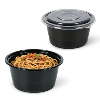
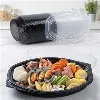
Nowadays, more and more people start to care about environmental protection, and many restaurants also start to struggle with the question: whether to use disposable containers or reusable take-out containers that can be reused is more environmentally friendly? These two kinds of lunch boxes look quite reasonable, but behind the environmental account, in fact, not so simple. This article is about them in the end, which is more environmentally friendly, more cost-effective, and how to use them more scientifically.
1. From an Environmental Point of View, Are These Two Lunch Boxes Going?
Environmental protection can not just look at the surface; you have to first figure out what these two lunch boxes.
Disposable Lunch Box in the End, What?
A disposable lunch box is a kind of meal thrown away box, commonly materials such as PP plastic, PS plastic, PLA, and pulp. They are characterized by being cheap, lightweight, and easy to transport, and their life cycle ends after one use. There are several ways to deal with them; some are landfilled, some are incinerated, and some can be degraded or composted. But in reality, many "degradable" boxes can not really decompose, unless in specialized processing equipment. So, although these boxes are convenient, the environmental pressure is not small.
What Are Reusable Plastic Take-Out Containers?
Reusable take-out containers are plastic lunch boxes that can be washed and reused over and over again. The materials used are strong, such as polymer PP, TPU, or Tritan, which can withstand high temperatures and can also go into the dishwasher. This lunch box can be used dozens of times or even hundreds of times, but it also needs regular high-temperature sterilization or special cleaning. It looks environmentally friendly, but it actually depends on how you use it. If you buy it and throw it away after a few uses, you might as well use disposable ones.


Where Are Different Lunch Boxes Suitable For?
Disposable ones are suitable for fast food, take-out, activities, and fast volume, where customers don't come back; reusable take-out containers are more suitable for scenarios with fixed sources of customers, such as chain brands, school canteens, shopping malls, and so on. Overall, it depends on where and how you use it.
2. Environmental Protection in the End: Who Is Better?
Environmental protection not only depends on the material, but also depends on the whole process from production to exhaustion.
What Are the Environmental Issues of Disposable Lunch Boxes?
The good thing about disposable lunch boxes is that they do not consume much energy to produce, and they are easy to transport and suitable for large quantities. However, the disadvantage is that there is too much garbage, which has to be thrown away after one use, and a large amount of use will cause disposal problems. Either landfill or burn, neither is environmentally friendly but also may pollute the environment. Especially in places where waste classification is not in place, these lunch boxes may end up in the landfill, which is not good for the soil and water.


Are Reused Ones Less Environmentally Friendly?
It sounds strange, but some people do say that reusable take-out containers use more energy and emit more carbon when they are manufactured in the first place. The reason for this is that the material is thick and the process is complex. However, if you can reuse them many times and "amortize" the initial pollution, it's still more environmentally friendly overall. But if you use a lot of hot water or electricity when cleaning, or do not use it a few times to throw away, then the environmental effect will be discounted. Therefore, how to use it is also very critical.
How Many Times Should I Use It Before It's Considered Environmentally Friendly?
Some studies say that reusable take-out containers should be used at least 16 to 50 times before they are considered more environmentally friendly than disposable containers. In other words, to be environmentally friendly, you have to use them consistently and wash them carefully, and you can't fish for three days and sun-dry the net for two days. Otherwise, the word "environmentally friendly" will become a mere decoration.

3. Is It Easy to Use? Is the Cost High?
In addition to environmental protection, catering establishments have to consider the ease of operation and whether it is cost-effective.

Disposable Lunch Box: Cheap, Good to Use, But There Is Waste
The advantages of disposable lunch boxes are obvious: cheap, throw away after use, suitable for crowded scenes, such as takeout, fast food. This kind of lunch box can also print a logo, do customization, and enhance the brand image. But in the long run, in fact, quite wasteful, not only with more money, environmental protection is also a loss. And now the policy is getting stricter and stricter, disposable plastic will be limited sooner or later.
Reusable Take-Out Containers: The Invisible Cost Is Also Quite a Lot
Reusable take-out containers are expensive; one may cost 0.5 to 2 dollars. But the bigger costs are in the back, such as how to recycle, how to wash, and how to send it back to be reused again. These "operations behind the scenes" require people, equipment, and time, so the cost naturally rises. For small restaurants, it may be a bit of a burden.


How Do You Decide if It's Worth It?
If your restaurant has stable and repeat customers, such as school cafeterias or shopping malls, reusable take-out containers are very suitable for you, and if you can apply for environmental subsidies or government support, it will be even more cost-effective. On the other hand, for fast food take-out restaurants where customers come and go without returning, disposable containers may be more suitable. The key is to look at your own suitability; don't follow the crowd.
4. How Can We Really Protect the Environment? Do Not Be "pseudo-Green" Fooled!
Environmental protection can not rely on shouting slogans; it has to really land.
Don't Just Be Anti-Plastic, We Have to Look at the Overall Situation
Now many places to hear about the environmental protection of plastic in the cold palace, in fact, not necessarily. Some paper, bamboo products look environmentally friendly, the actual carbon emissions are higher but not as good of some plastic containers. So the use of reusable take-out containers, combined with the material, usage, and transportation methods, together with calculated. Scientific evaluation is much more reliable than blindly following the trend.


Mixed Use Is the Way to Go
The most practical way is to use them in different scenarios: eco-friendly disposable containers for take-out, reusable take-out containers for dine-in, with dishwashing and recycling systems. This will not increase the cost too much, but can also really play a role in environmental protection. It's not black and white; the combination is the right solution.
Finding a Reliable Supplier Is Key
Regardless of which lunch box you choose, it is recommended to choose a certified one, such as FDA, BPI, LFGB; these international standards, quality, and safety are guaranteed. It is best to choose a supplier that supports recycling and reuse systems, so that the latter operation is also smoother. Environmental protection is not just about choosing a box; it is a whole set of systematic projects, and it is important to choose the right partner.

Where to Buy?
Huizhou Yangrui Printing and Packaging Co., Ltd. is a professional manufacturer specializing in biodegradable single-use containers and custom reusable takeout containers. Its product line includes PP and PLA food containers, stackable portion boxes, and reusable containers with dividers.
Email: sales@packagingbag5.com
Tel: +86 180 8644 3226
References
- United Nations Environment Programme (2021). Single-Use Plastics: A Roadmap to a Sustainable Development. United Nations Environment Programme.
- OECD (2022). Global Plastics Outlook: Policy Scenarios to 2060. Organization for Economic Cooperation and Development.
- Zhao, Y. et al. (2020). Life Cycle Assessment of Single-Use and Reusable Takeout Containers in Fast Food Service. Journal of Cleaner Production, p. 276.
- EPA (U.S. Environmental Protection Agency) (2023). Reducing Waste: What You Can Do.
- Ellen MacArthur Foundation. The Circular Economy and the Future of Packaging.