

1. Introduction

Disposable to go boxes for restaurants are a core packaging material in the modern catering service industry, and their leak-proof performance directly affects food transportation safety, consumer experience, and corporate brand image. Related surveys show that over 32% of negative reviews of takeout food are related to packaging leakage, especially concentrated in Chinese food, spicy hot pot, and soup-based products such as noodles and rice dishes. Against this backdrop, scientifically choosing the type of lunch box is of great significance to both catering businesses and consumers.
This article focuses on two mainstream disposable to go boxes for restaurants: snap-lock and flip-top. The two differ significantly in structural design, sealing mechanism, and material selection: snap-lock boxes achieve sealing through a physical fastening device, while flip-top boxes rely on the folding action of the lid and the box body.

2. Comparison of Lunch Box Structure Design and Sealing Mechanism
2.1 Features and Sealing Mechanism of Locking to Go Boxes for Restaurants
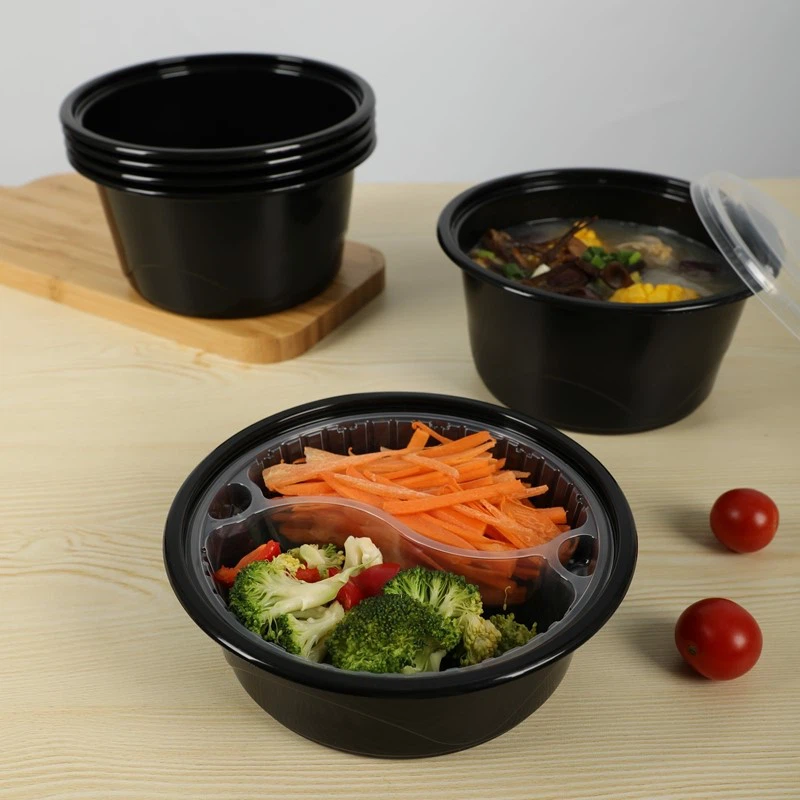
Locking to go boxes for restaurants are designed with a "multi-seal path" as their core principle. Their leak-proof capability stems from the synergistic effect of mechanical locking, multi-point pressure, and elastic sealing:
- Mechanical Locking Mechanism: Various locking designs are employed, including rotary, press-type, and snap-on types. Some high-end products, such as the "cute duckbill easy-open" lunch box, utilize leverage and mechanical reaction force, converting the screw's angular displacement into linear pressure for a one-second lock that is not easily broken. Other to go boxes for restaurants with external threaded rings, combined with positioning rods and slots, prevent the sealing cap from rotating, improving leak-proof stability.
- Multi-point Sealing Structure: Three-point locking boxes use triangularly distributed slots + pressurized inner lids. Round models feature an annular embedded sealing ring + negative pressure adsorption system. Ring-type models are equipped with an outer ring safety lock, ensuring even pressure distribution and preventing localized seal failure.
- Flexible Sealing Assistance: Generally equipped with food-grade rubber or silicone sealing rings, which fill gaps when the lid is closed; some modular to go boxes for restaurants have leak-proof structures on both the box body and lid, with the sealing strip using a snap-fit installation, forming double protection.
2.2 Structural Features and Sealing Mechanism of Flip-Top to Go Boxes for Restaurants
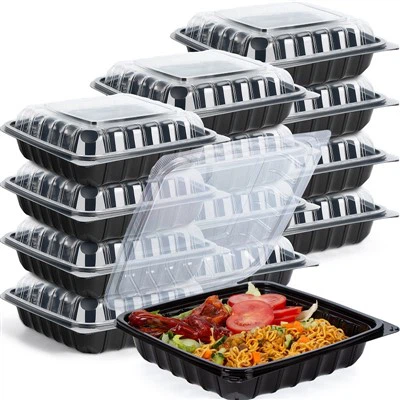
Flip-top to go boxes for restaurants rely on "structural fit + material elasticity" as their core, with sealing depending on integrated design and physical deformation:

- Snap-fit Sealing: The box body and flip-top are integrated, with the edge of the lid snapping into a snap-fit groove in the box body; some innovative models have a folded edge and protruding buckle on the box body, with a corresponding buckle groove on the lid. When the lid is closed, the folded edge elastically deforms and presses against the lid, and the buckle snaps into the buckle groove for fixation.
- Enhanced Material Elasticity and Food Pressure Resistance: When the box is full of food, the food compresses and folds the edges, making the clasp more securely locked into the slot, preventing the lid from loosening. High-end models introduce a magnetic design, with magnets on the clasp and a metal plate on the box body, magnetically securing the lid when closed, balancing sealing and ease of use (suitable for the elderly and children).
- Upgraded Composite Sealing: Some paper flip-top boxes have an installation groove at the bottom of the flip lid, with an internal paper strip sealing ring. The inner trapezoidal cavity connects to the cling film via a stretching section, and the sides are secured with pressing sections, combining physical sealing with film protection.
2.3 Impact of Material Selection on Sealing Performance
The heat resistance, low-temperature resistance, and chemical stability of materials directly determine the sealing effect. Mainstream materials exhibit significant performance differences:


| Material Type | Temperature Range | Core Advantages | Applicable Scenarios | Sealing Compatibility |
| Polypropylene (PP) | -20℃~120℃ | Excellent heat resistance, good elasticity, microwaveable | Hot meals (fried rice, noodle soup) | Compatible with silicone rings, achieving a "vacuum-like" seal |
| Polystyrene (PS) | 60℃~70℃ (continuous use) | Good low-temperature performance, low cost | Refrigerated foods | Weak sealing, prone to deformation and leakage at high temperatures |
| Polyethylene Terephthalate (PET) | -60℃~60℃ | High transparency, impact-resistant | Low-temperature storage | Poor heat resistance, high risk of high-temperature seal failure |
| 3004 Aluminum Alloy (Aluminum Foil) | 200℃~250℃ | Corrosion-resistant, high-temperature resistant, heat-insulating | Oven heating, high-temperature food | Combines with an aluminum foil lid for both sealing and heat preservation |
Among sealing materials, food-grade silicone sealing rings offer the best performance, usable for extended periods at temperatures ranging from -60℃ to 200℃. They are highly waterproof, non-toxic, and odorless, making them a core sealing component for high-end lunchboxes.


3. Comprehensive Evaluation of Leak-Proof Performance in Various Usage Scenarios
3.1 Leak-Proof Performance in Ordinary Food Scenarios
Ordinary foods (rice, stir-fries, noodles, etc., solid/semi-solid) have lower leak-proof requirements, and both types of lunchboxes generally meet these needs, but there are subtle differences:
- Snap-on type: The multi-point sealing design offers significant advantages. For example, the triangular slots of the three-point snap-on box apply pressure evenly, maintaining a seal even when holding a large amount of food; the PP material type has good elasticity, making it less prone to leakage due to slight pressure after closing. Over 80% of e-commerce reviews mention "good sealing performance, no spillage when holding hot food."
- Flip-top type: The slot design meets basic needs and is suitable for lightly soupy foods like rice bowls; however, lower-priced models are prone to loosening of the lid during bumpy transport due to insufficient slot precision. User feedback indicates that "it's stable with dry rice, but requires caution with small amounts of soup."
In terms of materials, PP material performs best in normal scenarios, while PS material should be avoided for foods hotter than 75℃ to prevent softening and leakage.


3.2 Leak-Proof Performance in Soup and Liquid Food Scenarios
Soup scenarios present a "rigorous test" for leak-proof performance, with significant differences between the two:
- Locking type: With its sealing ring and mechanical locking, it excels in leak-proof capabilities. For example, the Jinyijiaxin lunchbox showed no leakage even after vigorous shaking; the PP material model had a 0% leakage rate in 100℃ oily soup, and the Junzifeng patented lunchbox features a leak-proof and venting device that automatically vents and seals after cooling above 90℃, showing no leakage even when inverted or tilted.
- Flip-top type: Standard models have a high risk of leakage. Paper flip-top boxes are absorbent, making them prone to leakage from liquids. Even high-end models (such as those with cling film) still have a leakage rate of 15%~20% under vigorous shaking. PET models have a leakage rate of 15% in 70℃ soup, and PS models reach 22% in 95℃ oily soup.


3.3 Leak-Proof Performance Under High Temperature Conditions
High temperatures (hot food containers, microwave heating) can easily cause material deformation, affecting the seal.
- Locking type: PP material has excellent heat resistance (melting point 167℃) and can withstand short-term high temperatures of 130℃. Combined with a high-temperature resistant silicone ring, there is no leakage during shaking in a 100℃ boiling water test. High-end models are equipped with a pressure-balancing device to prevent lid deformation caused by thermal expansion and contraction.
- Flip-top type: PS material softens above 60℃ and is prone to collapse and leakage at 75℃; PET material loses shape stability above 85℃, increasing the gap between the lid and box, leading to a high risk of seal failure; only some aluminum foil flip-top boxes can withstand high temperatures, but these are more expensive.

3.4 Leak-Proof Performance in Refrigerated Environments
Refrigerated scenarios (refrigerator storage, cold chain transportation) test the material's low-temperature resistance and shrinkage stability:
 - Locking type: PP material retains elasticity at -20℃, and the mechanical locking structure is unaffected by low temperatures; extra-thick versions are freeze-resistant and crack-resistant, suitable for cold chain transportation, and the sealing ring does not harden at low temperatures, showing no leakage in inverted tests.
- Flip-top type: PET material has excellent low-temperature resistance (-60℃), but becomes brittle at low temperatures, and the lid latches are prone to breakage; PS material becomes brittle below -50℃ and is easily damaged by external forces, requiring the selection of thicker versions (such as Hengxiangrong PET cold chain boxes), which remain stable after 72 hours of storage at -20℃.
3.5 Leak-proof Performance During Transportation Scenarios
Transportation scenarios involve bumps, vibrations, and compression, where the locking mechanism offers significant advantages:
 - Locking type: Vibration test (triaxial simulated transportation) and 1m drop test (filled with 2/3 water) pass rate ≥95%; the anti-theft round soup bowl features a 1500-type lock, preventing the lid from falling off when tilted or upside down. In a simulated 30km bump test, the leak-proof pass rate reaches 92% (compared to only 54% for the ordinary model).
- Flip-top type: Relying on the friction of the slot, severe bumps can easily cause the lid to fall off. Even with a pressure-resistant cover design, the pass rate is only 65%~70%; user feedback indicates "acceptable for hand-carrying, but prone to spillage during delivery while cycling."
4. In-depth Analysis of the Working Principle of Leak-proof Mechanisms
4.1 Leak-proof Mechanism of Locking-type to go boxes for restaurants
The locking-type leak-proof mechanism is a systematic engineering project integrating "mechanical + material + structure":
Mechanical Locking Core: Continuous pressure is applied through structures such as snaps and threads. For example, a threaded ring lunch box with a positioning rod prevents the lid from rotating, ensuring that pressure is evenly applied to the sealing surface.
Elastic Sealing Filling: The silicone sealing ring deforms under pressure, filling the tiny gaps between the lid and the box, forming a continuous sealing interface; double-sealed models (both the box and lid have rubber rings) further reduce the risk of leakage.
Optimized Pressure Distribution: Multi-point snaps (such as a three-point snap) form a triangular force-bearing structure, avoiding insufficient local pressure and ensuring a full circumference fit of the sealing ring.

4.2 Leak-proof Mechanism of Flip-top Lunch Containers

Flip-top containers rely on a combination of structural fit and material deformation, resulting in relatively weak leak-proof stability:
Physical Sealing via Slots: The lid edge snaps into a slot in the container, relying on friction generated by material elasticity for fixation. The folded edge design enhances the fit through deformation, but uneven pressure distribution can lead to localized gaps.
Food Pressure Assistance: Food inside the container presses against the folded edge, making the latch more securely engage. However, insufficient pressure when the food volume is small reduces the sealing effect.
Supplementary Designs: Magnetic models enhance fixation with magnets, and plastic wrap models reduce leakage through film coverage, but neither can replace the stability of a mechanical locking system.
4.3 Comparison of Advantages and Disadvantages of Different Mechanisms
| Comparison Dimensions | Locking Lunch Box | Flip-Top Lunch Box |
| Sealing Reliability | High (Multiple protections, low leakage rate) | Medium-Low (Depends on material and fit precision, prone to failure in extreme scenarios) |
| Environmental Adaptability | Strong (Stable under high and low temperatures and vibration) | Weak (Prone to deformation at high temperatures, prone to brittleness at low temperatures) |
| Ease of Use | Medium (Operation required for locking, slightly difficult for the elderly and children) | High (Easy flip-top, suitable for frequent opening and closing) |
| Cost | High (Complex structure, 20%~30% higher cost) | Low (Simple structure, excellent cost performance) |
| Durability | High (Slow wear of locks, reusable) | Low (Easily deformable slots, reduced sealing after repeated use) |


5. Material Performance and Environmental Adaptability Assessment
5.1 High-Temperature Material Performance Changes
At high temperatures, molecular motion intensifies, leading to performance differences stemming from molecular structure:
- - PP: High C-C and C-H bond energies (347kJ/mol, 414kJ/mol), exhibiting only slight vibrations below 100℃ with no decomposition or release of harmful substances, suitable for microwave heating.
- - PS: Highly rigid molecular chains, with intensified motion above 60℃, softening and deforming at 70℃, releasing odors, unsuitable for microwave heating.
- - PET: Above 85℃, molecular chain segment motion becomes uncontrolled, resulting in loss of shape stability and failure of the cover fit.
Among sealing materials, silicone sealing rings maintain elasticity at 200℃, providing crucial protection in high-temperature environments.
5.2 Low-Temperature Material Performance Changes
At low temperatures, material toughness decreases, with significant differences in embrittlement risk:
- - PP: Maintains toughness above -40℃, becomes brittle below -50℃ due to increased crystallinity, but is unaffected by routine refrigeration (-20℃).
- - PS: Below -50℃, approaches the glass transition temperature, experiencing a surge in brittleness and susceptibility to breakage under external forces.
- - PET: Maintains structural stability even at -60℃, exhibiting optimal low-temperature resistance; however, elasticity decreases at low temperatures, making the clips prone to breakage.

5.3 Material Chemical Resistance Analysis
Acids, alkalis, and oils in food may react with the material, affecting safety and sealing:
- - PP: Non-polar molecular structure, stable against acids, alkalis, and oils, suitable for holding foods rich in seasonings.
- - PS: Poor chemical resistance; easily reacts with oils and sugars, releasing harmful substances, unsuitable for holding heavily oily foods.
- - PET: Resistant to general acids and alkalis, but may hydrolyze under strong acids and alkalis, affecting sealing.
- - 3004 Aluminum Foil: Excellent corrosion resistance, does not react with food acids and alkalis, suitable for long-term food contact.
5.4 Effects of Thermal Expansion and Contraction on Sealing Performance
Thermal expansion and contraction cause changes in material volume, affecting the precision of the fit:
- - At high temperatures, PP has a low coefficient of expansion (60×10⁻⁶/℃), and the elastic snap-fit can compensate for deformation; PS and PET have high coefficients of expansion (80×10⁻⁶/℃~100×10⁻⁶/℃), which can easily lead to the cap being too tight or too loose.
- - At low temperatures, PP and PET shrink uniformly, and the snap-fit mechanical structure can counteract the shrinkage; the flip-top type with a snap-fit mechanism is prone to gaps due to shrinkage, resulting in a decreased seal.


6. Comprehensive Comparison and Selection Recommendations
6.1 Comprehensive Comparison of Leak-Proof Performance
| Comparison Dimensions | Locking Lunch Containers | Flip-Top Lunch Containers |
| Overall Leak-Proof | Excellent (Multiple protections, stable in extreme scenarios) | Medium (Suitable only for mild scenarios) |
| Soup Scenario | Leakage Rate 0%~5% | Leakage Rate 15%~22% |
| High and Low Temperature Adaptability | Strong (Stable from -20℃ to 120℃) | Weak (Easily deformed at high temperatures, easily brittle at low temperatures) |
| Transportation Stability | Excellent (No leakage even from bumps and drops) | Medium (Suitable only for short-distance stable transport) |
| Cost | High (Unit price 20%~30% higher) | Low (Excellent cost-performance ratio) |
| Ease of Use | Medium (Requires operation to snap shut) | High (Easy flip-top) |

6.2 Selection Recommendations for Applicable Scenarios
- Soups/Liquid Foods: PP lockable containers are essential, preferably with silicone rings and venting devices (like the Junzifeng brand). Avoid flip-top containers.
- High-Temperature Heating/Hot Foods: Choose PP lockable containers; they are microwave-safe and leak-proof. Aluminum foil lockable containers are suitable for oven heating.
- Refrigerated/Cold Chain: PP lockable containers (-20℃) or PET flip-top containers (-60℃) are recommended; thicker versions are needed to prevent cracking.
- Takeout Transportation: Anti-theft lockable containers are highly recommended to reduce leakage during transport. Soups should be placed in an insulated bag for an improved experience.
- Daily Dry Foods: Flip-top containers offer good value; choose PP or PET materials and avoid containers with broth.
- Environmental Requirements: Biodegradable PLA lockable containers offer leak-proof performance close to traditional PP containers, suitable for environmentally conscious users.

6.3 Future Development Trends
- Technological Intelligence: The widespread adoption of intelligent venting and pressure-sensing sealing technologies will allow food containers to automatically adapt to temperature and pressure, improving leak-proof stability.
- Environmentally Friendly Materials: Modified and upgraded biodegradable materials such as PLA and PHA balance leak-proofness and biodegradability, replacing traditional plastics.
- Biomimetic Structures: Developing more efficient locking designs that mimic the natural sealing structures of seashells and nuts, balancing ease of use and leak-proofness.
- Stringent Standards: Specific standards for leak-proof performance have been introduced, clearly defining indicators such as leakage rate and high/low temperature testing, regulating the market.
Locking-type food containers, due to their superior leak-proof performance, remain the preferred choice for soups, high-temperature applications, and transportation. Flip-top containers are suitable for lightly dry food applications; future development requires material and structural innovation to narrow the gap. When choosing, users should consider their specific needs and cost, prioritizing leak-proofness and safety.
