Table of Contents
Introduction: Why "Is PP Microwave-Safe?" Isn't a Yes-or-No Question
The Material Science Behind PP's Heat Tolerance
What Real Temperature Tests on PP To Go Containers Actually Show
PP vs. Other "Microwave-Safe" Material Claims
How to Verify a Supplier's PP To Go Containers Are Actually Microwave-Tested
Best PP To Go Containers for Hot Food, Delivery, and Reheat-Heavy Use Cases in 2026
Frequently Asked Questions
Conclusion
Introduction: Why "Is PP Microwave-Safe?" Isn't a Yes-or-No Question
A customer reheats leftovers in the same polypropylene to go containers the restaurant packed them in, assuming "PP" and "microwave-safe" are interchangeable facts. As a packaging sourcing consultant, this assumption comes up constantly - a client sees resin code #5 on a container and treats every PP product as functionally identical, regardless of wall thickness or additive content.
Here's the real tension: PP is genuinely more heat-tolerant than most food-contact plastics. But "microwave-safe" is a conditional claim tied to specific temperature thresholds, resin purity, and heating duration - not a blanket property of the material. Two containers can both say "PP" and perform very differently under heat.
This guide unpacks the actual material science - specifically glass-transition temperature (Tg) and heat-deflection temperature (HDT) - along with what independent temperature testing shows under realistic reheating conditions, and how to translate that science into a sourcing decision.
Food-contact plastic performance claims are properly evaluated against recognized ASTM heat-resistance testing standards, not marketing language alone.


The Material Science Behind PP's Heat Tolerance
What makes PP microwave safe starts with its molecular structure. Polypropylene is a semi-crystalline thermoplastic with a melting point around 160°C (320°F) - meaningfully higher than polystyrene (#6) or standard PET (#1), per polypropylene material property data. That gap is exactly why PP tolerates reheating that would deform other common food-contact plastics.
But melting point isn't the most practical engineering metric for microwave performance. Heat-deflection temperature (HDT) - the temperature at which a plastic begins to warp under load, tested per ASTM D648 - is closer to what actually happens inside a microwave, where food presses against container walls well before anything melts.
Resin purity matters more than most buyers realize. Virgin-grade PP has a more consistent, predictable HDT than reground or recycled-blend PP, where mixed polymer content can lower effective heat tolerance unpredictably. We've compared two "PP" samples from different suppliers side by side under identical heat exposure - same resin code, visibly different warping behavior, traced back to differing resin purity.
Additives compound this variability. Pigments, fillers, and recycled-content percentages can all shift a container's real-world heat performance even when the base resin is still technically "PP." A black-pigmented container and a clear one from the same supplier aren't guaranteed to behave identically under heat.
This is also why wall thickness deserves separate attention from resin grade. Two containers can share the exact same virgin-PP formulation and still perform differently under reheat if one has thinner walls than the other - thinner sections deflect under load at a lower effective temperature than the resin's lab-tested HDT would suggest, simply because there's less material to distribute the stress. Buyers comparing quotes purely on "PP vs. PP" without checking wall thickness are missing a real variable.
What Real Temperature Tests on PP To Go Containers Actually Show
Are PP to go containers microwave safe in practice, not just on paper? Independent and in-house temperature testing on certified PP containers generally shows stable performance up to roughly 120–130°C (248–266°F) under short, intermittent heating cycles - well within typical household microwave conditions.
"Stable performance" in testing means something specific: no visible warping, no measurable dimensional change, and no detectable migration of resin compounds into a food simulant at standard reheat durations (1–3 minutes). This is consistent with the FDA's migration-testing framework for food-contact substances, which forms the regulatory basis for "safe under normal use conditions" claims.
The critical caveat: performance degrades predictably with repeated heating cycles. A container tested fresh behaves differently than the same container after 10+ reheat cycles - each cycle incrementally stresses the polymer structure. We've run basic kitchen-conditions heat tests on new supplier batches before approving them, and the containers that failed didn't fail on cycle one; they failed on repeated exposure.
One more nuance: results vary between controlled lab conditions (consistent wattage, controlled food load) and real-world kitchen conditions (variable microwave wattage, uneven food distribution, no cooldown between cycles). Real-world performance tends to run slightly below lab-ideal numbers - which is why 1–3 minute intermittent heating, not continuous-exposure stress testing, is the realistic benchmark for evaluating a to go containers line.

PP vs. Other "Microwave-Safe" Material Claims: What the Science Actually Supports
Choosing between microwave-safe plastic vs other to go containers materials means comparing PP against three alternatives commonly marketed alongside or instead of it: polystyrene (PS, #6), PET (#1), and compostable bagasse-based containers.
PS fails fastest under heat for a clear structural reason: its glass-transition temperature sits close to or within typical microwave reheat temperatures. That's why foam containers soften and buckle noticeably faster than PP under identical conditions - it's not a manufacturing defect, it's the material's inherent limit.
Compostable materials deserve a direct clarification: compostability and microwave-safety are separate, independently tested properties. Some PLA-lined or bagasse containers aren't rated for microwave use at all, regardless of their eco-material claims. We get this question often - why does a "premium" bagasse container sometimes perform worse under reheat than a basic PP container, despite costing more? Because compostable certification and heat-performance certification test for entirely different things, as BPI's compostable certification standards make clear.
PP lands as the practical middle ground for buyers who need genuine reheat performance: more heat-tolerant than PS, more consistently microwave-rated than most compostable alternatives - though not automatically superior on every dimension (cost, sustainability positioning, recyclability access).
If you're currently stocking a mix of materials, compare our PP and eco-material container lines to map out which SKUs actually meet your reheat requirements.


How to Verify a Supplier's PP To Go Containers Are Actually Microwave-Tested
Knowing how to verify to go containers are microwave tested starts with recognizing that a resin code (#5) alone does not confirm microwave-safety testing. Buyers need product-specific testing documentation covering the exact SKU being ordered - not a general factory letter.
What to actually request from any to go containers manufacturer:
ASTM-based heat-performance test reports for the specific product line
A documented reheat-cycle test result - not just a single-pass claim
Confirmation of virgin-vs-reground resin ratio, ideally per production batch
One common trap: a manufacturer's general "food-grade PP" claim is not the same as a specific product line being tested for microwave reheat performance at defined temperature and cycle counts. An experienced packaging buyer checks that the SKU and test conditions on a report actually match the product being quoted - not just the letterhead.
The practical verification step, regardless of what documentation a supplier provides: request a small sample batch and run a basic kitchen-conditions reheat test - multiple cycles, real food load - before committing to a full order. Don't rely on supplier claims alone.
Best PP To Go Containers for Hot Food, Delivery, and Reheat-Heavy Use Cases in 2026
Translating the material science into a sourcing recommendation: for hot food, delivery, and reheat-heavy menu items, virgin-grade PP with documented microwave testing is the practical default. Not every container needs this spec - but hot-food and delivery lines benefit most, making this one of the clearer best to go containers for hot food decisions a buyer will make.
Use-case fit breaks down fairly cleanly:
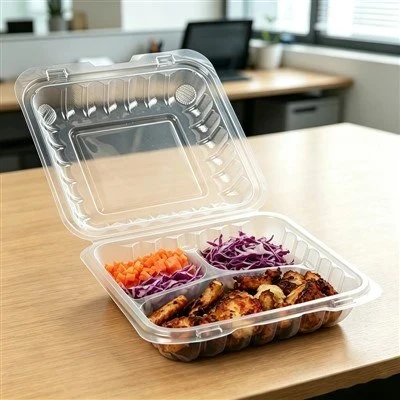
Single-compartment hinged PP containers for entrees customers are likely to reheat
Thicker-wall PP tubs for soups and sauces, where repeated heat exposure is more likely - including leakproof meal prep containers for delivery-heavy operations
Standard PP or anti-fog take away containers for cold items, where heat tolerance matters less but presentation does
For to go containers for small business in 2026 specifically: a single-location restaurant doesn't need the same heat-testing documentation rigor as a multi-unit chain shipping nationally - but both benefit from knowing which SKUs in their current lineup are actually reheat-rated versus assumed to be. Whether you're sourcing through wholesale plastic containers with lids programs or placing a smaller small MOQ food packaging trial order, test the new SKU with your actual highest-reheat menu item - not a generic test food - before full rollout.
Buyers evaluating a custom logo food container manufacturer relationship for private label food containers should apply the same rule: branding doesn't change the underlying resin physics, so confirm heat-test documentation before locking in a custom mold.
Ready to move on bulk to go containers for your reheat-heavy lines? Get a bulk pricing quote to see current volume tiers for your order size.

Frequently Asked Questions About PP To Go Containers and Microwave Safety
Is all PP plastic microwave-safe, or only some of it? Not automatically. Microwave safety depends on resin purity, wall thickness, and documented testing - a container stamped with resin code #5 (PP) is not guaranteed to be microwave-tested unless the manufacturer confirms it.
Can microwaving a PP to go container too many times make it unsafe? Yes - performance degrades predictably with repeated heating cycles. A container tested and rated fresh may perform differently after many reheat cycles, since each cycle incrementally stresses the polymer structure.
What's the difference between heat-deflection temperature and melting point? Melting point is where the plastic fully liquefies; heat-deflection temperature is the lower, more practical threshold at which a plastic begins to warp under load - a more realistic indicator of microwave reheat performance.
Are compostable to go containers microwave-safe like PP? Not necessarily. Compostability and microwave-safety are separate, independently tested properties - some bagasse or PLA-lined containers are not rated for microwave use at all, regardless of eco-material claims.
How can I tell if a PP container has actually been heat-tested? Request product-specific ASTM-based heat-performance test reports and documented reheat-cycle results for the exact SKU you're ordering - a general "food-grade PP" claim alone does not confirm microwave testing. For an independent trust signal, a manufacturer's verified B2B trading history is also worth reviewing alongside its technical documentation.

Conclusion: What the Science Means for Your Next To Go Containers Order
Choosing the right to go containers comes down to a simple recap: PP is genuinely more microwave-tolerant than most food-contact plastics, but that tolerance is conditional on resin purity, wall thickness, and documented testing - not an automatic property of the resin code alone.
For restaurant and foodservice buyers, this isn't just a technical curiosity. Choosing a documented, tested PP line protects against both customer complaints and compliance exposure - a melted-container incident costs far more than the resin-grade upgrade would have.
Ready to source to go containers backed by real heat-performance testing? Get a free packaging quote today.
FAQ
Q: Q1: What material do you use for your bulk take out containers?
A: We use 100% new PP material for our bulk take out containers. It's non-toxic, heat-resistant, and compliant with CE and FDA standards, making it safe for food contact. We never use recycled materials, so you can be sure our products are high-quality and safe for your clients. The new PP material also ensures that our take out containers are durable and can withstand the rigors of transportation and daily use, which is essential for buyers who need reliable packaging for their own clients.
Q: Q2: Can PP disposable plastic food containers be microwave-heated?
A: PP disposable plastic food containers are the only disposable plastic food containers that can be safely used for microwave heating. Their high-temperature resistance can reach 130℃.
Q: Q3: How can restaurants control the loss rate when purchasing in bulk?
A: Choose high-strength, good-sealing PP to go containers; store properly; negotiate loss rate with suppliers.
Q: Q4: How to judge whether PP takeout containers are food-grade?
A: Check the mark "5" + "PP" at the bottom; check qualification reports; no odor, uniform color, not soft.
Certificate Display


FDA Certification (SGS): YANGRUI take out containers are make from the safe & new material