

Disposable Plastic Lunch Boxes vs. Other Materials: A Comprehensive Comparison of the Advantages and Disadvantages of To-Go Plastic Containers
Choosing a lunch box has become increasingly challenging in recent years, as it requires consideration not only of cost and functionality but also of environmental sustainability. While to-go plastic containers remain the mainstream, materials like paper pulp, PLA, and paper are also gaining traction. This article will compare them from three perspectives: cost, user experience, and environmental performance, to help catering companies make more informed purchasing decisions.


1. Cost Comparison: Disposable Plastic vs. Other Materials
Cost is always a primary consideration for catering companies when choosing lunch boxes. Plastic lunch box technology is now highly mature, making it easy to transport, and new materials are becoming increasingly competitive with advancements.
Cost Advantages of To-Go Plastic Containers
Due to their stable raw material supply and mature production technology, to-go plastic containers offer significant cost competitiveness, often at a lower price per unit than paper pulp, PLA, or paper. The stackability of plastic lunch boxes often ensures their stability during transportation, effectively saving on logistics and warehousing costs. From a comprehensive perspective, this can significantly reduce procurement costs for catering businesses, especially for chain restaurants and takeout restaurants, where plastic lunch boxes are frequently used. This explains their long-standing dominance.
Price Trends of Pulp, PLA, and Paper Boxes
Pulp, PLA, and paper lunch boxes are often more expensive than plastic because their production processes are more complex, raw material acquisition costs are higher, and some materials must be imported, resulting in a relatively high overall cost. However, at the same time, government subsidies for these products lower the purchasing threshold. For example, in the European and American markets, PLA lunch boxes are becoming increasingly popular, but their cost remains higher than that of plastic. Small and medium-sized catering businesses are advised to choose plastic lunch boxes, while large brands or businesses seeking to promote environmental awareness should choose boxes made of environmentally friendly materials.
How to Balance Price and Quality for Best To-Go Containers
In actual procurement, companies need to strike a balance between price and quality. The best to-go containers are not just about low cost; they also represent a comprehensive improvement in functionality and image. Some catering companies are adopting a tiered strategy: using plastic containers for basic takeout to reduce overall costs, while using eco-friendly containers for high-end customization or brand promotions to enhance their image. This approach balances short-term savings with long-term brand benefits, helping companies establish a differentiated advantage in a highly competitive market.


2. User Experience Comparison: Convenience and Functionality
User experience is crucial. Only by satisfying customers can a brand be chosen by more people.
Durability and Versatility of Plastic Lunch Boxes
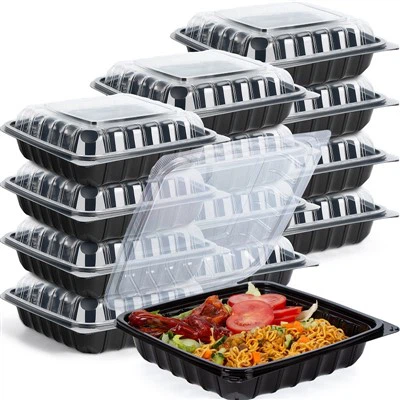
The leak-proof, oil-proof, and heat-resistant properties of to-go plastic containers ensure a stable user experience. Whether you're storing hot soup or cold food, they maintain a good seal. Many plastic lunch boxes also feature dividers to prevent odor transfer and enhance the dining experience. Furthermore, PP lunch boxes are microwaveable and refrigerator-safe, meeting the needs of everyday customers. This durability and versatility are its core competitive advantages, making them difficult to replace with other materials anytime soon.
Limitations of Paper Pulp and PLA
Although paper pulp and PLA are considered representative of eco-friendly to-go containers, they still have drawbacks in practical use. For example, paper pulp containers are prone to leaking when used with soupy foods, while PLA is prone to deformation in high-temperature environments. Both have their limitations. During transportation, these containers are prone to deformation or cracking, and their pressure resistance is relatively poor. These shortcomings have, to a certain extent, limited its scope of application and failed to meet the expectations of some groups.
Consumer Experience Preferences for Best To-Go Containers
Consumer preferences for best to-go containers are increasingly diverse. Beyond traditional functionality, design and environmental friendliness are becoming increasingly important. For example, transparent designs offer a clearer display of food, enhancing customer appeal; compartmentalized designs meet daily nutritional needs; and those with a higher level of environmental awareness generally choose recyclable containers. Overall, consumers are increasingly favoring products that balance practicality and environmental friendliness.


3. Environmental Comparison: Degradable vs. Recyclable
Environmental protection is a hot topic these days. While the environmental credentials of plastic lunch boxes are less clear, new materials are gaining favor with eco-conscious consumers thanks to their biodegradable properties.
Environmental Controversy Surrounding Plastic Lunch Boxes
To-go plastic containers labeled recyclable are not guaranteed to be recycled. Due to factors such as inadequate consumer sorting and insufficient processing facilities, a large number of plastic lunch boxes still end up in landfills or incineration, resulting in a relatively low recycling rate. Furthermore, plastic has a very long shelf life in the natural environment, which has already put a strain on ecosystems. Therefore, its environmental impact has become a focal point of controversy in the industry, prompting more companies to seek green solutions.
Advantages of Eco-Friendly To-Go Containers
The greatest advantage of eco-friendly to-go containers is their biodegradability. These materials decompose naturally into carbon dioxide and water, effectively reducing the environmental burden. Furthermore, their low carbon footprint complies with the "plastic reduction" policy. Many companies have already begun using these containers. As the technology matures and scales up, the future market potential for these containers is enormous.
The Choice for Catering Companies: Environmental Responsibility vs. Cost Pressure
Catering companies' decisions are often driven by brand positioning and market objectives. For example, international fast food chains are implementing environmentally friendly packaging upgrades worldwide. While this move may increase costs, it can significantly enhance brand image and customer loyalty. For small and medium-sized enterprises, they can introduce environmentally friendly lunch boxes to some production lines while retaining plastic containers to control costs. This flexible combination allows companies to adapt to market trends.


4. Future Trends and Decision-Making for Catering Companies
The future catering packaging market will undergo profound changes driven by policies, consumer demand, and technological innovation. How companies strike a balance between environmental protection and cost will directly determine their market competitiveness.
Material Technology Innovation: From Plastics to New Bio-Based Materials
The research and development of new bio-based materials is accelerating, and in the future, they are expected to achieve breakthroughs that combine the durability of plastic lunch boxes with the biodegradability of eco-friendly lunch boxes. The mature application of these materials will provide catering companies with more options, eliminating the need for packaging to be a trade-off between "environmental protection and functionality."
Choices Driven by Both Policy and Market Opportunities
With the strengthening of global plastic restrictions, catering companies are forced to seek alternatives. At the same time, consumers' environmental awareness continues to grow, and their acceptance of eco-friendly lunch boxes is increasing. This dual push from policy and market forces will accelerate the global adoption of eco-friendly lunch boxes.
Strike a Balance: Combining Eco-Friendly To-Go Containers with Plastic Solutions
The optimal strategy for catering companies in the future is to adopt a flexible approach. The basic supply chain will remain primarily plastic to ensure low costs and stable supply, while high-end product lines will incorporate eco-friendly lunch boxes to meet both environmental and brand needs.


Where to Buy?
 As a professional manufacturer of disposable lunch boxes, Yangrui boasts mature production capabilities in both plastics and environmentally friendly materials. Its product range includes to-go plastic containers, best to-go containers, and eco-friendly to-go containers, offering customers a diverse selection. With a stable supply chain, strict food safety standards, and extensive customized services, Yangrui helps customers strike the optimal balance between cost control, environmental responsibility, and brand enhancement.
Contact information:
Email: sales@packagingbag5.com
Tel: +86 180 8644 3226
References
- European Bioplastics. (2024). Bioplastics market data.
- UNEP. (2023). Single-use plastics: A roadmap for sustainability. United Nations Environment Programme.
- Food Packaging Forum. (2024). Safety and sustainability in food contact materials.
- Smith, L. & Chen, Y. (2022). Trends in sustainable food packaging. Journal of Cleaner Production, 352, 131-140.
