


With the deepening of environmental awareness, reusable take-out containers have gradually moved from a niche choice to a daily choice for the public. But at the same time, there is a question: are these reusable lunch boxes really safe? This article will provide you with a comprehensive analysis from multiple aspects, such as materials, cleaning, BPA risks, and purchasing standards, to help you make a safe choice.
1. What Is a Reusable Lunchbox? Why Is It Becoming More and More Popular?
As global pollution problems become more and more serious, reusable lunch boxes have also become popular.
Definition and Main Types of Reusable Lunch Boxes
Reusable take-out containers can generally be washed and used many times, and most of the materials they contain are PP (polypropylene), Tritan (copolyester), food-grade silicone, and stainless steel. These materials generally have better heat and cold resistance. PP has a low cost and light weight, so it is widely used; Tritan material is generally favored by mid-to-high-end consumers, while silicone and stainless steel are more suitable for people who pursue health and durability.


Why Are Merchants and Consumers Turning to Reusable?
The direct reason for the rapid popularity of reusable take-out containers is the promotion of environmental protection policies. For example, many EU countries have completely banned disposable plastic tableware. In addition, consumers are increasingly concerned about whether lunch boxes are food-safe lunch boxes. Brands turning to environmentally friendly materials can not only reduce long-term packaging costs but also enhance brand image and social responsibility.
Advantages and Potential Concerns Compared with Disposable Lunch Boxes
The most significant advantage of reusable take-out containers is that they can be reused, save costs, and effectively reduce garbage generation. However, consumers also have doubts about their safety, especially when improper cleaning or unknown materials may cause problems such as bacterial growth or the release of harmful substances.


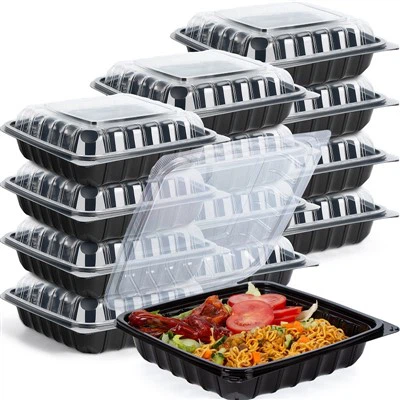


2. Service Life and Cleaning Frequency: How Often Should Reusable Lunch Boxes Be Replaced?
Although lunch boxes can be reused, it does not mean that they can be used all the time. Lunch boxes of different materials have different durability. Reasonable use and timely replacement can ensure health and safety.


Comparison of the Average Service Life of Lunch Boxes of Different Materials
PP to-go plastic containers are generally recommended to be thrown away after frequent use for half a year or a year. Tritan and food-grade silicone are highly resistant to high temperatures and oxidation, and can be used for about two to three years. Stainless steel is recommended to be replaced after about two years because the coating is prone to wear after long-term use.
Cleaning Frequency Recommendation: Wash Every Day, But How to Wash It?
For reusable take-out containers, they should be cleaned after each use. When cleaning, they should be washed with warm water, and strong alkaline products should be avoided to prevent damage to the lunch box itself. After cleaning, they should be naturally ventilated and dried to avoid storage in a humid environment. Some high-end food-safe lunch boxes also have an antibacterial treatment layer, which can effectively reduce the risk of contamination.


Identify Key Signs of Replacement
If the container surface is scratched, deformed, darkened, or has an odor, or the lid is unstable, it means that the lunch box needs to be replaced. It must be replaced in time to ensure the safety of yourself and the food.
3. BPA Risk: What Should We Worry About?
In addition to cleaning and material aging issues, reusable lunch boxes also face BPA issues.

What Is BPA? Why Does It Cause Health Concerns?
BPA (bisphenol A) is a chemical additive commonly used in hard plastics. Studies have shown that BPA may interfere with the human endocrine system, especially for children and pregnant women.
Is BPA Still Common in To-Go Plastic Containers?
Most to-go plastic containers are BPA-free, but some may still have BPA residual risks, that is, lower-priced products. So if you want to buy food lunch boxes in large quantities, you need to focus on whether there is a BPA-Free icon in the packaging, and you can ask the supplier to issue relevant FDA or LFGB food safety certification. Yangrui reusable lunch boxes are all made of BPA-free raw materials, which meet food-grade standards and are a good choice.


4. How to Choose Truly Safe Reusable Lunch Boxes?
Choosing truly safe, durable, and environmentally friendly products from a wide variety of lunch boxes is the most concerning issue for consumers and buyers.
Look at the Material Label
The bottom of a qualified reusable take-out container is generally marked with a material code, such as #5 for PP, #7 for PC, etc. When purchasing, you should avoid products marked with #7 and not marked BPA-Free. Try to choose products that have passed FDA, LFGB, or SGS tests.


Look at the Brand and Production Qualifications
High-quality brands usually disclose information such as production qualifications and third-party test reports. When purchasing, you can ask the supplier to provide a test certificate and product description to ensure that it is a real food-safe lunch box. Yangrui not only uses BPA-Free raw materials, but also has passed ISO9001, FDA, and other certifications. It is a trustworthy lunchbox manufacturer.
Where to Buy To-go Plastic Containers?
 Huizhou Yangrui Printing and Packaging Co., Ltd. offers a full range of reusable food-safe lunch boxes made of PP, MFPP, and PET, all certified BPA-free and compliant with FDA and ISO9001 standards.
Contact us now for samples or quotes:
Email: sales@packagingbag5.com
Tel: +86 180 8644 3226
References
- US Food and Drug Administration (FDA) – Bisphenol A (BPA) Use in Food Contact Applications

- European Food Safety Authority (EFSA) – Scientific Opinion on the Risks to Public Health Related to BPA
- International Association for Food Protection – Guidelines on Reusable Food Packaging
- Wang, J. et al. (2022). Safety Evaluation of Reusable Food Containers: A Comparative Study of Common Materials. Journal of Environmental Health, 84(6), 42–50.


