YANGRUI - COMPLETE BUYER'S GUIDE
Compostable To-Go Containers: A Complete Guide for Food Businesses
If you're a restaurant owner, catering service, or food business considering compostable to-go containers, you're facing a complex decision. The marketing says "eco-friendly," but what does that actually mean for your operations, your customers, and your bottom line?
This guide cuts through the greenwashing. We'll explain what "compostable" really means (hint: it's not the same as "biodegradable"), compare the four major compostable materials head-to-head, decode the certification landscape, and honestly assess where compostable containers excel - and where they don't.
About this guide: We're a manufacturer of PP and MFPP food containers. We wrote this guide on compostable options because we believe informed buyers make better decisions. If compostable is the right fit for your business, great. If PP recyclable containers are a better match, you'll know that too. Either way, you'll have the facts to choose confidently.
What Does "Compostable" Actually Mean for To-Go Containers?
The word "compostable" is heavily marketed but widely misunderstood. Here's the reality most buyers don't know:
Industrial Composting vs. Home Composting
The vast majority of "compostable" to-go containers require industrial composting facilities - not your backyard compost bin. Industrial facilities maintain temperatures of 140°F+ with controlled humidity and aeration, conditions that home composting cannot replicate. Without these conditions, a "compostable" container decomposes at roughly the same rate as conventional plastic.
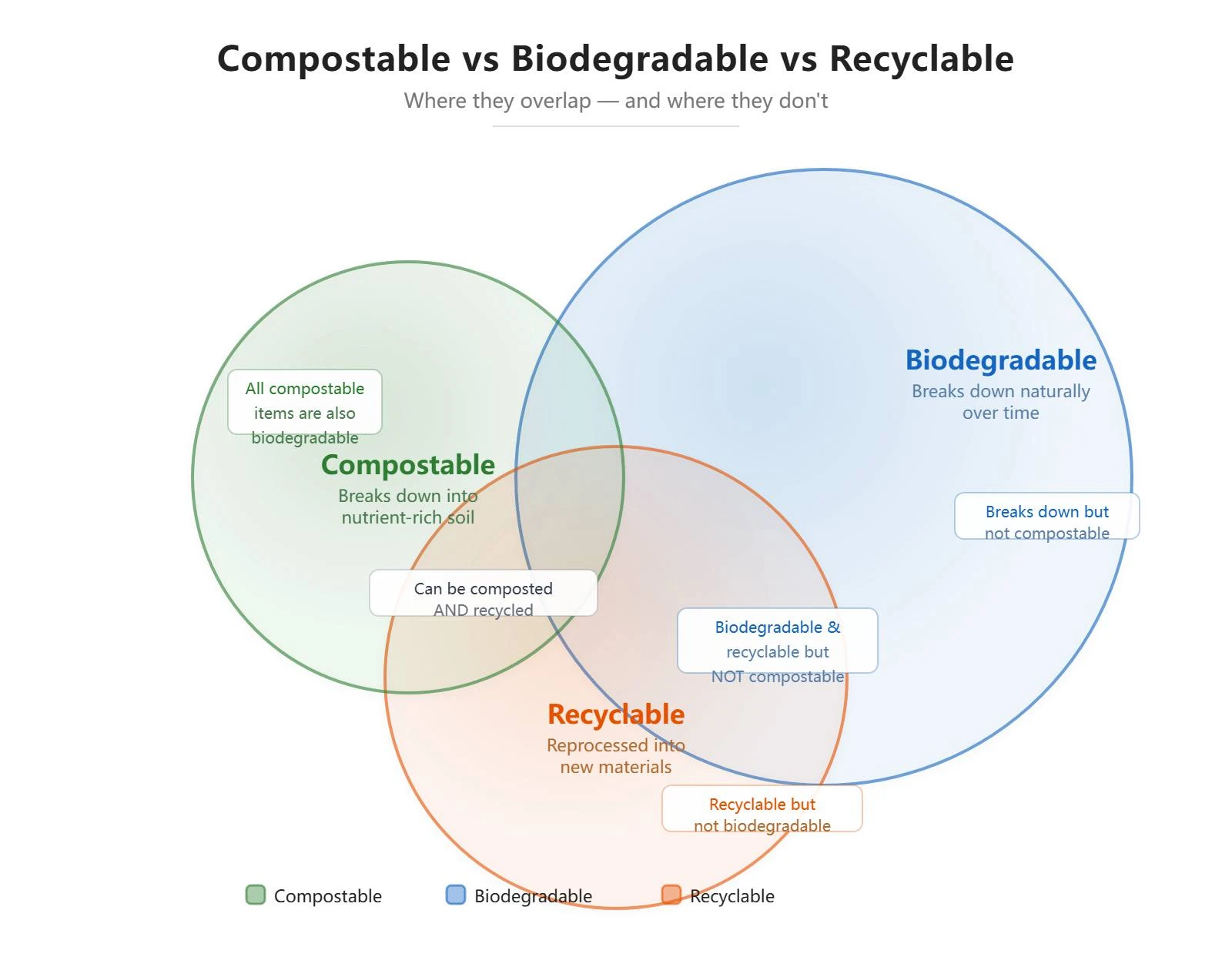
Compostable vs. Biodegradable
These terms are not interchangeable:
- Biodegradable: The material will eventually break down through natural processes - but "eventually" could mean 50 years. There are no certification standards or time requirements for "biodegradable" claims.
- Compostable: The material must meet strict standards (ASTM D6400 in the US, EN 13432 in the EU) requiring 90% decomposition within 90 days in industrial composting conditions, with no toxic residue.
The Infrastructure Gap
Here's the uncomfortable truth: the United States currently has approximately 150 industrial composting facilities that accept food packaging. Most cities don't have one. If your city lacks industrial composting infrastructure, your "compostable" container goes to the same landfill as plastic - where it may take decades to decompose.
The honest disclosure: Compostable containers are an excellent choice for businesses in cities with industrial composting programs (San Francisco, Seattle, Portland, and a growing list of others). For businesses without access to these facilities, the environmental benefit is largely theoretical.
Deep dive: What Is a Disposable Food Container? § Definition - the full definition framework for disposable food containers, including the spectrum of disposability.
→ What Is a Disposable Food Container? § Recycling Reality - the same "no greenwashing" approach applied to all materials.
Compostable To-Go Container Materials - PLA, Bagasse, Bamboo & Paper Compared
Four materials dominate the compostable to-go container market. Each has distinct properties, use cases, and limitations:
| Material | Feedstock | Temp. Tolerance | Leak Resistance | Microwave Safe | Certification | Cost vs. PP |
|---|---|---|---|---|---|---|
| PLA | Corn starch fermentation | ≤110°F (43°C) | Good (cold only) | ✗ Deforms | BPI / ASTM D6400 | 2–3× higher |
| Bagasse | Sugarcane pulp | ≤212°F (100°C) | Moderate (needs coating) | ✅ Short duration | BPI | 1.5–2× higher |
| Bamboo Fiber | Bamboo pulp | ≤212°F (100°C) | Moderate | ✌ Not safe (binders) | BPI | 2–3× higher |
| Paper / Kraft | Wood pulp + PLA coating | ≤120°F (49°C) | Moderate | ✌ Coating softens | Coating-dependent | 1.5–2.5× higher |
PLA (Polylactic Acid)
PLA is made from fermented corn starch and looks like conventional plastic - clear, rigid, and glossy. It's ideal for cold food display (salads, fruit cups, cold beverages) but has a critical limitation: it softens at 110°F, making it unsuitable for hot foods or microwave reheating. A hot soup poured into a PLA container will warp the container within minutes.
Bagasse (Sugarcane Pulp)
Bagasse is made from the fibrous residue left after sugarcane juice extraction. It has a natural beige color and a textured, earthy feel that signals "eco-friendly" to consumers. Bagasse tolerates higher temperatures than PLA (up to 212°F for short durations) and can handle brief microwave reheating. However, it requires a coating (usually PLA or a bio-based alternative) to prevent oil and moisture seepage - uncoated bagasse becomes soggy within 30 minutes when holding saucy foods.
Bamboo Fiber
Bamboo fiber containers are made from bamboo pulp mixed with binders. They're durable and have a premium feel, but the binders (often melamine-formaldehyde resins) make them unsuitable for microwave use. Bamboo containers are best for cold or room-temperature foods where the premium aesthetic justifies the higher cost.
Paper / Kraft (PLA-coated)
Paper containers with PLA coatings are common for soup cups and deli containers. The paper provides structure and insulation; the PLA coating provides leak resistance. However, the PLA coating softens above 120°F, limiting these containers to warm (not hot) foods. They're also more expensive than PE-coated paper alternatives.
💡 The Key Insight
No compostable material matches PP's combination of microwave safety, leak resistance, and cost-efficiency. But that's okay - they're designed for different use cases. Compostable containers excel in scenarios where environmental branding and end-of-life composting matter more than thermal performance or cost minimization.
Deep dive: What Is a Disposable Food Container? § Material Families - the complete six-material comparison.
→ Paper vs. Plastic: Cost & Durability Comparison - head-to-head testing.
Compostable vs. Recyclable PP To-Go Containers - Head-to-Head
This is the comparison most food businesses need to make. Here's the honest, dimension-by-dimension breakdown:
| Dimension | Compostable (PLA / Bagasse) | Recyclable PP | Who Wins |
|---|---|---|---|
| Microwave Safety | ✌ Most not safe | ✅ 212–266°F | PP |
| Leak Resistance | ⚠️ Coating degrades | ✅ Precision-fit lids | PP |
| Visual Clarity | Opaque (beige/natural) | Semi-transparent | Tie |
| End-of-Life | ✅ Returns to soil | ✅ Recyclable #5 | Tie |
| Unit Cost | $0.10–0.22 each | $0.04–0.10 each | PP |
| Regulatory Compliance | ✅ Meets plastic bans | ⚠️ Restricted in some | Compostable |
Microwave Safety
This is the dealbreaker for many restaurants. If your customers reheat food at home (and they do), compostable containers force them to transfer food to a microwave-safe plate. PP containers can go directly from fridge to microwave - a convenience advantage that drives customer satisfaction and repeat orders.
Leak Resistance
PP containers are injection-molded with precision-fit snap-on lids that create a near-hermetic seal. Compostable containers - especially bagasse - rely on coatings that can degrade over time, particularly with oily or acidic foods. For saucy dishes like Chinese stir-fry or Italian pasta, PP's leak resistance is superior.
Visual Clarity
Neither material offers crystal-clear transparency like PET. PP is semi-transparent (you can see the food, but not in sharp detail). Compostable materials are opaque. If visual merchandising is critical (think Instagram-worthy food presentation), neither PP nor compostable is ideal - PET is the clarity champion, though it's not microwave-safe.
End-of-Life
This is where compostable containers have a clear advantage - but only if industrial composting infrastructure exists. In cities with industrial composting programs, a compostable container decomposes into nutrient-rich soil within 90 days. PP containers are recyclable (#5 code), but only ~60% of US municipalities accept #5 plastics in curbside recycling.
Unit Cost
PP is 2–3× cheaper than compostable alternatives. For a restaurant using 10,000 containers per month, the annual cost difference can be $30,000–$60,000. This isn't a trivial difference - it directly impacts menu pricing and profit margins.
Regulatory Compliance
Some jurisdictions (California, Washington, New York City) have banned specific plastic types (primarily PS foam #6) or mandated that all food service packaging be compostable or recyclable. In these markets, compostable containers ensure compliance without requiring buyers to verify which plastics are allowed.
🎯 The Bottom Line
Neither material is universally better. The right choice depends on your menu (hot vs. cold foods), your local waste infrastructure (composting vs. recycling access), your brand positioning (eco-conscious vs. cost-conscious), and your customers' reheating habits.
Deep dive: Paper vs. Plastic: Cost & Durability Comparison - with real-world testing data.
→ Wholesale Takeaway Food Containers: Buyer's Guide - for wholesale PP container pricing, MOQ, and customization options.


Certifications That Matter - BPI, ASTM D6400, EN 13432
The compostable container market is flooded with "greenwashing" - products labeled "eco-friendly" or "biodegradable" that don't meet any certification standards. Here's how to verify that a container is genuinely compostable:
| Certification | Market | Core Requirement | How to Verify |
|---|---|---|---|
| BPI Certification | United States | ASTM D6400; 90% in 90 days | Search cert number on bpiworld.org |
| ASTM D6400 | US (tech standard) | Decomposition + no ecotoxicity | Request third-party lab report |
| EN 13432 | European Union | Equivalent to ASTM D6400 for EU | CE marking + EN 13432 statement |
| CMA / Seedling Logo | European Union | Certification mark based on EN 13432 | Look for Seedling logo on packaging |
BPI Certification
BPI is the gold standard for compostable certification in the United States. A BPI-certified product has been independently tested and verified to meet ASTM D6400 requirements. You can verify any BPI certification by searching the product or company name on the BPI website. Critical detail: BPI certification covers the finished product, not just the raw material. A supplier claiming "our PLA resin is BPI-certified" doesn't mean the finished container is certified - the manufacturing process (coatings, inks, adhesives) must also meet the standard.
ASTM D6400 (US Standard)
ASTM D6400 is the technical standard that defines "compostable" for the US market. It requires:
- Disintegration: 90% of the material must break down into pieces smaller than 2mm within 12 weeks in industrial composting conditions.
- Biodegradation: 90% of the organic carbon must convert to CO₂ within 180 days.
- Ecotoxicity: The resulting compost must not contain toxic levels of heavy metals or other contaminants.
EN 13432 (EU Standard)
EN 13432 is the European equivalent of ASTM D6400. The requirements are similar, but the certification process includes additional testing for soil ecotoxicity. Products certified to EN 13432 can display the "Seedling" logo - a recognizable mark that signals compliance to EU buyers.
Buyer's Verification Checklist
Before purchasing compostable containers, verify:
- ✅ Certification number is searchable on BPI website (for US market) or displays Seedling logo (for EU market)
- ✅ Test reports are from third-party labs (SGS, Intertek, TUV) - not in-house testing
- ✅ Certification covers the finished container, not just the raw material
- ✅ Certification is current (BPI requires annual renewal)
🚩 Greenwashing Red Flags
Products labeled "biodegradable," "eco-friendly," or "plant-based" without BPI or EN 13432 certification are likely not compostable in industrial facilities. These terms are unregulated and can be applied to any product.
Deep dive: What Is a Disposable Food Container? § Compliance & Sustainability - the full regulatory landscape including PFAS compliance, PS foam bans, and recycling infrastructure reality.
US State Plastic Bans & How They Affect To-Go Container Choices
Plastic ban legislation is one of the primary drivers pushing food businesses toward compostable alternatives. But not all bans are created equal - and many don't actually require compostable containers.
The Plastic Ban Landscape
| State / City | Legislation | Products Affected | Key Deadline |
|---|---|---|---|
| California | SB 54 | All single-use packaging must be recyclable or compostable | 2032 |
| New York | EPS foam ban | Polystyrene foam (#6) containers | Already effective |
| Washington | Packaging reduction mandate | All packaging must be recyclable, compostable, or reusable | 2030 |
| New Jersey | EPS foam ban + straw restrictions | Polystyrene foam containers + plastic straws | Already effective |
| Oregon | EPR Law | All packaging | 2025 |
Critical Clarification
Most state plastic bans target EPS foam (polystyrene #6) - not all plastics. PP (#5) is widely recyclable and is not banned in any current US state legislation for food containers. When New York banned "plastic" containers, they specifically banned EPS foam - PP containers remain fully legal and widely used.
What This Means for Your Business
If you operate in a foam ban state (NY, NJ, MD, VT, CO, VA, and 100+ cities):
- PS foam containers are illegal
- PP containers are legal and widely used
- Compostable containers are an option but not required
If you operate in California:
- SB 54 requires all packaging to be recyclable OR compostable by 2032
- PP (#5, recyclable) complies with this requirement
- You have until 2032 to reach compliance - no immediate mandate
If you operate in Washington:
- Similar to California - recyclable OR compostable by 2030
- PP (#5) complies
- No immediate mandate
🎯 The Bottom Line
Unless your jurisdiction has specifically banned PP (which none currently have), you're not forced to switch to compostable containers. PP remains a legal, compliant option in all US markets. However, if your brand positioning emphasizes sustainability, compostable containers may offer marketing advantages that justify the higher cost.
Regulations evolve fast. Always check your local municipality's current requirements - city-level bans can be more restrictive than state-level legislation.
Deep dive: What Is a Disposable Food Container? § PFAS Regulation - PFAS is another evolving regulation that affects both compostable and conventional containers.
The Real Cost of Compostable To-Go Containers vs. Traditional Options
The sticker price tells only part of the story. Here's the full economic picture for a typical restaurant operation:
Unit Cost Comparison
| Container Type | Unit Price Range | Monthly Cost (100K units) | Annual Cost |
|---|---|---|---|
| PP 16oz deli + lid | $0.05–0.08 | $5,000–8,000 | $60,000–96,000 |
| Bagasse 16oz + lid | $0.10–0.16 | $10,000–16,000 | $120,000–192,000 |
| PLA 16oz + lid | $0.12–0.20 | $12,000–20,000 | $144,000–240,000 |
Annual cost difference: Switching from PP to Bagasse costs an additional $60,000–96,000 per year for a restaurant using 100,000 containers monthly. Switching to PLA costs an additional $84,000–144,000 per year.
Is the Premium Worth It?
✅ Compostable containers make financial sense when:
- Your customers are willing to pay a premium for eco-friendly packaging (common in upscale urban markets, health-conscious demographics)
- Your brand positioning emphasizes sustainability (farm-to-table restaurants, organic meal prep services, corporate ESG commitments)
- You operate in a market where compostable containers are a competitive differentiator
- The additional cost can be passed through to menu pricing without losing customers
PP containers make financial sense when:
- Your customers prioritize value and convenience over environmental messaging
- You operate in a price-sensitive market (fast-casual, food trucks, high-volume delivery)
- Your menu includes hot foods that require microwave-safe containers
- You want to minimize operational complexity (PP works in all scenarios; compostable has limitations)
The Hidden Costs
Compostable containers
- Higher unit cost (2–3× PP)
- Customer complaints (leakage, deformation)
- No microwave compatibility
- Requires industrial composting infrastructure
PP containers
- Lower unit cost
- Higher recycling acceptance (60% vs 15%)
- No performance limitations
- Perception risk in eco-conscious markets
🧮 The Honest Math
There's no universally "right" answer - only the answer that's right for your business model. A high-end salad bar in San Francisco might justify the compostable premium. A high-volume Chinese takeout in Queens probably can't.
Where Compostable Containers Excel - and Where They Don't
This is the most important section of this guide. Compostable containers aren't "bad products" - they're specialized tools. Like any tool, they excel in certain applications and fall short in others.
The Application Matrix
| Application | Compostable Performance | PP Performance | Recommendation |
|---|---|---|---|
| Cold salads / fruit bowls | ✅ Excellent | ✅ Equally suitable | Depends on brand |
| Hot soup / hot noodles | ❌ Deforms | ✅ Best option | PP |
| Microwave reheating | ❌ Not safe | ✅ Best option | PP |
| Oily Chinese food | ⚠️ Seeps oil | ✅ Leak-proof | PP |
| Long-distance delivery | ⚠️ Weakens over time | ✅ Most stable | PP |
| Eco-conscious branding | ✅ Strong narrative | ⚠️ Needs education | Compostable |
| Lowest cost priority | ❌ 1.5–3× cost | ✅ Lowest cost | PP |
Where Compostable Containers Excel
- Cold food display: Salads, fruit cups, cold beverages - PLA's clarity for cold foods rivals PET, and bagasse's earthy aesthetic signals sustainability.
- Brand storytelling: If your brand identity centers on environmental responsibility, compostable containers provide a tangible commitment customers can see and touch.
- Regulatory compliance: In jurisdictions with strict plastic packaging mandates, compostable ensures compliance without navigating complex recycling codes.
- Farmers markets and outdoor events: Where industrial composting is available and the premium can be absorbed into event pricing.
Where Compostable Containers Don't Excel
- Hot food delivery: PLA softens at 110°F. Bagasse requires coatings that degrade with oily or acidic foods.
- Microwave reheating: The vast majority of compostable containers are not microwave-safe. Customers must transfer food to microwave-safe plates - a friction point that reduces convenience and satisfaction.
- Long-distance delivery: Compostable containers are more susceptible to moisture absorption and structural degradation. For delivery routes exceeding 30 minutes, PP's durability is more reliable.
- Cost-sensitive operations: The 2–3× cost premium directly impacts menu pricing and profit margins. For high-volume, low-margin operations, this premium is often prohibitive.
⚖️ The Balanced Conclusion
Compostable containers are brilliant for cold salads and eco-conscious branding, but not designed for hot soup or microwave reheating. They're not "worse" than PP - they're optimized for different use cases.
How to Choose - A Decision Framework for To-Go Container Materials
Still unsure which material is right for your business? Use this five-question decision framework:
The 5-Question Decision Tree
Q1: Does your menu require microwave reheating?
• Yes → PP is the only reliable option (microwave-safe to 266°F)
• No → Continue to Q2
Q2: Does your food temperature exceed 120°F?
• Yes → PLA eliminated (softens at 110°F); PP or Bagasse are options
• No → Continue to Q3
Q3: Is your brand positioning "eco-friendly" or "sustainable"?
• Yes → Compostable containers are worth the premium cost
• No → Continue to Q4
Q4: Does your state or city have plastic packaging bans?
• Yes → Prioritize Bagasse (best overall performance among compostable)
• No → Continue to Q5
Q5: Is lowest cost + highest performance your priority?
• Yes → PP is the best balance of cost, performance, and versatility
• No → Consider compostable for brand positioning
Real-World Examples
Scenario A: Upscale salad bar in San Francisco
- Menu: Cold salads, grain bowls, cold beverages (no microwave needed)
- Brand: Eco-conscious, sustainability-focused
- Infrastructure: San Francisco has industrial composting
Recommendation: Compostable (Bagasse or PLA)
Scenario B: High-volume Chinese takeout in Queens, NY
- Menu: Hot entrees, fried rice, saucy dishes (microwave reheating common)
- Brand: Value-oriented, convenience-focused
- Infrastructure: NYC has recycling but limited composting
Recommendation: PP - handles heat, leak-proof, cost-effective, recyclable
Scenario C: Meal prep service in Portland, OR
- Menu: Weekly meal plans, refrigerated (customers reheat at home)
- Brand: Health-conscious, environmentally aware
- Infrastructure: Portland has industrial composting
Recommendation: PP - microwave-safe for reheating; consider compostable for cold meal components
The Reality Check
Most takeaway restaurants end up choosing PP - not because it's the "best" material in every dimension, but because it covers the widest range of applications, offers the most consistent performance, and costs the least. But for specific scenarios and specific brands, compostable is the right answer.
The goal isn't to choose the "best" material - it's to choose the right material for your business.
Frequently Asked Questions
What are compostable to-go containers made of?
Compostable to-go containers are made from four primary materials:
- PLA: From fermented corn starch; clear and rigid; cold foods only (softens at 110°F)
- Bagasse: From sugarcane residue; natural beige; tolerates up to 212°F short duration; needs coating
- Bamboo Fiber: From bamboo pulp; premium feel; not microwave-safe due to binders
- Paper / Kraft (PLA-coated): Wood pulp + PLA; provides structure; coating limits temp tolerance
All certified compostable materials must meet ASTM D6400 (US) or EN 13432 (EU) standards.
→ See Compostable Materials Compared for the full breakdown.
What's the difference between compostable and biodegradable?
They are not interchangeable:
- Biodegradable: Unregulated marketing term. Material eventually breaks down - but "eventually" could mean 50 years. No certification standards or time requirements.
- Compostable: Certified claim. Must meet ASTM D6400 or EN 13432 - 90% decomposition within 90 days, no toxic residue.
If a product says "biodegradable" without BPI or EN 13432 certification, it's likely not actually compostable.
Are compostable to-go containers microwave-safe?
Most are not microwave-safe.
- PLA: ❌ Softens at 110°F (43°C)
- Bagasse: ⚠️ Limited - up to 212°F for short durations, but coating may degrade
- Bamboo Fiber: ❌ Binders may release chemicals when heated
- Paper (PLA-coated): ❌ PLA coating softens above 120°F
If your customers reheat food at home, compostable containers force a plate transfer. PP containers are microwave-safe (212–266°F) and go directly from fridge to microwave.
→ See Compostable vs. Recyclable PP for the full comparison.
How do I verify if a to-go container is truly compostable?
Look for third-party certifications, not marketing claims:
US market:
- BPI Certification: Search certification number on bpiworld.org
- ASTM D6400 compliance: Request third-party lab report (SGS, Intertek, TUV)
EU market:
- EN 13432 compliance: Look for CE marking + compliance statement
- Seedling Logo: CMA logo indicates EN 13432 certification
Red flag: "Biodegradable" or "eco-friendly" labels without BPI or EN 13432 certification are likely greenwashing. Also, "our resin is BPI-certified" doesn't mean the finished container is - certification must cover the whole product.
Do compostable to-go containers cost more than plastic?
Yes - typically 2–3× more than PP containers.
| Material | Unit Cost | Monthly (100K) | Annual |
|---|---|---|---|
| PP (recyclable) | $0.05–0.08 | $5,000–8,000 | $60,000–96,000 |
| Bagasse (compostable) | $0.10–0.16 | $10,000–16,000 | $120,000–192,000 |
| PLA (compostable) | $0.12–0.20 | $12,000–20,000 | $144,000–240,000 |
The annual premium: Switching from PP to Bagasse adds $60,000–96,000/year; switching to PLA adds $84,000–144,000/year. Whether this is justified depends on brand positioning and customer willingness to pay for eco-friendly packaging.
Need PP Food Containers for Your Business?
At yangrui, we manufacture PP and MFPP food containers - recyclable, microwave-safe, and leak-proof. We wrote this guide on compostable options because we believe informed buyers make better decisions. If PP is the right fit, explore our wholesale options.
Get factory-direct pricing, free samples, and OEM/ODM consultation.