


I. Introduction and Background
With the booming development of the food delivery industry and the accelerated pace of life, disposable plastic lunch boxes have become an indispensable part of modern life. However, these seemingly convenient plastic products, especially cheap togo containers, may hide serious health risks. This article will comprehensively analyze the various safety hazards that may arise during the use of cheap togo containers.
1.1 Market Status and Material Classification of Disposable Plastic Lunch Boxes
Currently, the Chinese disposable plastic lunch box market is enormous, with a huge daily volume of food delivery orders, nearly 70% of which are made of plastic, often in the form of cheap togo containers. The main materials used in disposable plastic lunch boxes on the market are as follows:

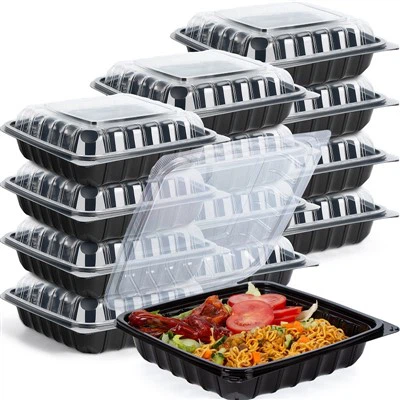
Various types of disposable plastic food containers
- - PP (Polypropylene): Currently, the safest microwave-safe material, with a heat resistance of approximately 100-120℃. However, cheap togo containers made from PP may have problems such as the use of recycled materials and excessive additives.
- - PS (Polystyrene): Commonly found in transparent plastic lunch boxes, instant noodle bowls, etc., with poor heat resistance. PS material releases styrene monomers above 60℃, which is a Group 2B carcinogen.
- PVC (Polyvinyl Chloride) contains a large amount of plasticizers, which release phthalates at high temperatures. Experiments have shown that after holding braised eggplant at 60℃ in a PVC food container for 30 minutes, the amount of plasticizer migration exceeded the national standard limit by 11 times.
- - PE (Polyethylene): Includes LDPE and HDPE, with poor temperature resistance, generally not exceeding 80℃, and easily deformed when heated.
- - PET (Polyethylene Terephthalate): Commonly found in beverage bottles, with a heat resistance limit of 70℃. Exceeding this limit easily leads to deformation and the release of heavy metal contaminants such as antimony.
1.2 Research Scope and Analytical Framework
This article will comprehensively analyze the safety hazards of inexpensive disposable plastic food containers, particularly cheap togo containers, from multiple dimensions, including material safety fundamentals, usage risks, health impact assessment, scenario-based risk analysis, supply chain risk tracing, and regulatory compliance.


II. Material Basis and Types of Safety Hazards
2.1 Chemical Properties and Risk Factors of Major Materials
- PP (Polypropylene) While its molecular structure is relatively stable, contact with hot, oily foods accelerates the migration of additives and oligomers in cheap togo containers. After three repeated heating cycles, microplastic release increases by 300%.
- PS (Polystyrene) Under high temperatures, it releases carcinogens such as styrene monomers and oligomers. Experiments show that PS cheap togo containers holding hot soup exceeded styrene levels by three times after one hour.
- PVC (Polyvinyl Chloride) During processing, large amounts of plasticizers (mainly phthalates) are added. These substances easily migrate into food at high temperatures, posing a risk to reproductive health.
- PET (Polyethylene Terephthalate) Antimony is used as a catalyst in its synthesis. This heavy metal may leach out at high temperatures, and long-term ingestion may damage heart function.

2.2 Potential Hazards of Additives and Chemicals
- Hazards of Plasticizers: Phthalate esters are the most common plasticizers. They have endocrine-disrupting effects, potentially leading to phthalate syndrome and affecting reproductive system development, especially in cheap togo containers made from substandard materials.
- Hazards of Bisphenol A and its Substitutes: Bisphenol A (BPA) and its substitutes, such as bisphenol S (BPS), have been proven or are suspected of having endocrine-disrupting effects, affecting fertility and fetal development.
- Hazards of Heavy Metal Catalysts: For example, antimony in PET can accumulate in the body with long-term ingestion, causing chronic poisoning and damaging the heart, liver, and kidneys.
2.3 Temperature Tolerance Range and Deformation Risk of Different Materials
Temperature is a key factor affecting the safety of plastic food containers, including cheap togo containers.
| Material Type | Heat Resistance Temperature | Safe Operating Temperature | Main Risks |
|---|---|---|---|
| PP (Polypropylene) | 100-120℃ | ≤100℃ | Releases oligomers and microplastics at high temperatures |
| PS (Polystyrene) | 60-90℃ | ≤60℃ | Releases styrene monomers |
| PVC (Polyvinyl Chloride) | 60-80℃ | ≤50℃ | Releases phthalates |
| PE (Polyethylene) | 70-80℃ | ≤60℃ | Easily deformed, releases additives |
| PET (Polyester) | 60-70℃ | ≤50℃ | Leak heavy metals such as antimony |

Studies have found that PP cheap togo containers release a large number of microplastic particles within 15 minutes when filled with braised pork at 78℃. PS cheap togo containers release harmful substances above 65℃ and completely soften and deform at 95℃. PVC materials release large amounts of plasticizers at 60℃.
III. Triggering Conditions for Safety Hazards During Use
3.1 Temperature Factor: Substance Release Mechanisms in High-Temperature Environments
Temperature is the most important factor triggering the release of harmful substances in cheap togo containers. 65℃ is a critical threshold-above this temperature, the release rate increases exponentially.
- Increased molecular chain movement: Higher temperatures loosen the molecular structure of plastics, making additives and monomers more prone to migration.
- Chemical bond breakage: High temperatures cause plastic molecular chains to break, producing monomers, oligomers, or nanoscale plastic particles.
- Increased diffusion coefficient: For every 10℃ increase in temperature, the diffusion rate of harmful substances increases approximately 2-3 times.
- Synergistic effect of oils and fats: As organic solvents, oils and fats can significantly lower the softening temperature of plastics and accelerate the dissolution of chemicals. When PS cheap togo containers hold oily foods, styrene dissolves 3 times faster than water.
-


3.2 Time factor: Long-term exposure and cumulative effects
- Short-term exposure risk: After one hour of holding hot soup in a PS cheap togo container, the styrene content exceeds the standard by 3 times. After 30 minutes of holding 60℃ food in a PVC cheap togo container, the amount of plasticizer migration exceeds the national standard by 11 times.
- Long-term cumulative hazards: Phthalate esters are slowly metabolized in the body; continuous exposure for 6 months can cause irreversible liver damage. Consumers who frequently use cheap togo containers have significantly higher concentrations of microplastics in their blood and a higher incidence of heart failure.
- Reuse risks: Reuse leads to plastic aging and surface wear, accelerating the release of harmful substances. The amount of microplastics released from a third-time-used PP cheap togo container is 30% higher than that from a new container.
3.3 Contact medium: The influence of food type on migration behavior
Food type significantly affects the migration of harmful substances in cheap togo containers:
- Fat foods: Have an "extraction" effect, dissolving organic matter in plastics. Heating oily foods in polypropylene cheap togo containers releases 30% more chemicals than heating dry foods.
- Acidic foods: Promote the dissolution of metal ions (such as antimony) from plastics.
- High-sugar foods: May cause localized excessively high temperatures (above 150°C) during microwave heating, causing rapid decomposition of plastics.
Based on risk level, food can be categorized as follows:
| Risk Level | Food Types | Characteristics |
|---|---|---|
| Extremely High Risk | Spicy hot pot, hot pot, fried foods | High temperature + high oil |
| High Risk | Braised pork, braised eggplant, and soups | High temperature or high oil |
| Medium Risk | Stir-fried dishes, stews | Relatively high temperature |
| Low Risk | Cold dishes, fruits, rice | Low temperature, no oil |

3.4 Special Usage Scenarios: Risks in Microwave Ovens, Food Delivery, etc
- Microwave Oven Heating: One of the most dangerous scenarios for cheap togo containers. Microwave heating for 3 minutes can release millions of microplastics and billions of nanoplastic particles.
- Food Delivery: Food is at a high temperature (80-90℃) when it comes out of the oven. The sealed cheap togo containers create a high-temperature and high-humidity environment, accelerating the release of harmful substances.
- High-Temperature Storage and Repeated Heating: Prolonged high-temperature storage multiplies the migration of harmful substances in cheap togo containers.

IV. Specific Safety Hazards and Health Impacts
4.1 Chemical Hazards: Monomer Residues, Plasticizers, Heavy Metals, etc
- Styrene Monomer (PS): A Group 2B carcinogen, neurotoxic, affects reproductive function, and long-term intake increases the risk of cancer, especially from cheap togo containers made of PS.
- Phthalate Esters (PVC, etc.): Endocrine disruptors, leading to reduced sperm count and quality in men, menstrual disorders in women, increased risk of obesity, diabetes, and other metabolic diseases.
- Heavy Metals (e.g., antimony in PET): Biotoxic; long-term intake may lead to myocardial fibrosis, liver damage, etc.
- Bisphenol A and its substitutes: Endocrine disruptors, affecting fertility and fetal development; its substitutes (BPS, BPF) may have similar or stronger toxicity.

4.2 Physical Hazards: Microplastic and Nanoplastic Pollution
Production Mechanism
Produced through mechanical wear, thermal degradation, and chemical degradation in cheap togo containers.
Release Amount
High temperature and microwave heating greatly accelerate the release. Microwave heating for 3 minutes can release up to 4.22 million microplastic particles/cm² and 2.11 billion nanoplastic particles/cm² from cheap togo containers.
Harmful effects on the human body:
- Intestinal damage: Disrupts the intestinal barrier, leading to leaky gut syndrome.
- Inflammatory response: Acts as a foreign substance, triggering chronic inflammation.
- Carrier of chemical substances: Adsorbs and releases other harmful substances, causing secondary pollution.
- Special hazards of nanoplastics: Can penetrate cell membranes, the blood-brain barrier, and even the placental barrier, directly interfering with cell function.

4.3 Microbiological hazards: Risk of bacterial growth and cross-contamination
- Bacterial growth: Scratches and abrasions on the surface of cheap togo containers provide a habitat for bacteria. Repeated use of disposable items may lead to a surge in bacterial counts.
- Cross-contamination: Sharing cheap togo containers for raw and cooked foods, contact with environmental pollutants, and poor hygiene among operators can all lead to cross-contamination.
- Microbial toxins: Aflatoxin (a potent carcinogen) produced by molds and heat-resistant enterotoxins produced by Staphylococcus aureus, etc., pose a great threat to human health.


