

A Complete Analysis of Size, Functionality, and Cost
Restaurant to-go containers have become essential as people order takeout more and more frequently. Other types of plastic to-go containers are also popping up like mushrooms after a rain. This can make it difficult for restaurants to choose the right product. What's the right product for your business? Which to-go container size is the best? Don't worry, this article will provide a detailed analysis of size, function, and cost.
1. Understanding Different Types of Lunch Boxes
Understanding the design and characteristics of different materials is essential before choosing a lunch box.
Common Material Comparison: Plastic, Paper Pulp, and PLA
Plastic, paper pulp, and PLA are the most common materials used in the industry. Plastic is the preferred choice for many restaurants due to its affordability, availability, and plentiful supply. Plastic and paper pulp offer environmental advantages over plastic, but they fall far short in other areas, such as durability and supply chain stability. Therefore, businesses must understand their needs before making a decision.
Advantages of Plastic To-Go Containers
Plastic lunch boxes are relatively mature, so their performance has been fully exploited by major manufacturers. For example, they are microwave-safe and can be stored at extremely low temperatures without breaking. Their greatest strength is versatility. Furthermore, some high-quality containers are extremely durable and can withstand repeated drops without breaking, making them ideal for restaurants, which require frequent takeout.
Diverse Designs of Restaurant To-Go Containers
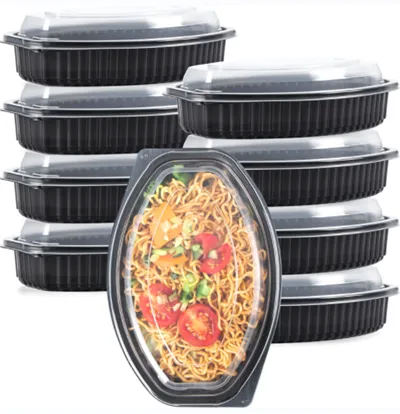
In addition to choosing the right material, there are also a variety of design options for lunch boxes, including the most common single-compartment boxes, multi-compartment boxes, and even one-piece boxes. The maturity of technology has created a diverse range of plastic lunch box designs. Plastic to-go containers are ideal for salads, noodles, hot rice, and other dishes, and the ability to choose from a variety of compartments tailored to your needs improves restaurant efficiency while also satisfying customers.



2. Size Selection: How to Match Your Menu?
 Different sizes often correspond to different menu items. Choosing the right to-go container sizes can effectively prevent waste and save costs.
Common To-Go Container Sizes
500ml, 750ml, 1000ml, and 1500ml are the most common sizes. Among these, 1000ml is the most commonly used size for food and can accommodate most meal sets. The 500ml and 750ml sizes are suitable for salads, noodles, and other items, while the largest 1500ml size is more suitable for family outings, picnics, or large dishes. Using large containers for small items can be distasteful to customers. Knowing your preferred size is crucial for successful business success.
Guide to Matching Menu Items and Sizes
As mentioned above, why might customers be unhappy? Imagine a large container filled with a small amount of food. Even if it's a normal portion size, seeing this combination would be distasteful to anyone. Therefore, it's best to ensure that the portion size of the dish corresponds to the size of the lunch box, ensuring the food appears to be of reasonable size or even represents excellent value. For example, a 1000ml-1200ml lunch box is suitable for rice set meals, while a 750ml one is suitable for lighter meals like salads. For dishes like noodle soup, a larger 1500ml capacity is desirable. This is crucial to consider and avoid making a blind choice.
Plastic To-Go Containers Offer Size Flexibility
Plastic containers offer greater size flexibility. Many manufacturers offer not only standard sizes but also special or brand-specific sizes. Customization is essential for manufacturers, offering features like logo printing, custom colors, and sizes. Brand recognition is crucial. As you've probably already seen, plastic lunch box technology is far more advanced than paper pulp and PLA. Furthermore, customized plastic lunch boxes not only meet functional requirements but also enhance a brand's image.


3. Functionality: More Than Just Food Storage
Beyond size, choosing the right lunch box also depends on whether its functionality meets your needs.
Leakproof and Heat-Resistant
Leakproofness is a fundamental requirement for today's lunch boxes, whether for takeout delivery or home use. Many customers immediately ask if restaurant to-go containers are leakproof, demonstrating how leakproofness has become a necessity. Effective leakproofness ensures food safety and directly impacts customer repurchase rates. Only by using quality lunch boxes can you earn customer recognition of your brand's quality.

Multi-Compartment Dividers
As people increasingly prioritize nutritional balance, the use of compartmentalized lunch boxes is becoming increasingly widespread. Using single-compartment lunch boxes inevitably leads to flavor transfer and can even affect the taste of different foods. The emergence of multi-compartment plastic to-go containers effectively addresses this issue.
Microwave and Freezer Compatibility
In addition to the two aforementioned features, there's another crucial one. One of the most frequently used functions is whether the food inside the container can be reheated in the microwave or stored in the refrigerator. This is a major concern for many. Plastic to-go containers made of PP and MFPP meet this requirement perfectly. The inherent properties of the material make it microwave-safe and refrigerator-safe. Using these containers can significantly enhance brand reputation and image, while also providing customers with peace of mind.


4. Cost Considerations and Procurement Strategies
 Cost remains a core concern for restaurant companies. How can quality and price be balanced?
The Relationship Between To-Go Container Sizes and Cost
The amount of material used is generally related to the size of the lunch box. The larger the size, the higher the price. Furthermore, transportation and storage costs also increase. Therefore, as mentioned above, it is important to choose the right size for the lunch box. Avoid blindly purchasing, which can lead to higher costs and ultimately outweigh the benefits.
Cost Comparison of Disposable and Compostable Lunch Boxes
Many people are unsure whether to choose plastic to-go containers or compostable ones. This depends on the brand's positioning. The former is moderately priced and generally has an abundant and consistent supply. The latter offers greater environmental advantages, but also carries a higher cost. At this point, restaurant companies need to assess whether they prioritize short-term cost savings or long-term brand building and environmental responsibility. This decision depends on the company's approach.
How to Choose Cost-Effective Restaurant To-Go Containers
So, have you learned how to choose the right lunch box? To summarize, when purchasing, you shouldn't just look at the price. You also need to consider the material, function, stable supply, and after-sales service. It's best to choose a manufacturer with international certifications, such as FDA and ISO9001, to ensure both product quality and safety.


Where to Buy Plastic To-go Containers?
Huizhou Yangrui Printing and Packaging Co., Ltd., equipped with German KIEFEL molding equipment and strictly implementing the ISO9001 quality management system, our products meet FDA and SGS certification standards. Our main products include disposable plastic lunch boxes, beverage cups, food trays, packaging bags, and eco-friendly and biodegradable products. We support logo printing, custom colors, and various to-go container sizes.
Contact information:
Email: sales@packagingbag5.com
Tel: +86 180 8644 3226
References
- Packaging Europe. Trends in Sustainable Food Packaging (2024).

- Journal of Foodservice Business Research. Consumer Perceptions of Takeaway Containers and Food Safety.
- Plastics Today. Advances in Microwave-Safe Plastic Food Containers.
- Food Packaging Forum. Comparison of Biodegradable and Plastic Food Packaging.
