

1. Why Do Frozen Lunch Boxes Need to Be Particularly Brittle and Crack-Resistant?
Frozen temperature is very low; the lunch box must be able to withstand it, it is not just about doing it on the line. You should know that low temperatures have a great impact on plastics; otherwise, the lunch box will be frozen and cracked, and the food will be wasted.
What Is the Effect of Low Temperature on Plastic Molecules?
Plastic is actually composed of many molecular chains. At room temperature, these chains are very flexible, flexible. But once frozen to minus ten degrees, these molecular chains harden and lose their flexibility. Just like glass, it becomes easily broken. Ordinary plastics encountered at such low temperatures, especially those that have not been modified, easily become brittle, and the lunch box accidentally cracks. Especially transparent Clear Plastic Take-Out Food Containers, which are thin and brittle, are more prone to this problem.


What Are the Difficulties in Cold Chain Logistics and Storage Environments?
From the factory to the customer, frozen food has to go through many stages, such as transportation by refrigerated trucks, freezing in warehouses, and handling and loading. During the process, the lunch boxes may be squeezed, collided, or even piled up. If the lunch box is brittle and crumbles at the slightest touch, it can be a real problem. Especially the takeaway lunch box and food packaging, if customers find the lunch box cracked, the catering business's brand image will also be affected.
A Cracked Lunch Box Will Bring What Trouble?
Cracked boxes expose food to air, which can easily spoil or be contaminated with bacteria. Consumers will also lose trust in the brand when they see a broken lunch box. Restaurants and food factories want meal boxes to remain strong in cold temperatures so they can ensure food safety and their own reputation. Protect your food and keep your customers happier with Clear Plastic Take-Out Food Containers that perform well.

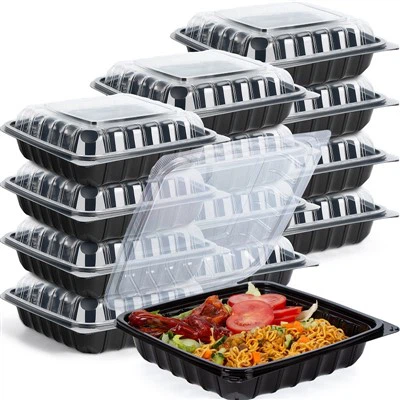


2. What Materials Are Commonly Used for Frozen Lunch Boxes? How Do They Perform?
The material determines whether the lunch box can resist freezing and cracking. The following are the advantages and disadvantages of several common materials on the market.
PP (Polypropylene) - Cheap but Easy to Freeze, Brittle
PP is the most commonly used plastic material, cheap and heat-resistant, but it tends to become hard and brittle at low temperatures and cracks easily. In order to improve this shortcoming, manufacturers will add some softeners to PP, so that it can also be a little tough when frozen, but the modified PP transparency is almost, but not very, suitable for transparent Clear Plastic Take-Out Food Containers.
PET--High Transparency, But Low Temperature Performance Needs to Be Strengthened
PET is a common material for making transparent food containers, with very good transparency, suitable for displaying food. Ordinary PET tends to become brittle at low temperatures, so manufacturers will use modified PET or mix it with other materials to enhance its toughness and anti-cracking ability. The resulting Clear Plastic Take-Out Food Containers are both beautiful and freeze-resistant, making them a popular choice in cold chain packaging.


HDPE - A Natural, Low-Temperature Resistant Toughness
HDPE is particularly good at withstanding low temperatures, and the colder it freezes, the stronger it gets, so it is generally used to pack ice cream, frozen meat, and other foods. However, it is not transparent, and you cannot see the appearance of the food. If you do not need a transparent display, HDPE is a good choice for frozen packaging.
Modified PLA and Pulp Composite - A New Attempt to Be Environmentally Friendly and Freeze-Resistant
PLA is a biodegradable material, environmentally protective, but afraid of cold; if used alone, freezing is easily brittle. Now there manufacturers are trying to combine PLA and soft materials or pulp, made of an environmentally protective freezer box, performance has improved, but the cost is higher. Customers with strong environmental concepts will consider using this combination, along with transparent lids to make Clear Plastic Take-Out Food Containers.


3. What Are the Important Technologies for Preventing Brittleness and Cracking of Frozen Lunch Boxes?
To keep the lunch box from breaking in the freezer, it is not enough to rely on the material; the structure and process should also be optimized.
Material Modification Is Critical
Adding elastomers (like POE, EVA) to the plastic can improve the toughness of the plastic at low temperatures, making it less prone to breakage. Copolymers can also be made to make the molecular structure softer. The Clear Plastic Take-Out Food Containers made in this way are more resistant to impacts in the freezer and are more reliable to use.


Reasonable Design, Not Too Thin a Wall Thickness
In the design of food containers, the corners should be rounded to avoid the sharp corners from concentrating stress and causing cracks. Wall thickness design should be uniform; there can not be particularly thin places, otherwise it will be easy to crack when frozen. Reinforcing ribs also makes the lunch box stronger. Clear Plastic Take-Out Food Containers are designed to be more resistant to freezing and compression.
The Manufacturing Process Also Affects Performance
The temperature and cooling rate should be controlled during injection molding. Cooling too quickly will cause high internal stresses in the plastic, making it prone to cracking. Properly adjusting the cooling time, the plastic has more uniform crystallization and better frost resistance. Some manufacturers will also add an anti-cracking coating to the lunch box to improve impact resistance, to ensure that each batch of Clear Plastic Take-Out Food Containers is qualified.


4. How to Buy Frozen Food Containers?
You can't just buy lunch boxes; you have to combine the actual needs, pay attention to the certification, and choose reliable manufacturers.
According to the Use of the Scene to Choose the Material
If you want to freeze some meals in your home refrigerator, just choose modified PP or PET; for commercial cold chain logistics, it is recommended to use low-temperature-resistant PET copolymer or HDPE; if you want to export to foreign cold regions, you should pay special attention to the material and frost resistance, and choose the appropriate Clear Plastic Take-Out Food Containers.
See if the Food Containers Have Any Low-Temperature Test Certificates
ASTM D746 low-temperature embrittlement test and SGS low-temperature impact certification can prove that the food containers will not be easily cracked under low temperatures. These certificates can prove that the lunch box will not be easily cracked in low temperatures. When you buy the lunch box, you should ask for these certificates, which are more reliable and can reduce transportation damage.


Where to Buy Clear Plastic Take-out Food Containers?
Yangrui is a trusted manufacturer specializing in high-quality disposable lunch boxes. Contact Yangrui for custom solutions to meet your specific needs in terms of size, material, and design.
Contact information:
Email: sales@packagingbag5.com
Tel: +86 180 8644 3226


References
- ASTM International. (2020). ASTM D746 - Standard Test Method for Brittleness Temperature of Plastics and Elastomers by Impact.
- SGS. (2022). Cold Temperature Impact Test Report for Plastic Food Containers.
- Zhang Wei, Li Qiang. (2021). Research on the Performance of Plastic Packaging Materials in Low-Temperature Environments[J]. Packaging Engineering, 42(3), 45-50.
- Wang Fang. (2020). Polypropylene Modification Technology and Its Application in Food Packaging[D]. Master's Thesis in Materials Science and Engineering.
- Smith, J., & Lee, H. (2019). Advances in Low-Temperature Resistant Plastics for Food Packaging. Journal of Polymer Science, 57(12), 1354-1365.
