Which Plastic Lunch Box Has the Best Insulation Effect? The Truth About Best to Go Containers for Restaurants from the Thermal Conductivity of the Material
Introduction
More and more catering brands are no longer just looking at price and appearance when choosing the best to-go containers for restaurants, but are gradually turning to whether the insulation is good. This article will compare the thermal conductivity of mainstream plastic lunch box materials to reveal, from a scientific perspective, which material is more suitable for insulation, so as to help companies accurately select and win customers.
1. How Important Is the Insulation Demand of Plastic Lunch Boxes?
The insulation of lunch boxes will directly affect the brand image.

The Effect of Heat Loss on the Taste of Food
As long as the temperature of the food changes, the taste will change. For example, when fried food cools down, it will lose its crispy taste; when soup cools down, the fat will solidify. These changes will seriously affect the customer's dining experience. Therefore, it is crucial to choose the right best to go containers for restaurants.
The Delivery Industry Is Increasingly Relying on the Insulation of Food Boxes
Data shows that the average delivery time for takeout is 15-35 minutes. During this process, the insulation of food boxes has become an important factor in maintaining word-of-mouth, allowing food to remain in good condition even after long-distance delivery.
Why Has the Insulation Effect Become One of the Core Indicators for Evaluating the Best To-Go Containers for Restaurants?
According to statistics, in user feedback on disposable food boxes, the good insulation effect is one of the most mentioned positive comments. Best to-go containers for restaurants with excellent insulation performance can not only improve the dining experience, but also effectively promote customer repurchase.


2. Comparison and Ranking of Thermal Conductivity of Common Plastic Materials
The lower the thermal conductivity, the harder it is to dissipate heat, and the stronger the heat preservation ability.
PP (Polypropylene)
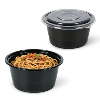
The thermal conductivity of PP is about 0.22, which is one of the better heat preservation options among plastic materials. It also has the characteristics of light weight, strong pressure resistance, and heat resistance (up to 120°C), which is also an important reason why many brands choose PP as the basic material for best to go containers for restaurants.
PS (Polystyrene, Including Foam Type)
The thermal conductivity of foam PS material is as low as 0.03-0.05, which is one of the best heat preservation materials on the market. However, ordinary PS is non-degradable and has a certain impact on the environment. Many countries have restricted their use. Driven by environmental protection policies, the best-to-go containers for restaurants using PS are gradually being replaced.


PET (Polyester)
The thermal conductivity of PET is about 0.4, which is much higher than PP and PS, and has weaker heat preservation performance. PET is transparent, beautiful, oil-resistant, and waterproof, but it is not suitable for scenarios that require long-term heat preservation.
Many restaurants use PET for cold food packaging, such as salads, fruits, and cold noodles, rather than hot food containers.
PLA (Polylactic Acid)
The thermal conductivity of PLA is between 0.16 and 0.25. Although its value is slightly better than PP, its thermal stability and structural insulation are average, and it is not suitable for high-temperature and long-term delivery of food. In the market that emphasizes biodegradability and environmental certification, PLA is gradually being adopted for best-to-go containers for restaurants of mid-to-high-end brands.
Pulp Molding (With Waterproof Coating)
The thermal conductivity of pulp products is between 0.05 and 0.15, and the multi-layer structure can effectively block heat loss. Pulp lunch boxes with PLA or PE oil-proof coatings have good thermal insulation performance while taking environmental protection into consideration.

3. Recommendation of the Best Plastic Lunch Box from the Perspective of Thermal Insulation
According to the needs of different scenarios, choosing the right material combination can achieve a balance between performance and cost.
Hot Soup/Hot Rice Fast Food: PS Foam or Double-Layer PP Lunch Box
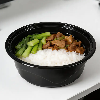
PS foam lunch boxes or thickened double-layer PP lunch boxes are suitable for hot soup noodles, fried rice, and other foods that need to be kept warm for a long time. This type of best-to-go containers for restaurants has good sealing and can effectively prevent food from cooling down quickly.


Lightweight Takeaway/Packing Scenario: Single-Layer PP + Insulation Bag Combination
The combination of a single-layer PP lunch box and an insulation bag is a cost-effective way, suitable for catering companies that need to control costs. Although the insulation is not the best, the combination can effectively guarantee the customer experience.
Mid-to-High-End Delivery/Airline Meal Scenario: PLA or Pulp + PLA Composite Structure
For catering brands that pursue environmental protection and brand tone, PLA or pulp composite lunch boxes are more suitable. This type of lunch box is not only degradable, but also can convey the sustainable concept of its own brand, which is in line with international trends.


Cold Food/Temporary Storage: PET Boxes
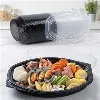
PET is more suitable for cold noodles, fruits, salads, and other refrigerated food due to its high brightness and good visual experience. PET is still the mainstream choice of this type of best-to-go containers for restaurants.
Where to Buy Best-to-go Containers for Restaurants?
Huizhou Yangrui Printing & Packaging Co., Ltd. mainly sells PP thickened lunch boxes, PLA environmentally friendly lunch boxes, and pulp composite lunch boxes. It supports OEM customization and microwave/refrigerated safety. It has passed ISO9001 and FDA certification and has served multiple brand catering customers in Europe, America, and Southeast Asia.
Contact information:
Email: sales@packagingbag5.com
Tel: +86 180 8644 3226


References
- Polymer Data Handbook, J.E. Mark, Oxford University Press, 2009 - Provides detailed original data on thermal conductivity of PP, PS, PET, and PLA.
- Plastic Materials: Properties and Applications, A. Brent Strong, Prentice Hall - Analysis of thermal conductivity properties of thermoplastic materials in the packaging field.

- China Food Contact Materials Industry White Paper (2023), Food Contact Product Standard Technical Committee of the State Administration for Market Regulation - Policy interpretation of food packaging materials in terms of safety and thermal performance.
- Sustainable Packaging Design, Scott Boylston - Analysis of the comprehensive performance of pulp molding and PLA in the environmental protection trend.
Takeaway Industry Research Report (2024), iResearch - Statistics on the correlation between takeaway users' "temperature satisfaction" and repurchase intention.