Table of Contents
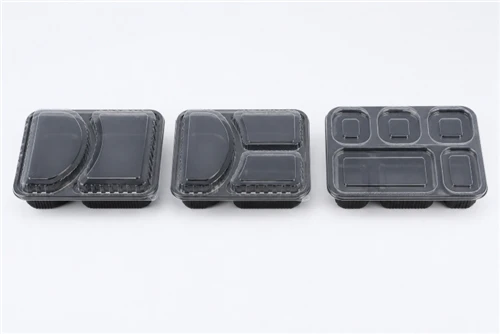
What Are Divided To Go Containers and Why Compartment Count Matters
2-Compartment To Go Containers: Best Use Cases and Limitations
3-Compartment To Go Containers: The Versatile Middle Ground
5-Compartment To Go Containers: Maximum Portion Control for Complex Meals
2 vs 3 vs 5-Compartment To Go Containers: Side-by-Side Comparison
How to Choose the Right Divided To Go Container for Your Business
Material, Durability, and Food Safety for To Go Containers
Frequently Asked Questions About Divided To Go Containers
Conclusion: Get the Right To Go Containers for Your Meal Prep Program
Certificate Display
Contact Now
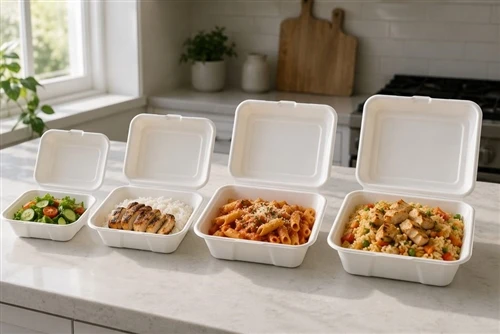
What Are Divided To Go Containers and Why Compartment Count Matters
To go containers with built-in dividers solve a problem every foodservice operator knows well: keeping different foods separated from preparation to the customer's table. A sauce that bleeds into rice, or a hot protein that steams soggy fries, isn't just a presentation issue - it's a customer-experience problem that shows up in reviews and refund requests.
What's the best compartment container for meal prep? The honest answer is that it depends entirely on your menu structure, not on which option "looks" more premium. Compartment count - 2, 3, or 5 - is consistently the single biggest decision variable in container selection, ahead of material, color, or branding.
This guide resolves three common buyer scenarios:
Fast-casual bowls
- a main item plus one side, moving at high volume
Full-plate meals
- a protein with two distinct sides, the meal-prep default
Bento-style, multi-dish meal prep
- several small, separated portions for premium or dietary-specific programs
Here's the direct answer up front: there is no universal winner. The right compartment count depends on how your menu is structured and how much portion separation your customers actually need. We'll walk through each format, then give you a side-by-side comparison and a decision framework you can apply today.
Across hundreds of wholesale orders we've fulfilled, a clear pattern shows up: restaurants and meal-prep brands typically test two compartment sizes before settling on their final SKU. That trial-and-error is expensive at scale - our goal here is to help you skip most of it.
From an engineering standpoint, compartment walls aren't just a visual divider. Structural rib design in the divider wall is what actually prevents sauce migration between sections during transit and stacking - a detail that matters more than wall count alone. And regardless of how many compartments a container has, it must still meet FDA food-contact material requirements - compliance is not optional at any compartment count.
Why does this matter more now than ever? The global online food delivery and meal-kit sector has grown dramatically, meaning packaging decisions that once felt minor now carry real revenue weight - a container that leaks or under-delivers on portion presentation translates directly into lost repeat orders. If you want to skip ahead, browse our full range of divided to go containers to see what's currently in stock.
2-Compartment To Go Containers: Best Use Cases and Limitations
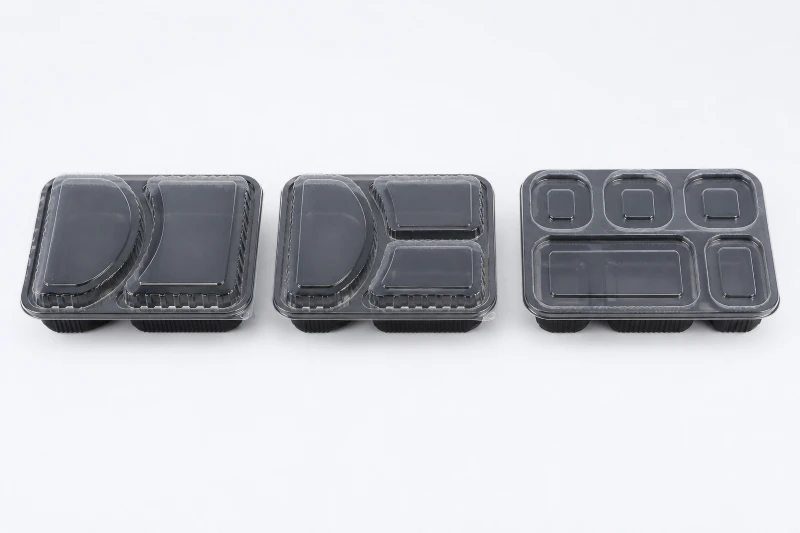
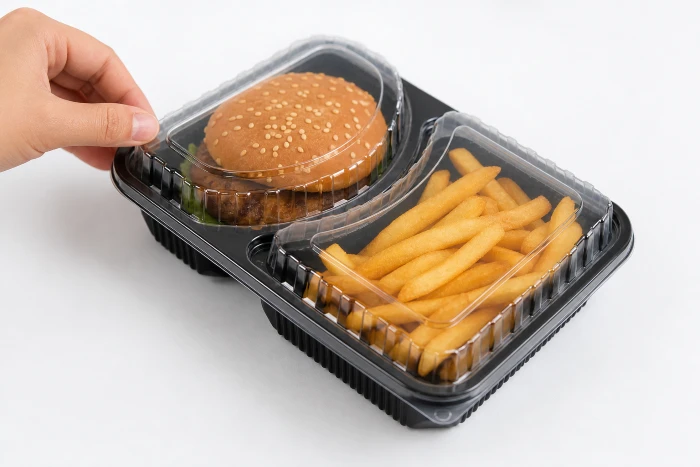
2-compartment to go containers are built around one core idea: a main section and a secondary section, almost always in a ratio like 70/30. That large primary cavity holds the entrée; the smaller one holds a side, dip, or sauce cup.
Best-fit menu types:
Burgers or sandwiches
+
fries or chips
Entrée
+
a single dipping sauce
Wraps or sandwiches
+
one side salad or slaw
Where it falls short: a 2-compartment layout cannot physically separate three or more distinct food groups without some mixing. If your menu regularly serves a protein plus two different sides, this format will force compromises - foods will touch, and sauce control becomes harder to guarantee.
On the cost and speed side, 2-compartment containers win decisively. They carry a lower per-unit cost than 3- or 5-compartment molds, and they move faster through a packing line - fewer compartments mean fewer placement decisions per order, which adds up across thousands of daily transactions for high-volume quick-service restaurants (QSR).
From direct packing-line feedback we've gathered from quick-service operators, 2-compartment formats measurably reduce packing time per order precisely because staff make fewer placement decisions per box. On the engineering side, that 70/30 compartment ratio isn't arbitrary - it's sized specifically to keep sauce contained in the smaller cavity during transit, reducing the kind of spill complaints that foodservice packaging selection guidelines from the industry's trade association are built to address.
|
Dimension |
Strengths |
Limitations |
|
Capacity |
Simple, generous main compartment |
Cannot separate 3+ food groups |
|
Cost |
Lowest per-unit cost of the three formats |
- |
|
Packing speed |
Fastest - fewest placement decisions |
- |
|
Menu flexibility |
Great for single-side menus |
Poor fit for multi-side meal prep |
3-Compartment To Go Containers: The Versatile Middle Ground
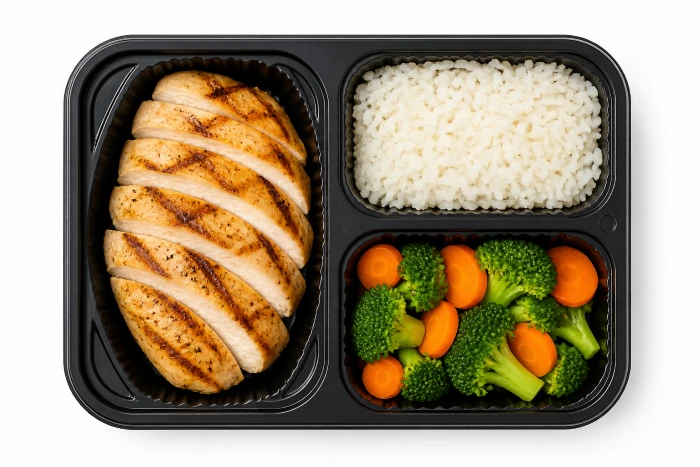
If you're searching for the best to go containers for meal prep business, the 3-compartment format is almost always the starting answer. It's the most ordered SKU across our meal-prep and catering clients, built specifically around the protein-plus-two-sides structure that dominates modern meal-prep menus.
Common layouts:
Even thirds
1. - balanced visual presentation, ideal for bowls where no single element dominates
50/25/25
2. - one larger protein section with two smaller side compartments
60/20/20
3. - maximum protein real estate with minimal side allocation
This format strikes the balance that most new meal-prep brands need by default: enough portion control to keep ingredients separated, without the packing-line slowdown or added cost of a 5-compartment mold. Where it falls short: complex bowls with four or more distinct ingredients - think a bowl with a protein, two vegetables, a grain, and a separate sauce - still risk mixing in a 3-compartment layout.
From order-history patterns across meal-prep subscription clients, 3-compartment is consistently the most frequently reordered format, specifically for protein + carb + vegetable layouts. On the engineering side, this is also where compartment wall height becomes critical - taller divider walls prevent liquid sauce from bleeding between three sections during stacking and transit, which matters even more once containers are palletized for shipping.
The format's popularity also tracks closely with widely used balanced-plate portioning guidance from nutrition authorities, which naturally aligns with a three-way division of a meal into protein, grain, and vegetable. That alignment isn't a coincidence - it's part of why 3-compartment adoption has scaled alongside the broader growth of meal-prep and delivery demand.
|
Layout Type |
Compartment Ratio |
Best For |
|
Even Thirds |
33/33/33 |
Balanced bowls, visual presentation |
|
50/25/25 |
One large + two small |
Protein-forward meals |
|
60/20/20 |
Maximum protein space |
Minimal-side menus |
5-Compartment To Go Containers: Maximum Portion Control for Complex Meals
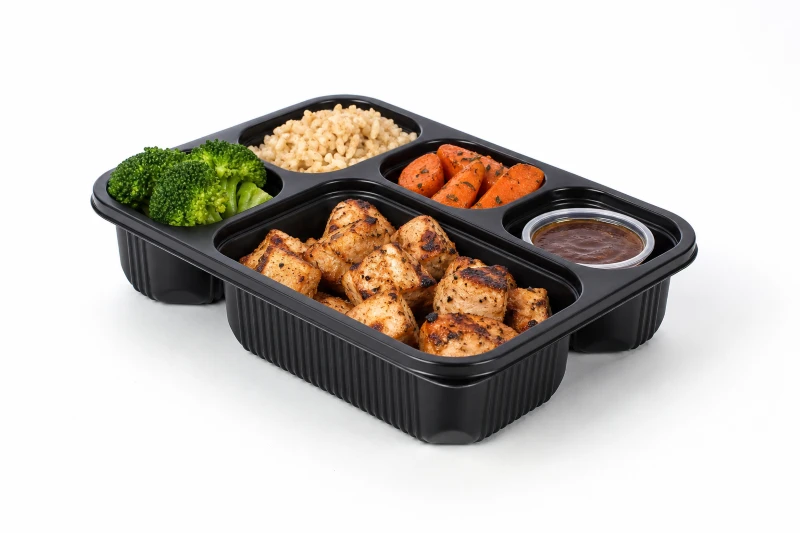
When a menu needs more separation than three compartments can offer, how do you choose divided to go containers for meal prep that handle genuinely complex dishes? That's exactly the gap 5-compartment containers fill - ideal for bento-style, multi-dish, or dietary-specific meals, such as keto plates built from four to five separate micro-portions.
Trade-offs to expect:
Higher unit cost
than 2- or 3-compartment equivalents
Bulkier footprint
, which affects shipping density and storage space
Slower packing line speed
- more compartments mean more placement steps per order
Who actually needs this? Three buyer segments consistently justify the added cost:
|
Buyer Segment |
Why 5-Compartment Fits |
Trade-off to Expect |
|
Premium meal kits |
Separates sauces from dry ingredients without extra pouches |
Higher per-unit cost |
|
Institutional catering |
Matches multi-item portioning requirements |
Slower packing speed |
|
Diet-specific programs |
Keeps keto/dietary components fully isolated |
Bulkier storage footprint |
We've seen this demand directly: premium meal-kit clients have specifically requested 5-compartment molds to separate sauces from dry ingredients without relying on extra pouches - a cleaner, lower-waste solution than bundling separate packets inside the box.
There's a real structural trade-off behind the "higher cost" label, too. More compartments mean reduced single-cavity depth, which affects which foods can be safely held without crushing - a thin-walled fifth compartment simply can't hold the same volume as a single large cavity. This is also the territory where multi-compartment trays are standard: institutional meal portioning standards used in school and institutional feeding programs commonly specify multi-compartment trays for exactly this reason - precise, isolated portion control at scale.
Because mold complexity and material use both increase with compartment count, 5-compartment containers also sit at the higher end of the current packaging material cost spectrum - a trade-off worth planning for before committing to bulk volumes.
Considering this format? View our 5-compartment to go container specs, or download our full container specification guide before committing to a production run.
2 vs 3 vs 5-Compartment To Go Containers: Side-by-Side Comparison
Comparing to go containers by compartment count side by side makes the decision far easier than reading three separate sections. Here's the complete picture across the dimensions that actually drive purchase decisions.
|
Feature |
2-Compartment |
3-Compartment |
5-Compartment |
|
Typical capacity split |
70/30 |
Even thirds or 50/25/25 |
5 micro-portions |
|
Relative unit cost |
Lowest |
Mid |
Highest |
|
Packing line speed |
Fastest |
Moderate |
Slowest |
|
Best menu fit |
Main + 1 side |
Protein + 2 sides |
Bento/multi-dish meals |
|
Typical buyer |
QSR, fast-casual |
Meal-prep brands, catering |
Premium meal kits, institutions |
No single format wins across every dimension - that's the article's core thesis, and the table above makes it visible at a glance. A QSR operator optimizing for packing speed and cost will almost always land on 2-compartment. A growing meal-prep brand balancing portion control against throughput typically settles on 3-compartment as the default. A premium caterer or dietary-specific program willing to trade speed and cost for maximum separation goes with 5-compartment.
One honest caveat: the unit-cost figures above vary by MOQ and material - a bagasse 3-compartment container and a PP 3-compartment container will not land at the same price point, and larger order volumes meaningfully change per-unit economics, consistent with broader packaging material cost trends across the industry this year.
Need pricing for your specific configuration? Get a quote for any compartment configuration, or compare all to go container sizes before you commit.

How to Choose the Right Divided To Go Container for Your Business
Here's a practical framework for how to choose divided to go containers for meal prep, broken into the three variables that matter most:
Menu complexity →
1. compartment count. Count your distinct food groups per dish. Two groups points to 2-compartment; three points to 3-compartment; four or more points to 5-compartment.
Order volume →
2. cost sensitivity. High-volume QSR operations should weight unit cost and packing speed heavily; lower-volume premium programs can absorb a higher per-unit cost for better separation.
Delivery distance →
3. leak-resistance priority. The longer the delivery window, the more a tight-fitting lid and reinforced divider walls matter, independent of compartment count.
If you're sourcing to go containers for small business, start with one versatile size - almost always 3-compartment - before expanding your SKU range. Launching with a single flexible format reduces inventory complexity while you validate demand; you can always add a 2-compartment SKU for simpler items or a 5-compartment SKU for premium lines once volume justifies it.
Sourcing considerations: MOQ, lead time, and customization all factor into timing. Current foodservice packaging lead times have been affected by ongoing ocean freight disruptions, so build buffer time into your planning - especially if you're approaching a seasonal demand spike. Always request samples before committing to a bulk order. Verifying wall rigidity, lid seal, and compartment separation on physical samples catches problems that specs on paper cannot.
The process we walk new wholesale clients through is straightforward: a menu audit to determine compartment needs, sample testing against real dishes, then an MOQ commitment once the format is validated. Request free container samples before you commit, learn about our wholesale MOQ options once you're ready to scale, or talk to our packaging team if your menu doesn't fit a standard layout.
|
Business Factor |
Question to Ask |
Recommended Compartment Count |
|
Menu complexity |
How many distinct food groups per dish? |
2 (2 groups) / 3 (3 groups) / 5 (4+ groups) |
|
Order volume |
Is packing speed a bottleneck? |
2 for high volume, 5 for lower volume |
|
Delivery distance |
How long until the customer opens the box? |
Prioritize leak-resistant design at any count |
|
Budget per unit |
What's your target landed cost per container? |
2 lowest, 3 mid, 5 highest |

Material, Durability, and Food Safety for To Go Containers
Compartment count isn't the only variable that determines how well a container performs. Material choice affects divider-wall rigidity, heat tolerance, and sustainability positioning - independent of how many compartments the container has.
Common materials:
PP (polypropylene)
- generally microwave-safe, good heat tolerance, holds divider-wall shape well under hot-fill conditions
PET
- excellent clarity for visual presentation, lower heat tolerance, typically not microwave-safe
Bagasse/fiber
- compostable, strong eco-positioning, but requires thicker divider walls to match PP's rigidity
From the manufacturing floor, this is a real, observable constraint: divider-wall thickness must scale up with material type to avoid warping during hot-fill use, particularly for fiber-based materials that don't hold a sharp divider edge as naturally as molded PP.
Food-contact safety certifications to verify when sourcing: any material you select should carry verified food-contact safety certification consistent with FDA requirements, alongside any additional regional standards relevant to your target export market.
Sustainability is increasingly a buying criterion on its own. For brands building an eco-conscious positioning, compostable packaging adoption continues to grow across the foodservice sector, making bagasse and other fiber-based compartment formats a meaningful differentiator - provided the divider-wall engineering compensates for the material's inherent flexibility.
|
Material |
Heat Tolerance |
Compostable |
Relative Cost |
|
PP |
High |
No |
Mid |
|
PET |
Low-Moderate |
No |
Low-Mid |
|
Bagasse/Fiber |
Moderate |
Yes |
Mid-High |
FAQ
Q: What is the best compartment container for meal prep?
A: There's no single best option - it depends on your menu. A 2-compartment container suits a main dish plus one side, a 3-compartment container is the most versatile for protein-plus-two-sides meals, and a 5-compartment container works best for bento-style or dietary-specific meals needing maximum portion separation.
Q: Can divided to go containers go in the microwave?
A: Microwave safety depends on the container material rather than the compartment count. PP containers are generally microwave-safe, while some fiber/bagasse and PET options are not - always confirm the material's food-safety certification before reheating.
Q: Are 3-compartment or 5-compartment containers better for catering?
A: 3-compartment containers suit standard catering menus with a protein and two sides, offering faster packing and lower cost. 5-compartment containers are better for premium or dietary-specific catering that requires separating several small portions, such as sauces or multiple micro-sides.
Q: What should I look for in to go containers in 2026?
A: Beyond compartment count, prioritize verified food-contact safety certification, leak-resistant divider design, and increasingly, sustainable or compostable material options as more meal-prep and catering brands shift toward eco-conscious packaging positioning.
Conclusion: Get the Right To Go Containers for Your Meal Prep Program
Request your wholesale quote today - the thesis of this guide is simple: no single compartment count wins universally. A QSR operator should default to 2-compartment for speed and cost; a meal-prep brand should default to 3-compartment for its balance of portion control and throughput; a premium caterer or institutional buyer should default to 5-compartment when menu complexity demands it.
We regularly see clients evolve their compartment mix as their menu grows - starting with one versatile size and adding a second SKU once order volume and menu complexity justify the investment. That's a normal, expected part of scaling a meal-prep or delivery program, not a sign that the first choice was wrong.
As a manufacturer with export experience serving customers across North America, Europe, and Australia, and with FDA and FSSC certifications behind every production run, YANGRUI builds this kind of wholesale to go containers wholesale solutions partnership from factory floor to final delivery - not just as a one-time supplier.
Whether you're locking in your first 3-compartment SKU or scaling toward a 5-compartment premium line, the right next step is simple: download the full container specification guide or talk to our team about your menu to get a configuration built around your exact portion requirements.
Certificate Display


FDA Certification (SGS): YANGRUI take out containers are make from the safe & new material