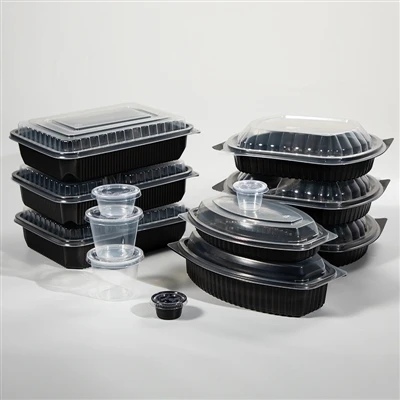
This guide runs long on purpose - it's built as a comprehensive, share-worthy reference for restaurant owners, foodservice buyers, and packaging decision-makers, not a quick skim. Use the jump links below to go straight to the section most relevant to your situation, whether you're troubleshooting a customer complaint today or planning a full supplier switch for next quarter. Each section stands on its own, so feel free to bookmark this page and return to specific parts as questions come up during your buying process.
Table of Contents
1.Introduction
2.The Short Answer: Are To-Go Containers Microwave-Safe?
3.How to Know If a To-Go Container Is Microwave-Safe
4.What Happens If You Microwave the Wrong Plastic To-Go Container
5.Microwave-Safe Plastic vs. Polystyrene (Styrofoam) To-Go Containers
6.Best To-Go Containers for Restaurants and Small Businesses in 2026
7.Eco-Friendly To-Go Container Solutions
8.To-Go Container Buying Guide: A Practical Checklist
9.Frequently Asked Questions
10.Conclusion

Introduction: Why "Can You Microwave Plastic To-Go Containers?" Is a Bigger Question Than It Seems
To go containers get reheated more often than most restaurant owners realize. A customer takes their lunch back to the office, pops the whole thing - food, lid, and all - straight into the breakroom microwave, and never gives it a second thought. As packaging consultants, we hear a version of this question almost every week from restaurant and foodservice clients who are switching suppliers: "Wait, is this container actually safe to microwave?"
That question sits at the intersection of convenience, hidden chemical risk, and real business liability. Customers assume that if a container holds hot food, it must be fine to reheat. That assumption isn't always true. Some plastics - like polypropylene (PP)- are built to handle microwave heat. Others, like polystyrene (PS) or certain PET containers, were never designed for it and can warp, leach chemicals, or fail outright.
This guide breaks down exactly how to tell the difference: what the safety symbols mean, which materials hold up under heat, and how to choose the right to-go containers for your business - whether you're a single-location restaurant or a growing regional chain. Food-contact plastic safety in the U.S. is regulated by the FDA, and similar regulatory bodies oversee it in most other countries, so getting this right isn't just about customer comfort - it's about compliance.

Are To-Go Containers Microwave-Safe?
It depends on the material - not all to go containers are microwave-safe. Some are engineered specifically to tolerate microwave heat; others will warp, soften, or release compounds into food well before your leftovers are hot all the way through.
Here's the quick-reference version:
✅ Generally safe: Polypropylene (resin code #5) containers that carry an explicit microwave-safe symbol.
❌ Generally unsafe: Expanded polystyrene / "Styrofoam" foam containers (resin code #6), many standard PET containers (#1), and unlabeled black plastic trays of unknown resin type.
⚠️Important caveat: "Microwave-safe" does not mean "safe indefinitely." Every heating cycle stresses the plastic slightly, and repeated reheating in the same container accelerates wear even on certified materials.
One mistake we see constantly: customers reheat food in black plastic containers, assuming dark plastic is automatically PP, when it's frequently uncoded polystyrene that simply looks similar. The difference matters more than color alone suggests - polypropylene has a melting point around 160°C (320°F), while polystyrene softens closer to 100°C (212°F), well within range of a standard microwave cycle.
These classifications aren't arbitrary. They trace back to FDA and NSF material classification standards, and to the plastics industry's own resin identification code system, which numbers common food-contact plastics #1 through #7. That numbering is your fastest, most reliable field check - see the table below.

How to Know If a To-Go Container Is Microwave-Safe (Symbols, Materials, and Labels)
Knowing how to know if to go containers are microwave safe comes down to reading a container the way a packaging buyer does - not guessing from color or shape. The good news: it only takes a few seconds once you know what to look for.
The official microwave-safe symbol is a small square icon with wavy lines inside it, almost always printed or embossed on the underside of the container, near the resin code triangle. If you see that symbol, the manufacturer has certified the material for microwave use under specific conditions (usually time and wattage limits printed nearby, if space allows).
If there's no symbol at all, that doesn't automatically mean the container is unsafe - but it does mean it's unverified. Treat unlabeled containers with the same caution you'd apply to any unverified claim: assume "no" until proven otherwise.
Here's the step-by-step check we walk suppliers' samples through before approving a new container line:
Flip the container over and locate the base.
Find the resin code inside the recycling triangle (look for #5/PP as the best sign).
Check for the wavy-line microwave-safe icon next to or near the resin code.
Cross-reference the supplier's spec sheet if the container will be used at scale - don't rely on a single sample.
One important nuance for buyers evaluating vendors: ASTM-tested microwave-safe claims are not the same thing as generic "BPA-free" labeling. BPA-free tells you about one specific chemical family; it says nothing about heat tolerance or migration risk under microwave conditions. A container can be BPA-free and still be a poor microwave choice. Look specifically for ASTM-tested microwave safety standards - that's the benchmark that actually addresses heat performance.
For any container you're sourcing in volume, it's worth going a step further and requesting a Certificate of Compliance or full spec sheet from the supplier. This is a simple, verifiable ask that protects you if a customer ever questions a product's safety - you can request a compliance spec sheet directly rather than relying on packaging claims alone.
One color-related caution worth flagging: dark and black trays are statistically more likely to be uncoded polystyrene than labeled PP. That's a pattern to watch for, not an absolute rule - always verify with the resin code rather than judging by color alone.
What Happens If You Microwave the Wrong Plastic To-Go Container
What happens if you microwave the wrong plastic container is a question worth understanding in concrete terms - not just as a vague warning, but as a real physical and business risk.
Physical failure first. The most immediate consequence is visible: warping, bubbling, or outright melting of the container walls, sometimes leading to collapse mid-reheat and a spilled meal in the microwave. This isn't rare - it's one of the most common customer support issues foodservice operators report after a packaging switch.
Chemical migration is the less visible risk. Under sustained heat, polystyrene can leach styrene, and certain plastics can release plasticizer compounds into the food they're holding. Peer-reviewed food-science research has examined how heat accelerates this migration process, generally finding that migration increases meaningfully as temperature and contact time rise - which is exactly the scenario a microwave creates. We reference this peer-reviewed research on plastic chemical migration rather than making unsupported claims, because the science here deserves precision, not alarmism.
Understanding why this happens helps put it in perspective. Every plastic has a glass-transition temperature - the point where a rigid plastic begins to soften and become pliable. Polystyrene's glass-transition point sits well below the heat a standard microwave can generate in a matter of minutes, which is exactly why foam containers soften and buckle so much faster than polypropylene ones.
For restaurant owners, there's a third layer of risk: business exposure. A single viral photo of a melted container - posted by a frustrated customer - can do outsized reputational damage relative to the actual cost of the packaging mistake. We've seen operators field a wave of complaints after one bad batch of foam containers shipped in a delivery order, simply because a customer assumed (reasonably) that any takeout container is microwave-ready. That assumption becomes the restaurant's liability the moment it goes wrong.
Poor packaging choices compound into customer trust problems fast - see how packaging mistakes affect customer trust for a closer look at the downstream cost of a single bad container experience.

Microwave-Safe Plastic vs. Polystyrene (Styrofoam) To-Go Containers
Choosing between microwave-safe plastic vs polystyrene to go containers is one of the most consequential sourcing decisions a foodservice buyer makes, because it affects cost, compliance, and customer experience simultaneously.
Polypropylene (PP) is a semi-rigid, heat-tolerant plastic commonly molded into hinged clamshells, deli tubs, and bowl-style containers. Expanded polystyrene (EPS/PS) - what most people still call "Styrofoam" - is a lightweight foam material, cheap to produce but poorly suited to heat and increasingly restricted by local regulation.
The two materials diverge sharply across four practical dimensions:

That "Ban Status" row isn't a minor footnote - it's an active purchasing risk. A rising number of cities and states have restricted or banned polystyrene foodware outright, and suppliers we work with report a steady increase in clients asking to move away from foam specifically because of local ordinance changes, not just sustainability preference. Before locking in a bulk order, it's worth checking current cities banning polystyrene foodware to confirm your jurisdiction isn't next.
The bottom line: PP remains appropriate for any hot, reheat-likely food item, while polystyrene's use case is shrinking to cold-only applications in the shrinking number of regions where it's still permitted at all. If you're currently stocking foam, our PP and foam container lines comparison page can help map out a transition plan without disrupting your supply chain.

Best To-Go Containers for Restaurants and Small Businesses in 2026
Finding the best to go containers for restaurants - or the best to go containers for small business in 2026 - isn't a one-size-fits-all answer. The right choice depends heavily on order volume, delivery mix, and brand priorities.
For Small Business Owners: Balancing Budget and Bulk Pricing
Most suppliers offer volume discount thresholds at predictable break points - often at case-pack, pallet, and full-truckload quantities. Before committing, estimate your monthly container spend by multiplying average daily order count by your per-unit cost, then checking whether stepping up to the next volume tier meaningfully lowers your effective rate.
There's also a real trade-off between per-unit cost and leak/heat performance, especially for delivery-heavy business models. A slightly more expensive container that resists leaks and reheats cleanly can cost less overall once you account for replaced orders, refunds, and customer churn from a single bad delivery experience. A practical rule of thumb: order a small trial batch before switching your entire supply chain - a few hundred units is usually enough to stress-test real-world performance before a full-scale commitment.
The smarter comparison metric isn't unit price at all - it's cost-per-meal-served, which accounts for container price, portion size, and failure/return rate together. A $0.02 cheaper container that fails on 3% of deliveries is not actually the cheaper option.
According to 2026 foodservice packaging trends tracked by industry research groups, cost-per-meal and compliance-readiness are increasingly outweighing raw unit price as the primary purchasing driver for small and mid-size operators.

For Restaurants: Custom Branding and Compliance
For restaurants building a delivery or pickup-forward model, custom-printed to go containers double as passive marketing - every unboxing is a brand touchpoint, especially for orders shared on social media.
Before finalizing any container line, run through a short local compliance checklist:
Is the material subject to any local material bans (e.g., polystyrene restrictions)?
Does your jurisdiction have a compostability mandate for foodware?
Is there adequate space on the container/label for allergen labeling, if required?
Ready to move on custom branding or a bulk order? Get a bulk pricing quote to see current volume tiers for your order size.

Eco-Friendly To-Go Container Solutions: Compostable, Recyclable, and Still Microwave-Safe
Interest in eco-friendly to go container solutions has grown steadily, but there's a misconception worth clearing up first: compostable does not automatically mean microwave-safe. Bagasse (sugarcane fiber) and PLA-lined kraft containers behave very differently under heat than traditional plastic, and not always predictably.
The main eco-material options currently on the market include:
Bagasse (sugarcane fiber) - sturdy, compostable, generally microwave-tolerant for short reheats.
PLA-lined kraft - compostable paperboard with a bioplastic lining; heat tolerance varies by lining thickness.
Mono-material recyclable PP - recyclable where local programs accept #5 plastics, and inherently microwave-safe if certified.
Each comes with cost and performance trade-offs relative to traditional plastic - eco-friendly materials are frequently priced at a premium, and some (particularly thinner PLA linings) can underperform on structural rigidity for heavier, saucier dishes.
Suppliers report that bagasse is the material customers ask about switching to most often, typically driven by sustainability positioning rather than cost savings. The most common regret point buyers report after switching is underestimating how a lighter-weight eco-container performs with hot, liquid-heavy dishes compared to their previous plastic option - a good reason to trial before a full transition.
Why some compostable liners fail the microwave test: many PLA-based linings have a lower heat-distortion temperature than polypropylene, meaning they can soften or deform at temperatures a standard microwave reaches easily, even though the same material handles cold or room-temperature storage just fine.
The reliable way to verify a compostable container's true performance is to check for recognized certifications rather than trusting marketing language alone. Look specifically for BPI-certified compostable packaging and, for the compostability standard itself, the ASTM D6400 designation - both are verifiable, checkable signals rather than vague "eco-friendly" claims.
Positioned correctly, sustainable packaging serves two goals at once: it satisfies a growing wave of local compostability mandates, and it functions as genuine brand differentiation for customers who actively choose vendors on environmental grounds. Explore our compostable container line to compare eco-material options against your current specs.
To-Go Container Buying Guide: A Practical Checklist for Restaurant Owners
This to go container guide for restaurant owners distills the vendor-qualification process we walk foodservice clients through into a single, actionable checklist - the same questions a packaging buyer would ask before committing to a new supplier.
Before finalizing any order, confirm the following:

A worked example: a mid-size restaurant serving roughly 150 to-go orders per day would need approximately 4,500 containers per month. Mapping that volume against a supplier's tier pricing - rather than eyeballing a per-unit quote - quickly reveals whether it makes sense to order monthly or lock in a quarterly bulk rate.
As with any packaging change, sample before you scale. Order a small trial run, test it under real kitchen and delivery conditions, and only then commit to a larger purchase order.
When vetting a new supplier, ask directly for:
Compliance documentation (Certificate of Compliance, resin test data)
Relevant certifications (ASTM, BPI, or equivalent)
Minimum order requirements and lead times
Customization options (branding, sizing, lid configuration)
This process aligns closely with general food-safety handling guidance foodservice operators already follow - treating packaging selection with the same rigor as ingredient sourcing is a natural extension of food-safety compliance guidance already in place at most kitchens.

Frequently Asked Questions About Microwaving To-Go Containers
Can you microwave plastic to go containers with the lid on? It depends on the container. Most microwave-safe lids allow venting, but tightly sealed lids can trap steam and cause warping or spills - vent or partially remove the lid before reheating.
Is it safe to microwave black plastic to go containers? Not always. Black containers are harder to visually identify, and some are unlabeled polystyrene rather than microwave-safe polypropylene. Always check the base for a resin code and microwave-safe symbol before heating.
How long can you microwave food in a to go container? Follow standard food-reheating guidance for your microwave wattage, and avoid exceeding the container manufacturer's stated heat-duration limits, since prolonged heating accelerates plastic degradation even in certified microwave-safe containers.
Are compostable to go containers microwave-safe? Not automatically. Compostable and microwave-safe are separate certifications - some bagasse and PLA-lined containers are not rated for microwave use, so check for an explicit microwave-safe label in addition to a compostability certification. See our eco-friendly options for a closer material comparison.
What's the difference between microwave-safe and oven-safe containers? Microwave-safe plastics are rated for the moderate, moisture-driven heat of microwaving, while oven-safe materials must withstand much higher dry-air temperatures - plastic containers rated for microwave use are generally not safe in a conventional oven.
These answers reflect the same standards referenced throughout this guide - FDA food-contact regulation, ASTM heat-testing benchmarks, and BPI compostability certification - rather than introducing new, unverified claims. For consumer-facing safety testing beyond industry standards, independent safety testing sources like Consumer Reports offer additional third-party perspective.

Conclusion: Choosing the Right To-Go Container Starts With Knowing What You're Reheating
Choosing the right to go containers ultimately comes down to three checks: look for the microwave-safe symbol, know the resin code, and match the material to how the container will actually be used - hot, cold, delivery, or dine-in.
For restaurant and foodservice buyers, this isn't just a customer-comfort issue. It touches safety, regulatory compliance, and the brand trust that a single melted-container complaint can quietly erode. Getting the material decision right up front is far cheaper than fixing a reputation problem after the fact.
This guide reflects packaging and food-safety practices current as of September 17, 2026. For the latest compliance specs relevant to your business, our team is glad to walk through your current container line.
Ready to source containers that are verified microwave-safe from day one? Get a free packaging quote from YANGRUI today.
FAQ
Q: Q1: Are black PP food to go containers less safe than clear ones?
A: A: No. Both use food-grade PP resin and meet the same safety standards (FDA, EU, etc.). Black PP's carbon black additive is food-safe with migration levels below detection limits. Safety depends on material quality, not color.
Q: Q2: Which type of PP container is better for microwave use?
A: A: Both are equally safe for microwave use up to 120°C. PP's unique thermal properties make it the only plastic approved for microwave heating. Avoid containers with metallic printing or non-PP components.
Q: Q3: Can black PP containers be recycled?
A: A: Yes, but with limitations. Standard black PP is difficult for NIR sorting systems to detect, resulting in low recycling rates (<10%). New NIR-detectable black formulations are improving recyclability to 25% by 2028.
Q: Q4: Which container type keeps food hotter longer?
A: A: Black PP retains heat 10–15 minutes longer than clear PP due to its higher thermal absorption properties. This makes it superior for hot food delivery applications.
Q: Q5: Can I use both black and clear PP containers in my operation?
A: A: Absolutely. Many operators use black PP for hot, saucy items and clear PP for fresh, premium foods. This strategic approach maximizes the benefits of both types while meeting diverse customer needs.
Certificate Display


FDA Certification (SGS): YANGRUI take out containers are make from the safe & new material