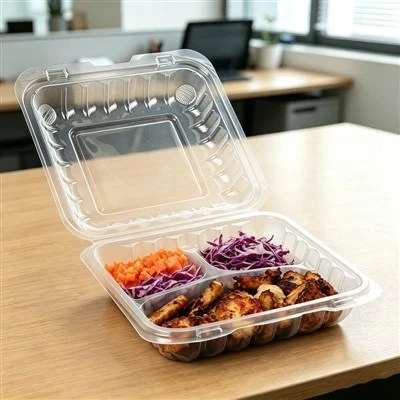
reviewing custom logo artwork color separation for food container printing
"Can you print our logo on this?" is usually followed almost immediately by "how many do we need to order?" - and the honest answer depends far more on how many ink colors are in that logo than most buyers expect. A single-color logo and a five-color gradient logo on the exact same container can sit on two completely different sides of a minimum order quantity, not because of the container itself, but because of what happens on the print line before a single unit gets filled.
We get this question constantly from buyers who assumed "custom printing" was a single flat service with one MOQ number attached. It isn't. The number of colors in your artwork changes the tooling involved, the setup time, and - in a lot of cases - whether your order even clears the minimum threshold a factory can justify running. This is the breakdown we'd walk a new customer through before they commit artwork to a print order.
1. Why "One Logo, One Price" Isn't How Container Printing Works

screen printing plate setup for multi-color packaging print
Printing on a food container isn't like printing a business card. Depending on the print method and how many distinct ink colors your design uses, the factory has to prepare a different number of print plates or screens, each one requiring its own setup, registration, and color-matching pass before production can start.
A one-color logo (say, a solid navy wordmark) needs exactly one plate and one ink station. A four-color logo needs four separate plates, four ink stations, and four passes that all have to align precisely on a curved or textured container surface - which is a meaningfully harder registration problem than printing on flat cardboard. More colors means more setup time, more plate cost, and more opportunity for registration error on a production run, and all of that gets baked into what a factory is willing to quote as a minimum order.
2. The Real Number: What MOQ Actually Looks Like in Practice

thermoforming production line for custom food container orders
For stock, uncustomized container designs - no logo, no color change - there typically isn't a minimum order quantity at all. You order what you need.
The moment custom printing enters the picture, that changes. As a general rule of thumb across the custom food-container printing industry, factories set a minimum order quantity around the tens-of-thousands range for custom-printed lunch boxes - specifically because that's roughly the volume needed to make the plate setup and changeover time worthwhile relative to the production run. We've found this to be the case with our own custom orders as well, where a general custom printed lunch box run typically starts at a minimum around 20,000 units - well above the "no minimum" threshold for an unprinted stock container.
3. Why Color Count Specifically Moves the Needle

comparison of one-color vs four-color custom logo printing on food container
This is the part that's easy to miss: the MOQ conversation isn't just "customized or not" - it's also "how many colors." Here's the practical reasoning factories use, independent of which specific printing method is involved:
- Spot color (1-2 colors): The lowest setup burden. A single solid-color logo or a two-tone design needs the fewest plates and the simplest registration pass. This is the most forgiving option for a buyer who wants a smaller, more affordable custom order, and it's often enough for a clean wordmark or a simple icon.
- Mid-range (3 colors): Each additional spot color adds a full plate and a full registration pass. Three distinct colors is usually still manageable without pushing into full-process printing, but the setup cost and lead time step up from the 1-2 color baseline.
- Full-color / process printing (4+ colors, gradients, photo-realistic art): Designs with gradients, shading, or photographic elements typically require CMYK process color separation rather than simple spot colors - breaking the artwork down into four (or more) overlapping color layers. This is a meaningfully more complex setup than spot-color printing, with tighter registration tolerances, and it's where setup cost and practical order-size thresholds climb the fastest.
- What this means for your artwork decision: A simplified, 1-2 color version of your logo isn't just cheaper per unit - it's the difference between a container printing project that's approachable for a smaller first order and one that only makes economic sense at higher volume. If your brand guidelines allow a single-color or two-color "stamped" version of your logo for packaging use, that version is worth asking about specifically before you commit to full-color artwork on your first custom run.
4. Questions to Ask Before You Commit Artwork

range of stock food container shapes available for custom printing
Before sending a logo file and asking for a quote, these are the specifics worth clarifying with any supplier - not just "what's your MOQ":
- How many distinct colors does my logo actually require, and is there a simplified version that would reduce that count without losing brand recognition?
- Does the quoted MOQ assume spot-color or full-process printing for my specific artwork? The same container, same logo concept, can sit at different thresholds depending on how the file is set up.
- Is there a cost difference between ordering the stock container with a smaller 1-2 color print vs. a full-color version, and does that change the realistic minimum you'd recommend for a first order?
- What happens if I want to test market response with a smaller batch first - is there a simplified print option (fewer colors, smaller print area) that would bring the minimum down for an initial run?
A supplier who can walk through these trade-offs with specific numbers for your exact artwork is speaking from real production experience - a vague "it depends, send us your file" without ever landing on a number is worth pressing further on before you commit.
5. Where This Fits Into a Bigger Packaging Decision
Logo printing is one piece of a larger customization conversation that also includes size, material, and color changes to the container itself. For a first-time custom order, many buyers end up choosing a stock container shape and color combination - our catalog includes hinged clamshells, double-color containers, oval containers, and round bowls among others - and treating the logo print as the one variable to keep simple, rather than customizing the container shape and the print complexity at the same time.
That sequencing matters for lead time too: a stock container with a 1-2 color custom print is a fundamentally faster, lower-risk first order than a fully custom mold combined with full-process printing - and it gives you a real production sample to evaluate before scaling into a bigger, more complex order.
Frequently Asked Questions
Does a lower MOQ exist if I only need a small test batch?
Ask specifically - some factories can offer a reduced minimum for a simplified 1-2 color print as a way to let a new customer test a design before committing to a larger order. This is a conversation worth having explicitly rather than assuming the standard custom MOQ is fixed for every scenario.
Is it cheaper to print directly on the container or use a printed label/sleeve instead?
That depends on volume and design complexity, and it's a genuinely separate question from color count - a printed label can sometimes make sense for very small batches or highly complex, photo-realistic designs, while direct printing is typically more cost-effective at higher volumes once you're past the MOQ threshold anyway.
Can I mix a simple logo with a more colorful background design?
Yes, but understand that the total color count for MOQ and cost purposes is based on the full design as submitted - a "simple logo" sitting on top of a 4-color background pattern still requires the full-process setup that the background demands, not the lower spot-color threshold.
Does the container shape (hinged lid vs. flat lid vs. bowl) affect printing cost separately from color count?
Container geometry affects registration difficulty - a flat or gently curved surface is generally easier to print accurately than a deeply textured or multi-angle surface - but this is a secondary factor compared to color count, which remains the primary driver of plate setup and MOQ.
If I order 20,000+ units, can I split that across two different logo color versions?
This depends on how a specific factory structures production runs - splitting one order into two different print setups effectively doubles the plate and changeover cost, so it's worth asking directly whether that's handled as two separate minimum orders or whether there's flexibility within a single larger commitment.
What file format should I send for the most accurate color quote?
Vector artwork (AI, EPS, or a clearly labeled PDF with named spot colors) lets a supplier count your actual color separations precisely. A flattened JPEG or PNG, especially one with gradients or anti-aliasing, is harder to quote accurately because it's not always obvious from a raster file whether a design is genuinely 2-color or secretly closer to full-process.
Conclusion
The honest version of "what's your MOQ for custom logo printing" isn't a single number - it's a number that moves depending on how many ink colors your design actually requires. A clean 1-2 color logo sits at a meaningfully more accessible threshold than a full-color, gradient-heavy design, and that difference comes from real setup and plate costs, not arbitrary pricing.
As a manufacturer running our own production lines for custom food-grade packaging, color count is one of the first things we ask about before quoting a project - because the honest answer to "how many do I need to order" starts with "how many colors is your logo, really."
Have artwork you're trying to quote? Send us your logo file and target quantity for a straightforward color-count breakdown →