1. Introduction: The Food Container Color Dilemma
1.1 Why Container Color Matters in the Food Industry
In today's food service industry, the choice between clear food containers and black food containers extends far beyond mere aesthetic preference. This decision impacts multiple critical aspects of food business operations, from food safety, food packaging, and consumer perception to environmental sustainability and cost management. The significance of container color has become increasingly apparent as consumers grow more discerning about their food packaging choices, particularly in the context of rising health consciousness and environmental awareness.
Beyond consumer psychology, the practical implications of container color selection are multifaceted. Different colors offer varying degrees of functionality, from temperature resistance and chemical stability to recyclability and ease of cleaning. These factors directly impact food safety, operational efficiency, and long-term business sustainability. As regulatory standards for food contact materials become increasingly stringent worldwide, understanding the implications of container color choices has become essential for food service businesses of all sizes.


1.2 Key Considerations for Food Service Businesses
Environmental considerations have emerged as a paramount concern for modern food service operations. The global push toward sustainable practices has led many businesses to reassess their packaging choices, with some regions implementing strict regulations on single-use plastics. The recyclability and biodegradability of containers can impact a business's carbon footprint and brand reputation. Notably, clear plastic containers demonstrate significantly higher recycling rates compared to their colored counterparts, with recycling equipment unable to identify black plastics effectively.
Cost-effectiveness remains a critical factor in container selection, particularly for businesses operating on thin profit margins. While the upfront cost of black containers may sometimes appear lower due to bulk pricing, the total cost of ownership must account for factors such as waste disposal, potential food waste due to reduced visibility, and any additional marketing expenses needed to compensate for reduced product presentation. Research indicates that using clear food containers can reduce food waste by 37% compared to opaque alternatives, which translates directly into cost savings for food businesses.
2. Food Safety and Regulatory Compliance

2.1 Material Composition and Safety Standards
The safety of food containers, regardless of color, fundamentally depends on the materials used in their production and adherence to stringent safety standards. Both clear and black food containers must comply with comprehensive regulatory frameworks designed to protect consumer health. In China, the GB 4806.7-2023 standard requires that all food contact plastics maintain normal coloration, be free from impurities and unusual odors, and undergo migration testing to ensure their soaking solutions remain clear, without sediment or foul odors.
Clear food containers are typically manufactured from high-grade food-grade plastics, primarily polypropylene (PP) and polyethylene terephthalate (PET). PP material, identified by the number "5" inside the recycling symbol, offers exceptional heat resistance, with thermal deformation temperatures ranging from 120-140°C. This makes it suitable for hot food applications and microwave heating. PET, identified by the number "1", provides excellent transparency and is commonly used for cold food applications, though it has lower heat resistance at 70-80°C.
Black food containers present a more complex safety profile. While high-quality black containers use food-grade polypropylene marked with the number "5", concerns arise from potential variations in manufacturing processes. Some black containers may incorporate recycled materials or industrial-grade colorants, particularly carbon black, which can introduce contaminants. However, when produced correctly with food-grade carbon black, these containers can meet safety standards, as research confirms that carbon black nanoparticles do not migrate into food once incorporated into plastic food contact materials.
2.2 Chemical Migration and Health Risks
Chemical migration represents one of the most critical safety concerns in food container selection. The process involves the transfer of chemicals from the container material into food products, potentially exposing consumers to harmful substances. Both clear and black containers must undergo rigorous testing to ensure that this migration remains within safe limits. According to international standards, total migration must not exceed 10 mg/dm², while specific regulations govern the migration of individual substances.
For clear containers, the primary migration concerns center on residual monomers and additives used in the manufacturing process. Studies have shown that PP material transparent containers demonstrate low residue levels, with various soaking solutions showing residue content below 10mg/L. This consistent performance across different testing conditions provides confidence in their safety for food contact applications.
2.3 Regulatory Standards Comparison (FDA, EU, China)
Different regions maintain varying regulatory approaches to food container safety, creating a complex compliance landscape for international food businesses. Understanding these regional differences is crucial for businesses operating across multiple markets or considering expansion into new territories.

In the United States, the FDA (Food and Drug Administration) regulates food contact materials through the Code of Federal Regulations (CFR). The FDA requires that all colorants used in food packaging meet specific safety standards, with Section 178.3297 governing colorants for polymers. The FDA defines a "food additive" as any substance that may reasonably be expected to become a component of food, unless it is generally recognized as safe (GRAS). This broad definition encompasses all materials used in food containers, including colorants.
The European Union employs a more comprehensive regulatory framework through Regulation (EC) No 10/2011, which specifically addresses plastic materials and articles intended to come into contact with food. This regulation establishes specific migration limits for various substances, including DEHP (≤1.5mg/kg) and DBP (≤0.3mg/kg). The EU's approach emphasizes precautionary principles, requiring extensive safety data for all additives used in food contact materials.
China has implemented increasingly stringent standards for food contact materials. The GB 4806.7-2023 standard, which took effect on September 6, 2024, consolidates previous regulations and introduces new requirements. This standard specifically addresses the use of colorants in food containers, requiring that all colorants must be listed in Appendix A of the standard. Additionally, if colorants are azo compounds, they must not release any of the 23 specific aromatic amines listed in Appendix B, as these substances have potential carcinogenic properties.
The Chinese standard also addresses heavy metal content, requiring that heavy metals (lead, cadmium, mercury, hexavalent chromium) be monitored to ensure compliance with overall food contact material requirements. While the standard does not set specific limits for colorants alone, it requires that the total heavy metal migration from the entire food contact material not exceed 1 mg/kg (calculated as Pb).
2.4 Manufacturing Process Impact on Safety
The manufacturing processes employed in producing clear and black food containers significantly influence their safety profiles. Clear food containers typically undergo simpler production processes, as they require no additional coloration steps. The material is melted and formed directly into the desired shape, minimizing the introduction of potential contaminants. This manufacturing simplicity translates into a more consistent safety profile, as there are fewer variables that could compromise product integrity.
Black food containers involve more complex manufacturing processes that introduce additional safety considerations. The production of black plastic requires the incorporation of carbon black, which is typically added at concentrations of 2.5% to 5.0% by weight. The carbon black must be thoroughly dispersed throughout the polymer matrix to ensure uniform coloration and prevent agglomeration, which could create migration pathways or weak points in the container structure.
Quality control during the manufacturing process is paramount for both container types. However, black containers face additional challenges due to the opacity of the material, which makes it difficult to visually inspect for contaminants or structural defects. Clear containers allow for easy visual inspection at various stages of production, enabling manufacturers to identify and remove defective products before they reach consumers.

3. Environmental Impact and Sustainability

3.1 Recyclability and Waste Management
The environmental impact of food containers has become a critical consideration for both consumers and regulatory bodies worldwide. The stark differences in recyclability between clear and black containers represent one of the most significant environmental distinctions between these two options. Research from 2023 reveals that PP container consumption and recycling reached 400,000 tons, with the recycling rate increasing from 23.3% in 2020 to 29.6% in 2023, approaching the national average recycling rate for waste plastics of 31%.
However, this seemingly positive trend masks a troubling reality: only 5% of plastic food containers are subject to large-scale recycling. The primary obstacle facing black containers is their inability to be identified by automated recycling equipment, which relies on optical sorting systems to identify different plastic types. Black plastics absorb light rather than reflecting it, making them indistinguishable from other materials in recycling streams.
The consequences of this identification failure are severe. In many recycling facilities, black plastics are automatically diverted to waste streams, ending up in landfills or incineration facilities. This problem is compounded by the fact that black plastic can only be recycled into other black items, which significantly lowers the value of recycling batches. Some black plastics may even be derived from electronic waste, potentially containing toxic materials that pose additional environmental and health risks if recycled for food container applications.
Clear food containers, by contrast, offer superior recycling potential. Their transparency allows for easy identification and sorting, enabling them to be recycled into new products with higher value. The ability to visually inspect clear containers also facilitates better quality control during recycling processes, ensuring that contaminants can be identified and removed before processing.
3.2 Biodegradability and Carbon Footprint
The biodegradability of food containers represents another crucial environmental consideration, with significant implications for waste management strategies. Traditional plastic containers, whether clear or black, are derived from petroleum-based sources and can take hundreds of years to decompose in natural environments. This long decomposition time contributes to the growing problem of plastic pollution, with microplastics entering the food chain and accumulating in marine environments.
The carbon footprint comparison between different container types reveals surprising results. A comprehensive life cycle assessment of five types of takeaway containers (PP, PE-coated paper, pulp molding, aluminum foil, PLA) found that PE-coated paper containers had the lowest environmental impact, while pulp-molded containers showed the least carbon emissions. Paradoxically, PLA containers emitted higher carbon emissions than conventional PP containers.
The production of recycled PP demonstrates significant environmental benefits. Research shows that recycled PP has 49.5% lower carbon emissions (GWP) and 52.6% lower non-biological fossil energy consumption (ADFf) compared to virgin PP. Specifically, producing one ton of recycled PP can reduce carbon dioxide emissions by 1,801 kg and save energy equivalent to approximately 15,100 tons of standard coal.
3.3 Environmental Impact of Colorants
The environmental impact of colorants used in food containers extends beyond their immediate safety considerations to encompass broader sustainability concerns. Carbon black, the primary colorant used in black containers, has a complex environmental profile. While carbon black itself may not migrate into food, its production involves energy-intensive processes and can generate air pollutants.
The use of recycled colorants presents additional environmental challenges. When recycled materials are used in black container production, they may contain residues from previous applications, including potentially hazardous chemicals. The opacity of black containers makes it impossible to visually inspect for these contaminants, creating potential environmental and health risks throughout the product lifecycle.
Natural colorants offer an alternative approach to synthetic colorants, but they present their own environmental challenges. Natural colorants derived from plant sources may require extensive agricultural resources and processing to achieve the desired color intensity. Additionally, natural colorants often exhibit lower stability than synthetic alternatives, potentially leading to more frequent product replacement and increased waste generation.
The carbon footprint of colored containers is influenced by both the colorant itself and the additional processing required. Manufacturing processes for colored containers typically consume more energy due to the mixing and dispersion requirements of colorants. The use of masterbatches, while improving color consistency, adds another layer of material and processing complexity to the production cycle.

4. Branding and Consumer Perception

4.1 Visual Marketing Impact
The visual impact of food containers on consumer purchasing decisions cannot be overstated. Clear containers offer an immediate advantage through their ability to showcase food products directly to consumers. This "what you see is what you get" transparency creates trust and confidence, particularly for visually appealing dishes such as salads, sushi, or colorful meal prep bowls. Research confirms that this visual presentation significantly influences consumer behavior, with one pre-made food brand reporting a 15% increase in repeat purchase rates after switching to transparent packaging.
The psychology of color in food presentation reveals fascinating insights. Studies show that desserts served on black plates are perceived as modern, appetizing, and aesthetic, while the same desserts on white plates are seen as traditional, natural, and somewhat boring. This perception extends to container colors, with black containers often associated with premium products and sophisticated dining experiences.
However, the relationship between container color and food perception is complex and context-dependent. For instance, one study found that chocolate tasted from red plates was perceived as sweeter than chocolate from black plates, highlighting how container color can influence taste expectations. This effect is particularly relevant for food containers, where color can shape consumer expectations about flavor, quality, and value.
The impact on specific food categories varies significantly. For salads and fresh foods, clear containers provide an unmatched advantage by showcasing vibrant colors and fresh ingredients. The transparency allows consumers to verify the quality and freshness of produce, reducing purchase hesitation. For oily or sauce-based dishes, black containers may offer benefits by hiding spills and maintaining a clean appearance, though this comes at the cost of visual product presentation.
4.2 Consumer Preferences and Psychology
Consumer preferences for food container colors reveal significant demographic and cultural variations. Younger consumers (18-35 years) show markedly different preferences compared to older generations, with 52% of young consumers stating that attractive packaging enhances their dining experience, compared to only 28% of consumers over 35. This generational divide has profound implications for food businesses targeting different demographic segments.
The influence of container color on appetite and food perception is well-documented. Research indicates that bright colors and transparent packaging can increase appetite perception by 15%, while geometric textures can enhance quality associations by 30%. These findings suggest that clear containers, by allowing direct visualization of food, may naturally enhance perceived value and desirability.
Cultural factors also play a significant role in container preferences. In Asian markets, where food presentation and visual appeal are highly valued, clear containers are particularly popular for showcasing elaborate dishes. The Japanese concept of "ichijiku-ippai" (one plate, one season) emphasizes visual harmony and seasonal ingredients, making clear containers an ideal choice for traditional Japanese cuisine.
Environmental consciousness increasingly influences container preferences. A growing segment of consumers actively seeks products in recyclable packaging, with some studies indicating that over 70% of consumers prefer reusable or recyclable containers. This preference particularly favors clear containers, which are perceived as more environmentally friendly due to their superior recyclability.
4.3 Market Segmentation Analysis
Different market segments show distinct preferences for container colors, driven by various factors including price sensitivity, brand image requirements, and practical considerations. Understanding these segment-specific preferences is crucial for food businesses developing targeted packaging strategies.
Fast food chains typically favor clear containers for several reasons. The ability to showcase product quality helps build customer confidence, while the lower cost of clear containers aligns with price-sensitive fast food consumers. Additionally, the superior stacking properties and lighter weight of clear containers reduce storage and transportation costs, critical factors for high-volume operations.
Premium restaurants and fine dining establishments often opt for black containers to create a more sophisticated presentation. The elegant appearance of black containers aligns with luxury brand positioning and can command premium pricing. These establishments are less price-sensitive and more focused on creating memorable dining experiences that extend beyond the food itself.
Health food and salad chains represent a segment where clear containers are virtually universal. The ability to display fresh ingredients and colorful combinations directly supports health-conscious positioning and helps communicate nutritional value. Studies show that clear packaging for healthy foods can increase perceived healthfulness by up to 25%, translating into higher sales and customer satisfaction.
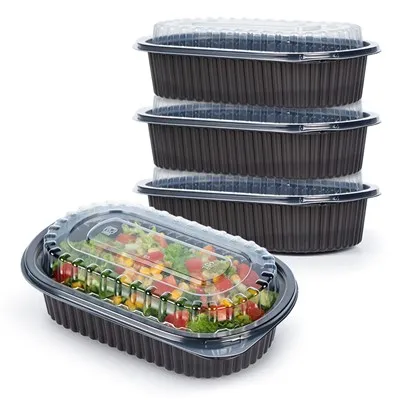
Food delivery services face unique challenges that influence container selection. The need for leak-proof, stackable containers that maintain product quality during transportation often conflicts with aesthetic preferences. Many delivery services compromise by using black bases with clear lids, combining the practical benefits of black containers with the visual advantages of transparency.
5. Performance and Practical Applications
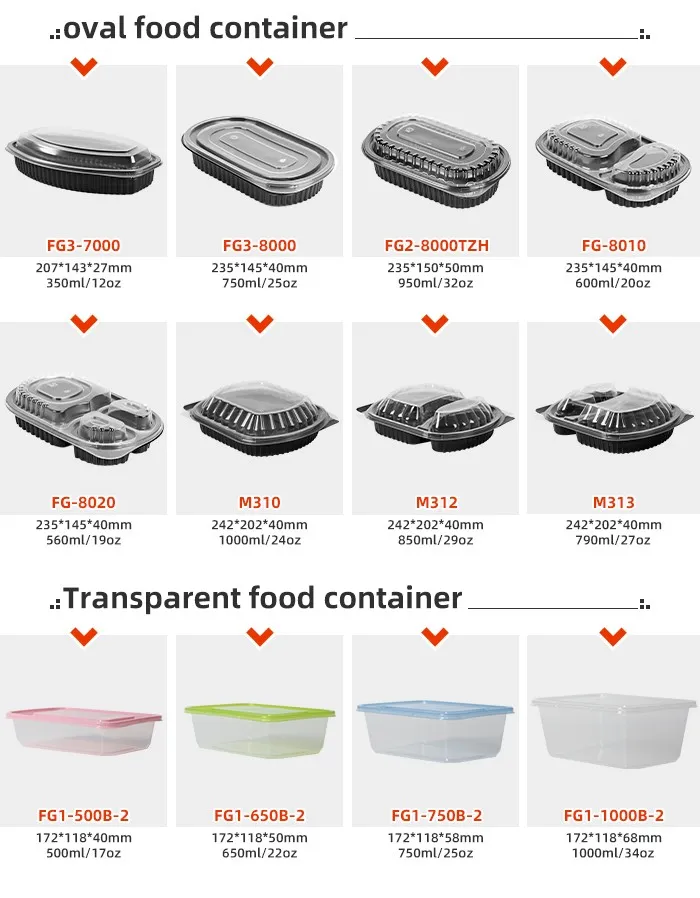
5.1 Temperature Resistance and Food Compatibility
Temperature resistance represents a critical performance characteristic for food containers, directly impacting their suitability for various food applications. PP material containers, whether clear or black, demonstrate exceptional heat resistance with thermal deformation temperatures ranging from 120-140°C. This high heat resistance makes PP containers suitable for hot food applications, including microwave heating and oven use, up to temperatures of 120°C.
The performance difference between clear and black containers under temperature stress is minimal when both use high-quality PP material. However, the presence of colorants can affect thermal conductivity and heat distribution. Black containers, due to their dark color, may absorb more radiant heat, potentially leading to slightly higher surface temperatures during microwave heating. This characteristic requires careful consideration for safety labeling and usage instructions.
PET containers show different temperature profiles, with thermal deformation temperatures of 70-80°C. This lower heat resistance makes PET containers suitable for cold food applications but unsuitable for hot foods or microwave use. The transparency of PET containers makes them particularly popular for cold salads, desserts, and beverage packaging, where heat resistance is not required.
The compatibility with different food types varies significantly between container materials and colors. Clear PP containers excel with oily foods due to their excellent chemical resistance. Black containers may hide oil stains and spills, maintaining a cleaner appearance, but this advantage comes at the cost of reduced visibility for quality inspection. For acidic foods, both clear and black PP containers perform equally well, as PP demonstrates excellent resistance to acids and alkalis.
Temperature cycling performance is another important consideration. Containers that undergo repeated heating and cooling cycles, such as those used in meal prep services, must maintain structural integrity over time. Clear containers excel in this application due to their ability to show signs of degradation or damage, allowing for timely replacement before failure occurs.
5.2 Storage and Transportation Efficiency
Storage and transportation efficiency significantly impact overall operational costs for food businesses. Clear containers offer several advantages in these areas, primarily due to their lighter weight and superior stacking properties. The absence of heavy colorants in clear containers reduces weight by approximately 5-10%, translating into lower transportation costs and reduced fuel consumption.
Stacking efficiency is enhanced by the uniform properties of clear containers. Their consistent dimensions and smooth surfaces allow for more stable stacking, reducing the risk of collapse during storage or transportation. This stability is particularly important for businesses that store large quantities of containers or transport them over long distances.
The transparency of clear food containers revolutionizes inventory management. With traditional opaque containers, businesses must rely on inventory tracking systems or physical counts to manage stock levels. Clear containers enable visual inventory checks, reducing the time and labor required for stock management. This efficiency can save businesses 15-20% in inventory management costs.
Temperature monitoring during transportation benefits from clear containers. The ability to visually inspect product condition during transit helps identify temperature-related issues early, preventing food spoilage and waste. This capability is particularly valuable for perishable foods that require specific temperature control during transport.

5.3 Special Applications and Use Cases
Different food categories require specialized container solutions, and the choice between clear and black containers must consider these specific requirements. Understanding these applications helps businesses make informed decisions about container selection for their particular needs.
Asian cuisine, particularly rice-based dishes and soups, presents unique challenges due to high liquid content and the need for heat retention. Clear food containers with steam vents have proven effective for these applications, allowing heat to escape while maintaining product integrity. The ability to see the food level helps portion control and prevents waste.
Western fast food applications favor clear containers for their ability to showcase burgers, fries, and other visually appealing items. The transparency helps communicate portion size and quality, building customer confidence. Additionally, the lighter weight of clear containers reduces delivery costs for high-volume fast food operations.
Health food and meal prep represent a segment where clear food containers are virtually essential. The ability to display colorful vegetables, proteins, and grains supports health-conscious positioning and helps consumers track their nutritional intake. Meal prep businesses report that clear containers increase customer satisfaction by 30% and reduce returns by 40%.
Beverage packaging presents another specialized application where clear food containers excel. From smoothies and juices to yogurt parfaits and pudding cups, clear containers allow consumers to see the product before purchase. This transparency is particularly important for layered products or those with decorative elements.
The dessert presentation shows interesting dynamics with container color. While clear containers allow for full product visibility, black containers can enhance the perceived sophistication of premium desserts. Some high-end bakeries use a combination approach, with black bases and clear lids, combining visual appeal with practical benefits.
Industry Recommendations
Based on a comprehensive analysis of all factors, we offer the following recommendations for different segments of the food service industry:

- Fast Food and Quick Service Restaurants - Strongly recommend clear containers. The cost savings of 15-20%, combined with improved customer satisfaction and the ability to showcase product quality, provide compelling advantages. The superior stacking and lighter weight also reduce operational costs.
- Casual Dining Establishments - Recommend clear containers for most applications, with selective use of black containers for premium items or special occasions. The transparency helps build customer confidence, while the cost savings support competitive pricing.
- Fine Dining and Premium Restaurants - Consider a hybrid approach using black containers for main courses and clear containers for desserts and presentations where visual appeal is important. This strategy balances sophistication with practical benefits.
- Health Food and Salad Chains - Strongly recommend clear containers. The ability to showcase fresh ingredients and colorful combinations directly supports health-conscious positioning and can increase perceived healthfulness by 25%.
- Food Delivery Services - Recommend clear containers with advanced sealing technology. The transparency helps build customer trust, while improved sealing reduces leakage complaints by 52%. Consider black bases with clear lids for products where spill concealment is important.
- Convenience Stores and Retail Food - Recommend clear containers for maximum product visibility and inventory management efficiency. The ability for customers to see products before purchase increases sales and reduces returns.
- Catering and Event Services - Consider a mix of clear and black containers based on specific applications. Clear containers work well for showcasing appetizers and desserts, while black containers may be preferred for more formal presentations or to maintain a sophisticated appearance.
The choice between clear food containers and black containers should be viewed as part of a broader strategy for business sustainability and growth. By carefully evaluating all factors-including food safety, environmental impact, cost considerations, brand positioning, and consumer preferences-businesses can make informed decisions that support both immediate operational needs and long-term success in an increasingly conscious marketplace.