


Products Description
With the booming popularity of takeout and delivery services across the United States, disposable plastic to-go food containers have become essential tools in the restaurant industry. From bustling fast-casual spots in New York City to cozy diners in the Midwest, restaurant owners and managers often face a tough decision when stocking up: Should they opt for round to-go food containers or square ones?
This choice isn't just about aesthetics-it impacts everything from how much food you can pack in to how easily they stack in a delivery bag. In this in-depth analysis, we'll break down the pros and cons from multiple angles, including capacity utilization, storage convenience, customer experience, brand presentation, environmental factors, cost considerations, and market trends.
With a compound annual growth rate (CAGR) of 4.1%, the takeout container industry is expected to expand from $109.1 billion in 2024 to $163 billion by 2034. Convenient, portable meals and environmentally friendly packaging are the main drivers of this increase in consumer choices. The argument between round and square disposable plastic to-go food containers is still heated despite this expansion.

Capacity Utilization
Square Containers
Volume Efficiency for Solid Foods
Square disposable plastic to-go food containers excel at neatly packing solid products. Their flat bottoms and straight edges allow even distribution of foods like rice, pasta, veggies, or proteins without creating wasted space.
- Stores 8-12% more solid food than round containers of equal nominal capacity
- Eliminates wasted space along curved walls
- Allows for more accurate portion control
- Up to 33% more efficient in space utilization for solids
Ideal for: rice, noodles, set meals, burgers, fries, and other solid food items
Round Containers
Structural Benefits for Liquids
Round disposable plastic to-go food containers offer superior performance for liquids and semi-liquids. Their curved design distributes pressure evenly, making them less prone to leaks or deformation during transport.
- Lid seals more tightly, enhancing leak-proofing
- Even pressure distribution prevents spills
- Better airflow for cooling and preservation
- No weak corners, increasing overall durability
Ideal for: soups, sauces, salads with dressings, smoothies, and poke bowls

Capacity Utilization Comparison
| Aspect | Square Container | Round Container |
|---|---|---|
| Nominal Capacity (750ml) | Holds 8-12% more solids due to straight edges | Better for liquids; even pressure distribution |
| Space Utilization | Up to 33% more efficient in packing solids | Loses space in curves but excels with liquids |
| Best For | Rice, noodles, set meals, solid foods | Soups, salads, desserts, liquid items |
| Durability Impact | Corners may weaken over time | More durable; no weak corners |
Storage and Transportation
Which shape offers more convenience for storage and transportation?
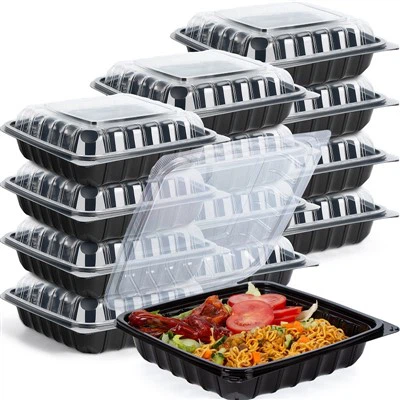
Square Containers: Stacking Efficiency
Square disposable plastic to-go food containers are champions of stacking. Their flat sides allow for tight, stable arrangements with minimal gaps, optimizing space in warehouses, trucks, and even delivery bikes.
▕ 25-33% better space utilization compared to round shapes
▕ Stable stacking prevents shifts during transportation
▕ Integrates seamlessly with automated packaging lines
▕ Reduces transportation costs for large operations

Round Containers: Flexibility in Handling
Round disposable plastic to-go food containers offer unique flexibility in handling and certain storage scenarios, despite their space limitations.
▕ Ergonomic design fits comfortably in the hands for one-handed carrying
▕ Better airflow in coolers speeds up cooling processes
▕ Superior anti-slip qualities during transportation
▕ Easier to seal with liquid film for leak resistance
Impact on Delivery and Logistics
In the delivery ecosystem, combining forms according to food type is essential. Round disposable plastic to-go food containers are better suited to withstand bumpy trips, while square ones balance well in insulated bags. By guaranteeing that food arrives undamaged, a hybrid approach-square for solids, round for liquids-can increase customer satisfaction.
Transportation Efficiency
Industry data shows that effective storage can cut logistical expenses by up to 15%. Square containers minimize wasted space in delivery vehicles.
Temperature Control
Square containers pack tightly in insulated bags, maintaining temperature better, while round containers allow for better airflow when needed.
Customer Satisfaction
Proper shape selection reduces spillage and damage, with studies showing a 20% higher satisfaction rate when using appropriate container shapes.
Customer Experience and Brand Presentation
How shape affects customer perception and brand identity

Square to go Containers
Visual and Psychological Impacts
Square to-go food containers project a modern, professional image that works well for upscale takeout or healthy food restaurants. They communicate efficiency and organization.
Customization Opportunities
Square lids offer ample space for logos, QR codes, or slogans, turning each container into a marketing tool. This aligns well with brands emphasizing structure and precision.
"Research indicates that angular shapes are often associated with higher perceived quality and professionalism."

Round to go Containers
Visual and Psychological Impacts
Round disposable plastic to-go food containers appear warm and friendly, making them ideal for casual settings, home-style dinners, and desserts. They create a more approachable aesthetic.
Customization Opportunities
Round designs work well for stickers or embossed elements, adding a premium touch. They mimic traditional bowl forms, enhancing the connection with homemade or artisanal food.
"Curved shapes are consistently associated with greater liking and perceptions of softness and comfort."
Brand Alignment Examples

Healthy Fast Casual
Square containers align with the organized, fresh aesthetic of salad chains and healthy meal providers

Cafés & Desserts
Round containers enhance the warm, inviting presentation of desserts, soups, and comfort foods

Fine Dining Takeout
Often uses hybrid approaches with custom shapes that reflect brand identity
Environmental and Sustainability Considerations
Comparing the environmental footprint of round and square containers
In today's eco-conscious market, the environmental footprint of disposable plastic to-go food containers matters. While both shapes are typically made from polypropylene or PET, differences emerge in material use and recyclability that impact their overall sustainability.
Round Container Sustainability
+ Often use less plastic due to structural strength
+ No weak points means more even material distribution
- Less efficient packing increases transportation emissions
- Curved design can complicate recycling sorting
Square Container Sustainability
+ Efficient packing reduces transportation emissions
+ Angular shapes are easier to sort in recycling facilities
- May require thicker plastic at corners for durability
- Sharp corners can puncture recycling bags
Sustainable Packaging Market Trends

The foam food container market, which includes round and square containers, is expanding; by 2024, round to-go food containers are expected to reach $10.21 billion. Restaurants are increasingly switching to compostable alternatives in response to consumer demands and regulatory requirements.
Cost Analysis
Balancing upfront and long-term expenses of round vs. square containers.
Cost Factors Comparison
Production Costs
Round to-go food containers are generally cheaper to produce due to simpler molds and more efficient material usage. Square containers require more complex molds, increasing initial production costs.
| Round container production | $0.10-0.15 per unit |
| Square container production cost | $0.13-0.19 per unit |
Shipping and Storage Costs
Square to-go food containers' space efficiency translates to lower shipping and storage costs, often offsetting their higher production costs for medium to large operations.
| Round container shipping efficiency | 70-75% space utilization |
| Square container shipping efficiency | 90-95% space utilization |

Key Cost Findings
√ For small operations (under 5,000 units/month), round containers are typically 10-15% cheaper
√ For medium to large operations, square containers save 10-15% due to shipping efficiency
√ Spillage and damage costs are 20-30% higher with improperly shaped containers
How to Choose the Best Shape ?
Ultimately, the choice between round and square disposable plastic to-go food containers should match your restaurant's menu, operations, and brand identity. There's no one-size-fits-all solution, and many successful restaurants use a strategic combination of both shapes based on their specific needs.
When to Choose Square Containers
- ◇ Your menu features primarily solid, stackable foods
- ◇ You operate at scale with high-volume orders
- ◇ Brand identity emphasizes modernity and efficiency
- ◇ Storage and transportation efficiency are priorities
- ◇ You want maximum space for branding and customization
When to Choose Round Containers
- ◇ Your menu features soups, sauces, or liquid-heavy items
- ◇ You operate a small business or food truck
- ◇ Brand identity emphasizes warmth and approachability
- ◇ You prioritize leak prevention and durability
- ◇ Your customers frequently eat on-the-go
Final Recommendations
Consider a hybrid approach that uses square containers for solid items and round containers for liquids. This strategy maximizes efficiency while minimizing spillage and customer complaints.
Test small batches of both shapes to evaluate how they fit your workflow, and consult with suppliers like Yangrui for customized solutions that balance your specific needs for capacity, storage, and brand presentation.


