There is a spec most buyers never ask for and suppliers rarely volunteer: how many centimeters does one container add to a stack of 100?
That number - the stacking increment per unit - determines how many cases fit on a pallet tier, how many pallet tiers fit in your racking, and ultimately how much warehouse floor space you're committing to every 10,000 pieces you order. For a restaurant chain running three distribution centers, or a foodservice distributor maintaining 60-day inventory, it compounds quickly.
This is not a theoretical concern. A buyer sourcing hinged food containers for a chain of 50 locations might order 200,000 pieces quarterly. A container that stacks 2 cm taller per 100 units than its alternative means 400 cm - roughly 4 meters - of additional stacking height across the same order volume before you even start packing cases. That's the difference between filling a pallet and needing a second one.
1. What "Nesting Ratio" Actually Means
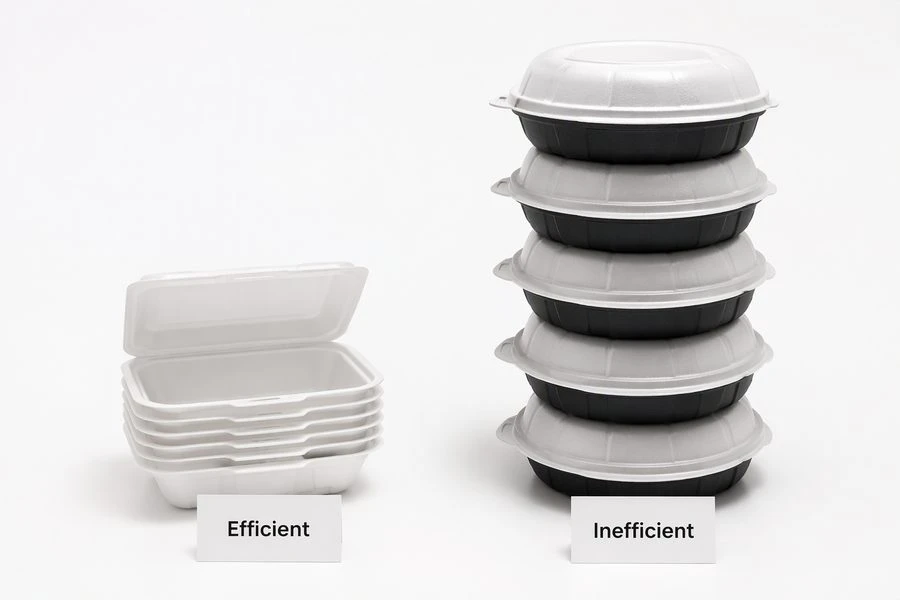
Nesting ratio is the relationship between a container's closed height and the height it adds when stacked inside or on top of an identical unit.
There are two stacking modes for clamshell containers:
Mode A - Closed stacking (lid-down, base-up): Each container sits on top of the previous one's closed lid. The height increment equals the full closed height of one container. This is the worst-case stacking mode.
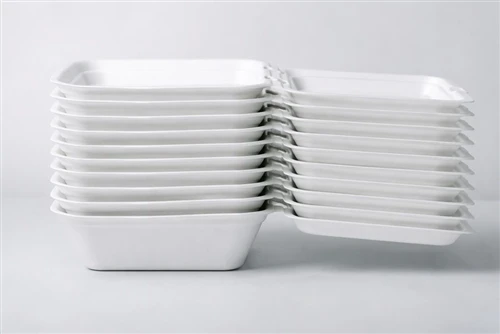
Mode B - Open nesting (base-inside-base): The base of one container sits partially inside the base cavity of the container below, with the lid folded back. The height increment is only the exposed portion - typically 15–30% of full closed height for well-designed thermoformed bases.
| Stacking Mode | Height per 100 units | Use case |
|---|---|---|
| Closed (lid-down) | 100 × full closed height | Retail-ready, pre-filled display |
| Open nested (base-inside-base) | 100 × (rim-to-rim increment) | Storage, restaurant operations, distribution |
For MFPP clamshell containers with a closed height of approximately 7.1 cm (the 781 series at 2.8"), open nesting reduces the per-unit height increment to approximately 1.0–1.5 cm. That means 100 units nest into roughly 15–17 cm of vertical space instead of 71 cm - a 4× improvement in storage density.
2. The Cost Calculation Buyers Skip
Warehouse space in the US foodservice sector runs at roughly $8–$18 per square foot per year for ambient temperature storage (varying significantly by market and facility type). The cost of holding inventory isn't just the carrying cost of the product - it's the floor space the product occupies.
Here's a simplified example using real container dimensions:
Scenario: A foodservice distributor holds 20,000 units of a 9"×9" MFPP hinged container in ambient storage.
| Variable | Low-nesting container | High-nesting container |
|---|---|---|
| Closed height | 7.5 cm | 7.5 cm |
| Nesting increment (open) | 2.5 cm | 1.2 cm |
| Stack height per 100 units | 25 cm | 12 cm |
| Cases (250 pcs/case) | 80 cases | 80 cases |
| Units per pallet tier (1.2m height) | ~480 units | ~1,000 units |
| Pallet positions needed | ~42 | ~20 |
| Relative floor space | 2.1× | 1.0× |
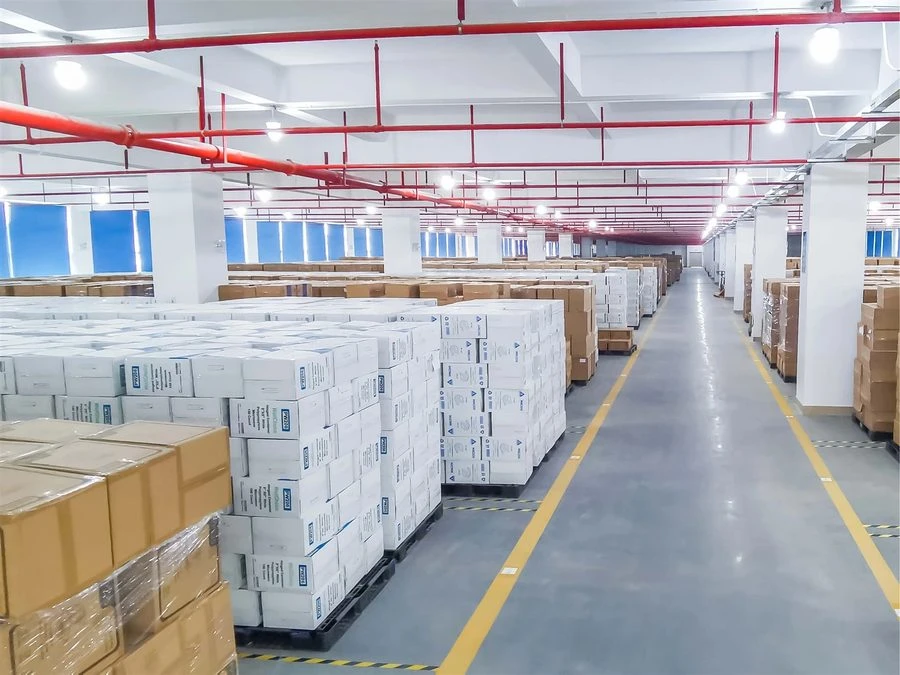
The difference - roughly 22 pallet positions - translates to approximately 55–70 square meters of occupied floor space at a 10-pallet-per-row racking configuration. At $12/sq ft/year, that's $7,000–$9,000 USD per year in warehouse cost attributable to container geometry alone.
This is why sourcing teams at chain restaurant operators ask for stacking spec sheets before they approve a packaging vendor. The product cost per unit tells only part of the story.
3. What Makes a Container Stack Well (and What Doesn't)
Three design factors control nesting efficiency in thermoformed clamshell containers:
Base draft angle
The sidewalls of a thermoformed container base are not perfectly vertical - they taper slightly inward toward the bottom. This taper (called draft angle) is what allows one base to slide partially into another. A larger draft angle means deeper nesting; a steeper (more vertical) sidewall limits how far one unit can nest into the next. Standard thermoforming draft angles run 3–7°; containers designed for high nesting efficiency often use 5–7° on the base sidewalls.
Rim width and stacking ledge
When one container nests into another, it rests on a stacking ledge - the rim or shoulder of the lower container. The width and profile of this ledge determines the nesting depth. A wide flat rim stops the upper container higher; a narrow or angled rim allows deeper nesting. multi-compartment containers with internal dividers have additional ledge points that can limit nesting depth even when the outer rim allows more.
Hinge geometry
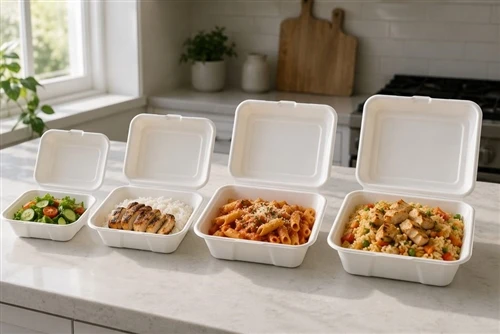
For MFPP to-go boxes with integrated hinges, the hinge protrudes at the rear of the container. When stacking base-inside-base in open nesting mode, the hinge of the upper container may contact the lid of the lower container. Well-designed containers route the hinge below the stacking plane; poorly designed ones require the lid to be folded back further, reducing stability.
Material rigidity
MFPP has a foamed microstructure that provides good rigidity at relatively low weight. This rigidity matters for stacking: a container that flexes under load will not maintain consistent nesting depth in a tall stack. Thin-gauge PP containers without the foamed structure may nest shallower and stack less consistently, particularly under the weight of a full case.
4. How to Evaluate Nesting Efficiency Before You Order
The spec sheet you receive from a container supplier should ideally include two figures: closed height and nesting increment. If only closed height is provided, you can derive a rough nesting estimate from the base draft angle and rim profile, but physical testing on a sample is more reliable.
A practical four-step test you can run on any sample:
Step 1 - Establish baseline closed height. Measure one container, lid closed, with calipers. This is your worst-case per-unit height.
Step 2 - Nest 10 units base-inside-base, lids folded back. Measure the total height of the 10-unit nest.
Step 3 - Subtract one closed height from the total. The result, divided by 9, gives you the per-unit nesting increment. The first container contributes its full closed height; each subsequent one adds only the increment.
Step 4 - Project to 100 and 500 units. Formula: Total stack height = one closed height + (N–1) × nesting increment.
Using sample data for a standard 7.5" square MFPP hinged container:
- Closed height: 7.1 cm
- 10-unit nest height: 15.6 cm
- Nesting increment: (15.6 − 7.1) ÷ 9 = 0.94 cm
- 100-unit nest: 7.1 + (99 × 0.94) = 100.2 cm - just over 1 meter
- 500-unit nest: 7.1 + (499 × 0.94) = 476.1 cm - roughly 4.75 meters
A supplier that cannot provide nesting increment data or refuses to send samples for pre-order testing is worth pausing on. Stacking behavior is verifiable before commitment; it shouldn't be a post-delivery surprise.
5. Comparing Container Types: Nesting Efficiency by Design
Different container formats have inherently different nesting characteristics. Here's how common types compare:
| Container Type | Typical Nesting Increment | Notes |
|---|---|---|
| Square MFPP hinged (1-compartment) | 0.9–1.2 cm | Best nesting efficiency in thermoformed clamshells |
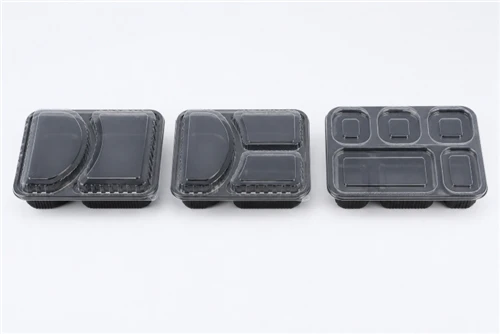
| Square MFPP hinged (3-compartment) | 1.4–2.0 cm | Dividers create additional stacking contact points |
| Clear PP hinged (1-compartment) | 1.0–1.5 cm | Similar to MFPP; stiffer material aids consistency |
| Oval MFPP hinged (dome lid) | 2.5–4.0 cm | Dome lids do not allow true base-inside-base nesting |
| Round PP bowl with flat lid | 0.8–1.2 cm | Lids and bases nest separately; evaluate each |
| Rectangular PP (snap-lock lid) | 1.8–3.5 cm | Lid is separate; base nests well, lid nesting varies |
The gap between single-compartment and three-compartment containers is worth noting specifically. For buyers switching from a 1-compartment format to a multi-compartment container with the same outer dimensions, nesting efficiency typically drops 40–70%. If your storage situation is tight, that's a spec worth evaluating before the product decision is finalized.
6. Practical Implications for Ordering and Receiving
Case pack quantity affects density too. Most MFPP containers ship 125–250 units per carton. Higher units per carton means fewer cartons to handle and stack, but it also means heavier individual cartons. At 250 pcs per carton for a 9"×9" container, each carton weighs approximately 3–4 kg - well within manual handling range, but worth checking for operations with one-person pick operations.
Pallet configuration should be agreed at order time. A supplier shipping 48 cartons/pallet vs. 60 cartons/pallet at the same container spec will deliver meaningfully different inventory per inbound shipment. If your warehouse runs cycle counts by pallet position rather than unit count, pallet configuration affects your per-SKU count accuracy.
Reception space for 20,000-piece deliveries. At 250 pcs/carton and 48 cartons/pallet, 20,000 pieces arrive on roughly 2 pallets. At 24 cartons/pallet (a tighter case-pack scenario), that's 4 pallets. The difference between 2 and 4 pallet positions at receiving matters for facilities with limited dock apron space or narrow staging areas.
Pre-Order Stackability Checklist
Before confirming any container spec in a bulk order, verify:
☑ Request nesting increment data - not just closed height. Ask the supplier for the per-unit nesting height when stacking base-inside-base in open mode.
☑ Request sample for physical nesting test - run the 10-unit test and project to your actual order quantity.
☑ Confirm compartment count impact - if comparing a 1-compartment and 3-compartment option of the same outer size, factor the 40–70% nesting reduction into your storage plan.
☑ Confirm carton quantity and pallet configuration - cases per pallet and units per case both affect your receiving dock throughput and storage density.
☑ Check hinge interference at high stack counts - for open-nested hinged containers in stacks above 20 units, verify the hinge does not cause the stack to lean or topple. This is particularly relevant for FIFO pick operations where full 50+ unit sleeves are moved together.
☑ Measure your storage space before ordering - maximum stack height under your lowest rack beam, pallet position dimensions, and aisle width for pallet mover access all need to be matched against the supplier's pallet configuration before the order is confirmed.
Frequently Asked Questions
What is a good nesting increment for a PP clamshell container?
For single-compartment thermoformed hinged containers in the 7"–9" range, a nesting increment of 0.9–1.4 cm per unit is considered good efficiency. Anything above 2.0 cm suggests a design that doesn't nest well, and you should evaluate whether the closed-stacking mode is more practical for your operation.
Do dome-lid containers nest as efficiently as flat-lid designs?
No. Dome-lid containers - including oval or round containers with raised arch lids - cannot nest base-inside-base in the same way as flat-lid clamshells. The dome prevents full nesting. For high-volume storage, flat-lid or low-profile hinged designs have a clear storage efficiency advantage.
Can I mix container types on the same pallet?
Technically yes, but it creates problems for warehouse operations - mixed pallet configurations complicate cycle counting, pick accuracy, and FIFO rotation. Most distributor receiving operations prefer single-SKU pallets. Confirm this expectation with your supplier and your 3PL before the first shipment.
Does material (PP vs. MFPP) affect nesting behavior?
The nesting increment is primarily determined by container geometry - draft angle, rim profile, and hinge design - rather than material type. MFPP's higher rigidity may provide more consistent nesting depth in tall stacks compared to thinner-gauge solid PP, but the per-unit increment for comparable geometries is similar.
How many containers fit in a standard 20-foot shipping container?
Container quantities vary significantly based on carton dimensions, pallet configuration, and loading efficiency. For 9"×9" MFPP hinged containers at 250 pcs/carton with standard pallet configuration, a 20' FCL typically holds 80,000–120,000 pieces. Your supplier should provide a packing list with confirmed piece count per container for each order.
CTA
Stackability data should be part of your packaging evaluation, not an afterthought. We provide nesting increment data and pre-order samples on all standard container formats. Contact us with your required format, compartment count, and storage situation, and we'll confirm the stacking spec before you commit to a production run.
Request specifications and samples →