1. Basic Information on Plastic To-Go Disposable Container Types and Materials
1.1 Classification of Common Plastic To-Go Disposable Container Types
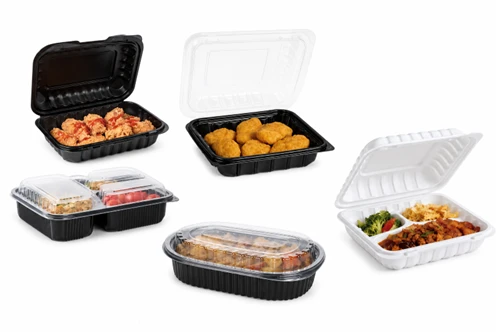
In daily life, plastic to-go disposable containers are mainly divided into three categories based on their usage scenarios and functions: disposable takeout containers, reusable containers, and microwave-safe containers.
Disposable takeout containers
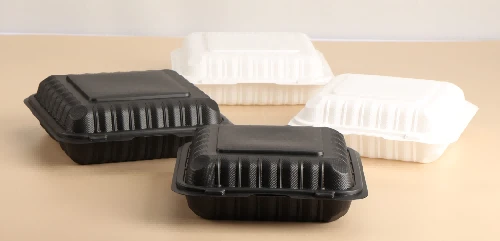
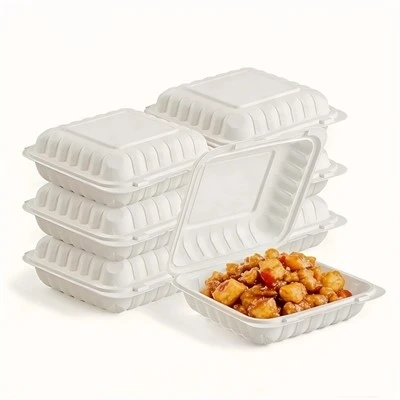
 The mainstream packaging in the takeout industry, mostly made of polystyrene (PS), polypropylene (PP), or polyethylene terephthalate (PET), is designed for single use and then discarded. According to data from a 2025 national market supervision and administration inspection, the failure rate is approximately 5%-8%, with problems mainly concentrated in excessive fluorescent substances, unqualified evaporation residue, and substandard load-bearing performance.
Reusable containers
Often made of polypropylene (PP) or polycarbonate (PC), with high mechanical strength and chemical stability, requiring durability testing to verify long-term performance. A mandatory requirement is planned for 2025, suggesting that these products should be used no more than 500 times.
Microwave-safe containers
Require special heat resistance, needing to withstand high temperatures without releasing harmful substances. They are usually marked with "microwave-safe" and a temperature range (e.g., "-20℃~120℃").
1.2 Characteristics and Safety Standards of Various To-Go Disposable Container Materials
Different plastic to go disposable container materials have significantly different characteristics, which are key factors in determining their quality:
| Material | Recycling Symbol | Characteristics | Heat Resistance | Applicable Scenarios | Safety Tips |
|---|---|---|---|---|---|
| Polystyrene (PS) | #6 | Good transparency, hard and brittle texture, low cost | 70-90℃ | Instant noodle containers, fast-to-go containers | Low-quality foamed PS may release styrene monomer above 70℃; easily crushed |
| Polypropylene (PP) | #5 | Chemically stable, not easy to release harmful substances | Above 100℃, melting point 167℃ | Reusable, microwaveable to-go containers | Only plastic is safe for the microwave; reusable after cleaning |
| Polyethylene Terephthalate (PET) | #1 | Poor heat resistance | Approximately 60℃ | Mineral water bottles, beverage bottles, disposable containers | Designed for single use; deforms at high temperatures, not reusable |
| Polycarbonate (PC) | - | Excellent transparency, high strength, high impact strength | 120℃ | Reusable to-go disposable containers | May contain bisphenol A (BPA), which interferes with the endocrine system |
| High-Density Polyethylene (HDPE) | #2 | - | Approximately 110℃ | Food bags, detergent bottles, and some to-go containers | - |
| Low-Density Polyethylene (LDPE) | #4 | - | Approximately 80℃ | Cling film, plastic bags, and refrigerated to-go containers | Only for refrigerated food, not for microwave heating |
| Polyvinyl Chloride (PVC) | #3 | Contains a large amount of plasticizers | Not recommended for food storage | Plastic boxes, toys | Harmful to human health, not recommended for food storage |


1.3 2026 Latest National Standards Requirements
In 2026, my country's plastic to go disposable container industry standards will be updated, imposing stricter requirements on materials, labeling, and performance:
GB/T 18006.1-2025
Published on August 29, 2025, and implemented on March 1, 2026, this standard completely replaces the "non-degradable disposable tableware" content in the old standard, strengthening requirements for physical and chemical properties and hygiene indicators, and clarifying material purity, additive use, and labeling specifications.
GB 4806.7-2023
This standard merges and revises two original standards, implemented on September 6, 2024, revising the scope, terminology definitions, and technical requirements, and strictly limiting chemical substance migration.
Other new regulations
 For the first time, "design red lines" are established for mainstream plastic containers such as PET and HDPE, requiring labels to be compatible with hot washing processes, ink to use biodegradable formulas, containers to avoid complex structures, and recycling symbols to be marked. These regulations will be implemented on February 1, 2026; plastic products for food contact must be labeled with "for food contact," "temperature range of use," and "whether microwaveable." Reusable products are recommended to be used no more than 500 times and must pass multiple migration tests.
2. Methods for Identifying Inferior Plastic To-Go Disposable Containers
2.1 Identification of Material Labels and Certification Information
Checking material labels and certification information is the first step in identification. Regular to-go disposable containers must be labeled with complete information:
Recycling symbol
The numbers 1-7 inside the triangular recycling symbol correspond to different materials (No. 1 PET, No. 2 HDPE, No. 3 PVC, No. 4 LDPE, No. 5 PP, No. 6 PS, No. 7 PC or others), facilitating quick material identification.
Labeling completeness
According to GB/T 16288 standard, the marking system includes identification, plastic numerical code, graphic symbols, functional descriptions, and supplementary explanations. Regular to-go disposable containers must clearly indicate the material name and number (e.g., "PP 5"). Lack of labeling or unclear labeling often indicates inferior products.
Production license and certification
Plastic products for food contact must obtain a production license (QS mark) and display the license number. The words "for food contact" are crucial for distinguishing food-grade from non-food-grade products.
Special Function Marking
Microwave-safe to-go disposable containers must be marked "Microwave Safe" and indicate the temperature range (e.g., -20℃~120℃); products containing recycled plastic must be marked with a warning: "Contains recycled plastic, not for food packaging."

2.2 Quick Observation Method for Appearance Quality
Appearance is a direct indicator, and problems can be detected through visual observation and touch:
Color and Transparency
 High-quality to-go disposable containers have uniform color, clear contours, a flat and smooth opening without dents or wrinkles, no burrs or rough edges, and a clean, transparent body with uniform thickness, free from impurities, bubbles, watermarks, and fish-eye defects. It is recommended to choose transparent and colorless containers to avoid the risk of discoloration in colored containers. When observing, view under natural light or specified illumination at a distance of 30-50cm with normal vision. Excessively dark colors, significant color differences, or abnormal transparency may indicate the presence of inferior raw materials or excessive chemical substances.
Surface Smoothness
High-quality to-go disposable containers have a smooth and flat surface, free from scratches, wrinkles, peeling, cracks, or perforations, and free from oil stains, dust, or mold. When touched, if the surface is rough, granular, or has bubbles or dents, or if the inner wall is rough and astringent, or has irregular, small black spots when viewed against the light, these are all characteristics of inferior quality.
Thickness Distribution
High-quality to-go disposable containers have uniform thickness, with the bottom, walls, and lid being basically the same thickness. Gently pinch different parts to feel the thickness; if any part is too thin or too thick, it indicates poor production quality control. Although a professional thickness gauge is not used, a preliminary judgment can be made based on feel and visual comparison.
Deformation and Defects
High-quality to-go disposable containers sit stably on a flat surface without warping or deformation, and the edges are neat without cracks or notches. Significant deformation or cracks not only affect use but also pose safety hazards.
2.3 Simple Physical Performance Testing Method
Physical performance tests can be completed using everyday items without complex instruments:
Heat Resistance Test
- Warm Water Immersion: Fill with 60-70℃ warm water and observe for 1-2 minutes. High-quality containers will not deform or emit any odor. If softening, deformation, leakage, or a pungent odor occurs, the heat resistance is poor, and it is not suitable for holding hot food.
- Microwave Test: (only for microwave-safe to-go disposable containers) Pour a small amount of water, heat in a 500- 600W microwave for 1-2 minutes, check for deformation or unusual odor. The test time should not be too long.
Physical Strength Test
Compressive Strength
Apply even pressure to the top; no deformation or breaking (standard ≥500N, deformation ≤3mm)
Drop Resistance
Drop from ~1 meter; impact-resistant and not easily break (standard ≥3 drops from 1.2m)
Flexibility
Gently bend the edge; flexible and returns to its original shape without breaking
Seal Test
Fill with water, invert for 1-2 minutes; no leakage (check sealing ring for intactness)
Load-bearing Capacity
Place heavy objects inside, observe for 10-15 minutes; no deformation or damage (standard ≥500N)

2.4 Preliminary Assessment of Chemical Safety
Ordinary consumers can make a preliminary assessment of chemical safety using simple methods:
Odor Test
Open the new to-go disposable container packaging and gently waft the air towards your nose from a distance of 5-10 centimeters. A high-quality container will have no odor. If there is a pungent plastic smell, chemical smell, or other unusual odor, it may contain harmful chemical substances; if a used container still has an odor after washing, the material may be continuously releasing harmful substances.
Soaking Test
Cold Water Soak: After rinsing with clean water, fill the container with clean water at room temperature (20-25°C) and soak for 2-3 hours. If the water has an unusual odor, changes color, or becomes cloudy, the container may be releasing harmful substances.
Hot water immersion: Fill with 60-70℃ warm water and soak for 10-15 minutes. High temperatures make it easier to detect the release of harmful substances. If the water appears abnormal, the to-go disposable container has poor heat resistance and chemical stability, and it is not recommended to continue using the container after the test.
Special substance testing
 Paraffin wax detection: Touch the inner wall of the to-go disposable container. If there is a thick, waxy feeling, the quality is substandard. Low-quality to-go disposable containers may be coated with paraffin wax to increase gloss, releasing harmful substances during use.
- Fluorescent agent detection: Shine a UV light on the container in the dark. If there is a significant fluorescent reaction, it may contain fluorescent agents. Fluorescent substances are strictly prohibited in plastic products used for food contact.
- Plasticizer assessment: If the to-go disposable container leaks quickly or shows oil stains after contact with oily foods, it may contain excessive plasticizers. Plasticizers will migrate into food more quickly when in contact with oil.
3. Specific Identification Points for Different Types of To-Go Disposable Containers
3.1 Identification Points for Disposable Takeaway Containers
Disposable takeaway containers are frequently used. A 2025 survey showed that among the reasons for non-compliance, substandard physical performance (temperature resistance, load-bearing capacity) accounted for 40%, excessive chemical additives (fluorescent agents, plasticizers) accounted for 35%, and non-standard labeling accounted for 25%. Identification should focus on:
Material and Labeling
Common materials include PP (No. 5, resistant to 130°C, suitable for hot food), PS (No. 6, resistant to 70-90°C, easily deforms and releases styrene when exposed to hot oil), and PET (No. 1, resistant to around 60°C, only suitable for cold/room temperature food). The material of both the container body and lid should be checked. Some vendors use non-heat-resistant PET for the lid, making it unsuitable for microwave use.
Appearance Quality
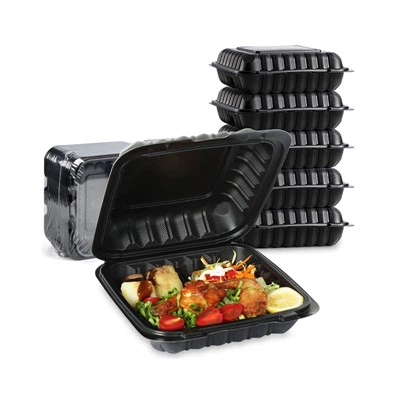
High-quality containers have good transparency, allowing the food inside to be clearly visible, with a smooth surface free of scratches, bubbles, and impurities, and uniform thickness (especially the bottom and walls). The edges should be neat without burrs or notches; poor transparency, rough surface, and uneven thickness indicate inferior quality.
Physical Performance
For heat resistance testing, fill with 60-70°C hot water; there should be no deformation or odor after 1-2 minutes. For load-bearing capacity testing, fill with approximately 500 grams of weight; there should be no deformation or damage after 10-15 minutes. For containers requiring sealing, there should be no leakage after being inverted for 1-2 minutes.
Chemical Safety
There should be no pungent odor upon opening the packaging. Soak in 60°C warm water for 10-15 minutes; if the water shows no abnormalities, the container is relatively safe. Note that plastic to-go disposable containers heated above 65°C may release microplastics and perfluorinated compounds; caution is advised when using them for hot food.


3.2 Identification Points for Reusable To-Go Disposable Containers
Reusable to-go disposable containers need to withstand repeated use, cleaning, and high temperatures, requiring higher quality standards:
Material and Labeling
Prioritize PP material (No. 5, heat-resistant above 100°C, non-toxic and odorless, microwaveable, impact-resistant, and corrosion-resistant); for PC material, choose those labeled "BPA-free" and "food grade". The labeling must be clear and complete, including the material name and number, the words "for food contact," and instructions for reuse. In 2025, it is planned to mandate a suggested number of uses ≤ 500 times, requiring multiple migration tests. When purchasing, choose products from reputable brands.
Durability
In terms of mechanical strength, the edges should not crack when bent. The standard requires a bending strength of 90° bending ≥ 1000 times without breakage (with a load of 50N); no breakage after free fall from a height of 1 meter (the standard requires resistance to impact from a certain height); no obvious scratches when lightly scratched with a fingernail, preventing bacterial growth in scratched areas.
Washability
When soaked in a 1% detergent solution, the surface should not degrade or dissolve (consumers can observe after short-term soaking); if claimed to be dishwasher-safe, it must have the corresponding label and be able to withstand high-temperature and high-pressure cleaning without deformation or residue.
Aging resistance
High-quality containers should not easily yellow, discolor, or lose their luster under normal use. After a period of use, there should be no significant decrease in heat resistance and physical strength. PP containers have a lifespan of 3-5 years, PC containers (BPA-free) about 3 years; it is recommended to replace them every 3 years, as frequent heating may lead to the release of harmful substances.


Special functions
Insulated lunch boxes can keep food warm for several hours after being filled with hot water and the lid is closed; sealed lunch boxes have a complete and elastic sealing ring, preventing leakage when inverted; microwaveable containers have clear markings, and heating time should not exceed 3-4 minutes.
3.3 Key Points for Identifying Microwaveable Lunch Boxes
Microwaveable lunch boxes need to withstand high temperatures and pressure changes, requiring extremely high safety standards:
Material and labeling
 Only No. 5 PP material is safe for microwaving, with a heat resistance of 100-140℃, able to withstand the steam temperature and heat conduction during heating. The labeling must include "microwave safe" and temperature range (e.g., -20℃~120℃), and the PP material (No. 5) label. The box body and lid must be checked separately to avoid using non-heat-resistant PET (resistant to 70℃) for the lid.
Heat Resistance Test
Heated in a 120℃ oven for 30 minutes, no deformation, melting, or odor (standard requirement: heat resistance ≥120℃); after freezing at -20℃ for 4 hours, immediately placed in 100℃ boiling water, cycled 5 times without deformation or cracking; filled with 2/3 volume of water, heated in a microwave oven on high heat for 3-4 minutes, no deformation, leakage, or odor, and the surface temperature of the box did not exceed 80℃ after heating; filled with a small amount of water and covered with a lid (not sealed), microwaved for 1-2 minutes, able to withstand pressure changes without damage.
Safety Assessment
No odor after microwave heating, avoiding the release of harmful substances; choose reliable quality boxes to reduce microplastic release (heating above 65℃ may release microplastics); high-quality boxes can withstand ≥50 microwave heating cycles without performance degradation.
Usage Precautions
 Heating time should not exceed 3-4 minutes (PP boxes heated for more than 3 minutes may release microplastics, it is recommended to transfer to glass/ceramic containers for heating); do not heat high-oil, high-sugar, or acidic foods; the lid should be open or not sealed during heating, and the non-heat-resistant lid should be removed; regularly check the box for cracks and deformation, and replace it promptly if there are any problems.
4. Comprehensive Identification Process and Practical Suggestions
4.1 "Look, Smell, Touch, and Test" Quick Identification Process
The "Look, Smell, Touch, and Test" process is simple and easy to operate, and can efficiently identify:
Look (Appearance and Labeling)
Check the recycling symbol and material number (such as "No. 5 PP"), and the words "for food contact"; no label or blurred label indicates inferior quality; check for uniform color, transparency without impurities or bubbles, uniform thickness, no deformation or cracks, and neat edges; check for special markings (microwave-safe boxes require "microwaveable" and temperature indication).
Smell (Odor)
Open the new box packaging and smell it; no odor indicates high quality, while a pungent plastic smell, chemical smell, or other abnormal odors indicate excessive additives or inferior raw materials; if there is still an odor after washing, the material may continuously release harmful substances; if the odor is pungent and causes discomfort, stop using it immediately.


Three-Point Inspection (Texture and Strength)
Feel the surface – it should be smooth and even, without a grainy or waxy feel; pinch different parts – the thickness should be uniform with good hardness and toughness, not too soft or thin; feel the edges and joints – they should be smooth without burrs, cracks, or looseness.
Four-Point Testing (Simple Tests)
 Heat resistance – fill with 60-70℃ warm water for 1-2 minutes, no deformation or odor; physical strength – apply pressure to the top without deformation, no breakage after a 1-meter drop; sealing (for sealed containers) – fill with water and invert for 1-2 minutes without leakage; immersion test – fill with 60℃ warm water for 10-15 minutes, the water should remain odorless, colorless, and clear.
4.2 Daily Purchase and Usage Suggestions
Purchase Suggestions
- Choose reputable channels (department stores, supermarkets, qualified online stores), and avoid street vendors.
- Choose well-known brands with stricter quality control.
- Pay attention to price – qualified containers are ≥0.13 yuan, those ≤0.1 yuan are mostly inferior;
- Check the production date and expiration date, and choose fresh products.
- If possible, request a quality inspection report that meets national standards.
Usage Suggestions
- Use according to product instructions, use different materials as required;
- Use appropriately – disposable containers should not be reused, reusable containers should not be misused;
- Replace regularly (PP containers every 3 years, PC containers (BPA-free) every 3 years);
- Wash with mild detergent and a soft sponge or cloth, avoiding steel wool;
- Store in a dry and ventilated place, away from direct sunlight and heavy pressure.
Health Protection
- Reduce frequency of use, prioritize glass and ceramic tableware;
- Do not hold high-fat, high-sugar, or acidic foods;
- Cool food to below 60℃ before putting it in the container;
- Do not store food for long periods, especially in high-temperature environments.
- Choose reliable to-go disposable containers for children, avoiding products containing BPA.
4.3 Special Situation Handling Guide
Takeaway to-go disposable container Handling
When receiving takeaway food, first check the container for damage, leakage, or odor; if there are problems, contact the vendor; determine safety based on markings, transfer to a safe container as soon as possible if there are no markings; observe the container's performance at high temperatures, be cautious if there is deformation or odor; do not reheat, transfer to a microwave-safe container if heating is necessary.

Travel and Outdoor Use
Choose reusable containers made of PP material with good sealing properties; bring disinfectant wipes to clean the containers; avoid heating at high temperatures, and only use microwave-safe containers with proper timing; store them properly to avoid damage from squeezing or impact.

Special Considerations for Vulnerable Groups
Pregnant women, children, people with allergies, and the elderly should prioritize PP material, BPA-free, and reliable quality containers. Those with allergies should test the containers to avoid adverse reactions.
Emergency Situations
If you must use an unmarked container, test it by soaking it in 60℃ warm water; use it for a short period only; closely observe during use and stop immediately if any abnormalities occur; clean the container after use and observe your body's reaction, seeking medical attention if necessary.
Environmental Protection and Recycling
Use reusable containers more often to reduce single-use plastics; recycle different materials according to waste classification; choose biodegradable containers made of paper or plant fibers; maximize the lifespan of reusable containers to avoid premature disposal.
In summary, identifying inferior plastic to-go disposable containers requires considering material, appearance, and performance.