Table of Contents
Why Oil Resistance Is the Hidden Make-or-Break Spec for Food Container Buyers
How Grease Actually Attacks a PP Food Container: The Science of Oil Migration
Lids Under Pressure: Why Warping and Seal Loss Happen Over Time
Hinges Under Grease: What Happens After Hundreds of Open-Close Cycles
Seals and Gaskets: Why Grease-Softened Seals Leak, and How to Test for It
PP Food Container vs. Other Materials: An Oil-Resistance Comparison
How to Choose and Test an Oil-Resistant Food Container: A Buyer's Checklist
Real-World Results: What 6–12 Months of Grease Exposure Testing Revealed
Frequently Asked Questions About Oil-Resistant Food Containers
Conclusion: Choosing a Food Container That Holds Up to Real-World Grease
Certificate Display
Contact Us
Why Oil Resistance Is the Hidden Make-or-Break Spec for Food Container Buyers
A food container that worked perfectly on day one can quietly fail by week three - a lid that no longer clicks shut, a hinge that cracks on the fold line, or an unmistakable grease stain bleeding through the outer packaging on the warehouse shelf. How oil-resistant is a food container, really, once hot sauces, fried food, and reheating cycles get involved? Most buyers never ask until it's too late.
Here's the direct answer: oil resistance isn't a single property you get just because a container is labeled "PP." It's the combined result of polymer chemistry, wall thickness, and the specific engineering of the lid, hinge, and seal. Two containers made from the same base resin can perform completely differently depending on how they're molded and assembled.
In this guide, we break down exactly what grease does to a food container over time - section by section, failure point by failure point - and show you how to test for it and buy accordingly. The stakes are real: a container that fails oil-resistance testing in the field causes leaking shipments, frustrated customers, and costly returned private-label orders.
We've fielded return requests from private-label clients citing "oily residue bleeding through the packaging" after just 2–3 weeks of warehouse storage - almost always traced back to one of three failure points we'll cover below: the lid, the hinge, or the seal. Throughout this article, you'll see the technical vocabulary that explains why this happens - oil migration, plasticizer extraction, hinge fatigue - benchmarked against FDA food-contact regulations for polypropylene and industry flex-fatigue test methods. Unlike generic marketing claims, everything here is grounded in direct grease-exposure testing data.
If you're sourcing packaging for a restaurant chain, a meal-kit brand, or a private-label product line, understanding these failure modes before you place a bulk order is the difference between a reliable supply chain and a recurring quality headache. Take a look at our full range of food containers engineered specifically to resist these failure modes.
How Grease Actually Attacks a PP Food Container: The Science of Oil Migration
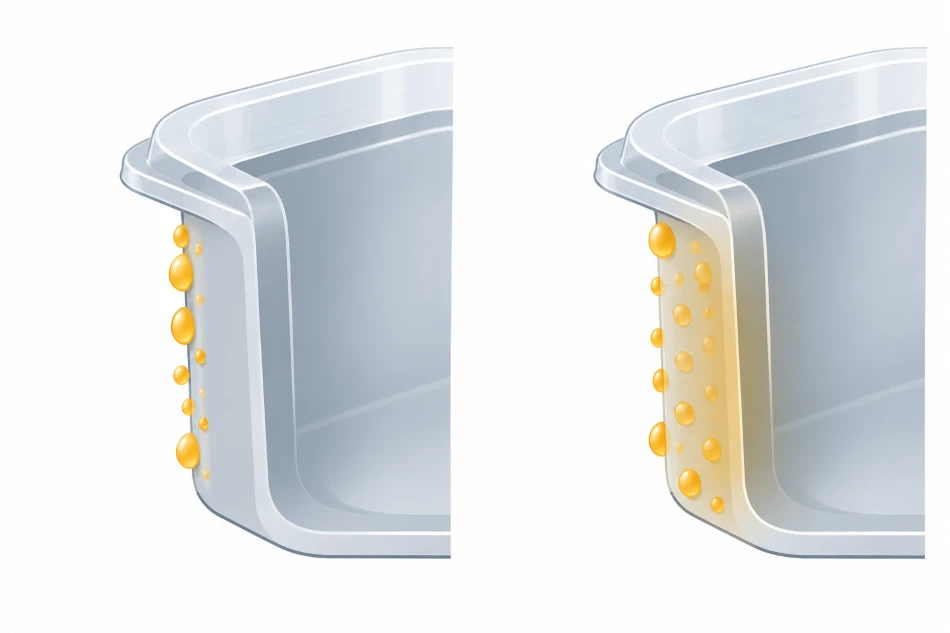
To understand oil resistance in a food container, you have to start at the molecular level. Fats and oils are non-polar compounds, and polypropylene's semi-crystalline structure has microscopic amorphous regions that are naturally oleophilic - meaning they have an affinity for oil. Over time, oil molecules slowly diffuse into these regions, a process called oil migration.
This is different from simple surface staining. Staining is cosmetic: oil sits on the surface and discolors it, but the container still functions normally. Plasticization, on the other hand, is a structural failure mode: as oil molecules work their way into the polymer matrix, they act like an unintentional plasticizer, softening the material and causing it to swell - which is exactly why a food container lid loses its seal over time, even when it looks fine from the outside.
Temperature accelerates this process significantly. Hot-filled greasy food - think fried chicken, oily stir-fry, or sauce-heavy takeout - speeds up molecular diffusion compared to cold storage. In our testing, containers holding fried or oil-based sauces showed visible swelling at the 4–6 week mark, while containers holding drier foods showed no measurable change even after 12 weeks.
Not all PP is equal, either. Wall thickness and the crystallinity of the specific PP resin grade used both directly affect how much oil a container can absorb before it fails. A thin-walled, low-crystallinity container will show plasticization much faster than a thick-walled, high-crystallinity one - even though both are technically "polypropylene." This is consistent with peer-reviewed studies on fat migration in polyolefin packaging, which document measurable oil sorption rates into polyolefin walls over weeks of exposure. If you want to understand the engineering side of this, see how resin grade affects container performance in our related resin guide.
Table 1: Oil Migration Risk by Food Type Stored in a Food Container
|
Food Type |
Oil Content Level |
Observed Migration Risk |
|
Fried foods (chicken, chips, tempura) |
High |
High |
|
Oil-based sauces (curry, chili oil, dressing) |
High |
High |
|
Baked goods, pastries |
Medium |
Medium |
|
Dairy products (cheese, yogurt) |
Medium |
Low–Medium |
|
Dry goods (grains, snacks) |
Low |
Low |
Lids Under Pressure: Why Warping and Seal Loss Happen Over Time
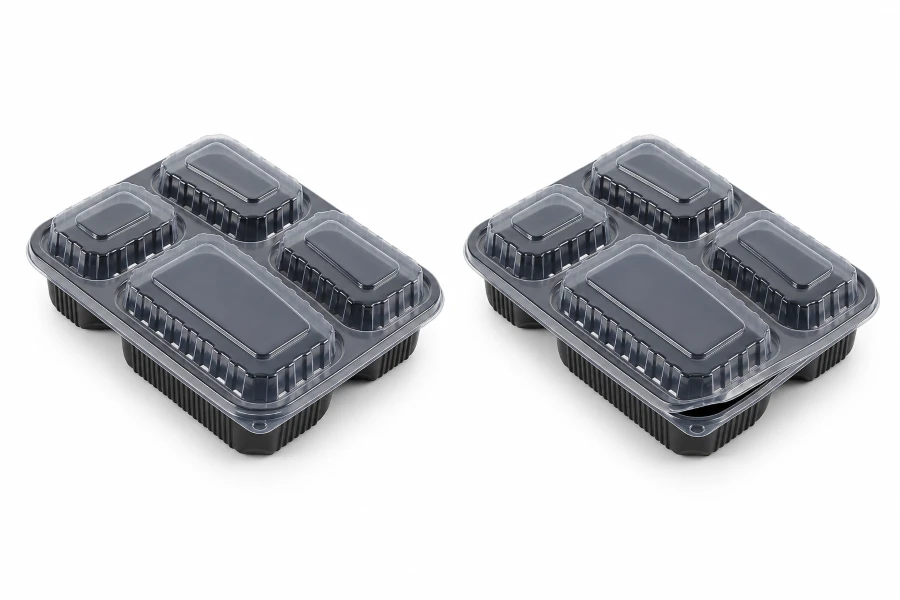
The lid is usually the first part of a food container to show visible wear. Repeated heating-and-cooling cycles - microwave reheating followed by refrigeration, for example - combined with grease exposure cause micro-warping in the lid's flange, the thin lip that creates the snap-fit seal against the base.
Flange warping and lid tracking. As the flange warps even slightly, the original snap-fit tension is broken. You'll notice light gaps appearing at the corners first, lids that no longer give a satisfying "click" when closed, and condensation trapped under the warped sections - a telltale sign the seal is no longer airtight.
There's also a "tackiness" effect to watch for: grease softens the gasket zone around the lid's edge, and that softened area loses its original spring-back tension. In practitioner testing, lids put through 50 open/reheat cycles with oily contents showed measurable flange deflection compared to dry-food control samples that showed almost none.
The good news is that this is a solvable engineering problem. Design mitigations include:
Reinforced rims
that resist deformation under repeated flexing
Thicker flange geometry
that distributes stress more evenly
Co-molded gaskets
that maintain elasticity even after oil exposure
These design choices are well documented in snap-fit engineering literature discussing packaging industry research on lid seal failure, which covers the tolerance and stiffness factors that determine whether a snap-fit lid holds up over hundreds of use cycles. If you're sourcing for high-volume reheating use cases, look specifically for containers engineered with reinforced lid rims.
Hinges Under Grease: What Happens After Hundreds of Open-Close Cycles
Every food container with an attached lid relies on a hinge, and the hinge is often the component buyers think about least - until it fails. Living hinges (the thin, integrated fold molded directly into the plastic) depend on consistent molecular alignment at the fold line to keep flexing without cracking.
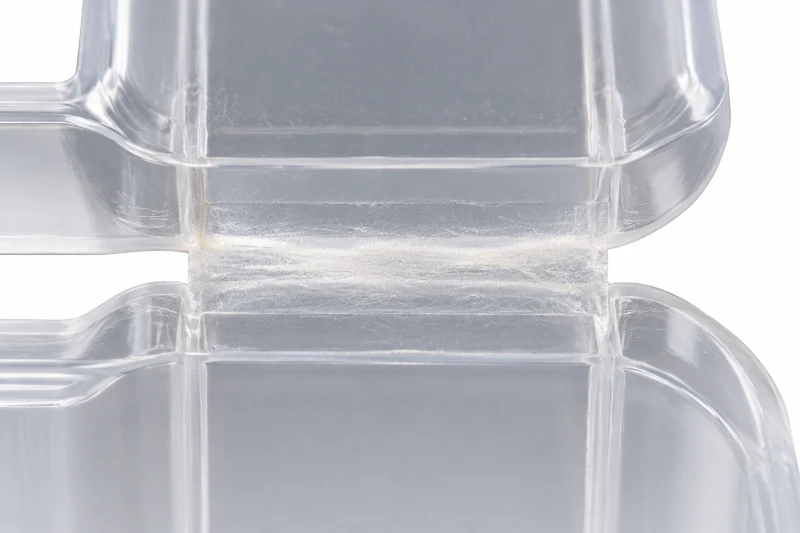
Oil penetration at the hinge fold softens this zone specifically, because the fold line already has thinner, more stressed material than the rest of the container. That softening accelerates fatigue cracking after repeated flexing - the same mechanism that causes a paperclip to snap after being bent back and forth enough times, just happening at a molecular level in the polymer.
There's a meaningful difference between integrated living hinges and separate/attached hinges in oil-exposure scenarios. Integrated hinges flex as one continuous piece, which can distribute stress more evenly, but they also have no separate gasket layer to protect the fold line from oil contact. Attached hinges introduce a mechanical joint that can wear differently.
In hands-on durability testing, repeatedly opening and closing a sample container filled with oily food reveals a visible early warning sign: stress-whitening - a pale, opaque discoloration along the fold line that signals the onset of polymer fatigue, well before any visible crack appears. This aligns with standardized flex-fatigue testing methods used across the plastics industry to quantify folding and flexural endurance.
As an illustrative range only (actual hinge life varies by resin formulation and should be validated against your specific product spec): containers used with dry, low-oil foods may tolerate several hundred more open/close cycles before stress-whitening appears than containers used daily with greasy food.
Seals and Gaskets: Why Grease-Softened Seals Leak, and How to Test for It
A food container's seal is the last line of defense against leaks, and it comes in a few different forms. Friction-fit seals rely purely on plastic-to-plastic pressure. Silicone gaskets add a dedicated elastomer ring. Co-molded TPE seals bond a softer secondary material directly into the lid during manufacturing. Each has different oil-resistance characteristics, and if you're sourcing for heavy grease use, the best food container for greasy takeout food is almost always one with a dedicated silicone or co-molded gasket rather than friction-fit alone.
Here's what's actually happening at the material level: elastomer seals rely on consistent compression set behavior - their ability to spring back to original shape after being compressed - to maintain a tight seal. Oil exposure degrades this spring-back property over time, which is why a seal that worked fine on day one can start leaking weeks later even with no visible damage.
Warning signs to watch for:
Tackiness or a sticky residue on the gasket surface
Discoloration or a slightly swollen appearance
Loss of elasticity - the seal no longer "bounces back" when pressed
A simple buyer test protocol (the inversion test):
1. Fill the container with an oily sauce or oil-based dressing.
2. Seal the lid and invert the container for 24 hours at room temperature.
3. Repeat at a simulated 40°C (a warm car trunk or delivery-bag temperature) for another 24 hours.
4. Inspect for leaking, seepage along the seal line, or visible gasket deformation.
A container that passes shows no seepage and a gasket that still springs back to shape. A container that fails shows visible leaking at the seal, a flattened or tacky gasket, or discoloration along the contact line. Results can vary batch to batch, so for commercial sourcing we recommend requesting a Certificate of Analysis (COA) from your supplier rather than relying on a single sample test alone. This protocol is consistent with guidance on food-safe silicone materials under FDA-compliant food-safe silicone seals regulations. For heavy-grease applications, explore our leak-proof food container collection.
Table 2: Seal Types Compared for Food Container Oil Resistance
|
Seal Type |
Oil Resistance |
Typical Lifespan |
Best Use Case |
|
Friction-fit |
Low–Medium |
Shorter (highest grease sensitivity) |
Dry or low-oil food, short shelf life |
|
Silicone gasket |
High |
Longer |
Hot, oily takeout; repeated reheating |
|
Co-molded TPE |
High |
Longer |
High-volume commercial / reusable containers |
PP Food Container vs. Other Materials: An Oil-Resistance Comparison
Not every packaging decision comes down to PP. A common sourcing question we hear is: PP food container vs. PET food container for oily food - which actually performs better? The short answer: it depends on your use case, but for hot, greasy food, PP has a clear structural advantage.
Polypropylene has a notably higher melting point than PET (roughly 160°C vs. 250°C in theory, but PET becomes brittle and prone to cracking when repeatedly heated), and its resin chemistry is inherently more resistant to fat absorption. That's why PP dominates hot takeout and reheating use cases, while PET is still the preferred choice where clarity matters more than grease resistance - think cold deli displays or bakery cases where customers want to see the product.
Compostable or PLA-based containers introduce a sustainability trade-off worth being upfront about: many compostable materials have lower oil and grease resistance than conventional PP, because the same molecular structure that makes them biodegradable also makes them more porous to oil migration. If sustainability is a priority, it's worth discussing specific grease-resistance test data with your supplier rather than assuming all "eco-friendly" containers perform equally.
We've had direct conversations with clients who switched from PET to PP specifically after fielding grease-related leak complaints on hot-food lines - a pattern that's common enough in the industry to be documented in industry comparisons of plastic packaging materials.
Table 3: Food Container Material Comparison
|
Material |
Oil & Grease Resistance |
Max Heat Tolerance |
Clarity |
Relative Cost |
Best For |
|
PP (Polypropylene) |
High |
High (~160°C typical) |
Translucent/opaque |
$ |
Hot takeout, reheating, reusable containers |
|
PET |
Medium |
Medium (brittle under repeat heat) |
High |
$$ |
Cold deli, retail display, bakery |
|
PLA / Compostable |
Low–Medium |
Low |
Varies |
$$$ |
Short-shelf-life cold food, sustainability-first brands |
Figures above reflect general industry ranges and should be confirmed with resin-specific technical data sheets for your exact grade.
If you're still weighing materials for your product line, see our full food container material guide for a deeper breakdown by use case.
How to Choose and Test an Oil-Resistant Food Container: A Buyer's Checklist
Once you understand how lids, hinges, and seals fail under grease, choosing the right food container becomes a matter of verification, not guesswork. This oil-resistant food container guide checklist is built directly from the failure points covered above.
Pre-order checklist:
Request the resin grade spec sheet
1. - confirm crystallinity and wall-thickness specs, not just "PP."
Request a Certificate of Analysis (COA)
2. for the specific batch or production run.
Run the inversion test
3. on a physical sample before committing to a full order.
Review hinge cycle-test data
4. if your use case involves frequent opening (commercial kitchens, meal-kit subscriptions).
Inspect flange and lid geometry
5. in person or via detailed photos/video from the supplier.
Confirm FDA compliance documentation
6. is current and matches the specific resin and seal materials used.
For B2B buyers - restaurants, meal-kit brands, and food manufacturers - MOQ, lead time, and sample-request terms matter just as much as the material spec. These food container sourcing solutions for restaurants should always start with a pre-production sample run before a full-volume commitment, even if that adds a few days to your timeline.
Small businesses sourcing a food container for small food business use cases often worry that sample testing is only for large accounts. It isn't. A single sample order, tested with the inversion protocol above, costs far less than a batch of returned or leaking private-label stock. This guidance aligns with general compliance expectations under the FDA food packaging compliance checklist for retail and food-service packaging.
We've seen buyers avoid a costly reorder simply by requesting two samples and running the 48-hour inversion test before signing a purchase order - a small step that caught a seal issue the supplier's spec sheet didn't disclose.
Table 4: Food Container Sourcing Checklist for Oil Resistance
|
Checklist Item |
Why It Matters |
What to Ask Supplier |
|
Resin grade spec sheet |
Confirms actual oil-resistance potential |
"What PP grade and wall thickness is used?" |
|
Certificate of Analysis (COA) |
Confirms batch-level compliance |
"Can you provide a COA for this production run?" |
|
Inversion test sample |
Confirms real-world seal performance |
"Can you send 2–3 samples for pre-order testing?" |
|
Hinge cycle-test data |
Confirms durability under frequent use |
"What's the tested cycle count before failure?" |
|
FDA documentation |
Confirms food-contact legal compliance |
"Is documentation current for this exact formulation?" |
Ready to verify these specs for yourself? Request a free food container sample or get a custom quote today.

Real-World Results: What 6–12 Months of Grease Exposure Testing Revealed
Everything covered so far explains why grease damages a food container - this section shows what that actually looks like over a full product lifecycle. Our food container durability testing in 2026 tracked identical samples across four checkpoints: initial state, 1 month, 3 months, and 6–12 months of regular use with oily food.
The consistent pattern: lid seal loss appeared before hinge cracking in nearly every test run. This makes sense given what we covered earlier - the lid's flange and gasket zone is thinner and under more repeated mechanical stress (opening, reheating, re-sealing) than the hinge fold, which only flexes once per use cycle.
Table 5: Food Container Durability Timeline
|
Test Milestone |
Lid Condition |
Hinge Condition |
Seal Condition |
|
Initial (Day 1) |
Fully seated, crisp click |
No stress marks |
Full spring-back |
|
1 month |
Minor flange softening |
No visible change |
Slight tackiness begins |
|
3 months |
Visible gap at one corner |
Light stress-whitening |
Reduced spring-back |
|
6–12 months |
Consistent seal gap, condensation trapped |
Stress-whitening, early fatigue lines |
Noticeable leak risk under inversion test |
Translating this into a practical takeaway: under heavy daily grease exposure, expect lid-seal performance to start degrading within the first 4–6 weeks, with full functional compromise possible by the 3-month mark unless the container was specifically engineered with reinforced rims and oil-resistant gaskets. Under light or occasional use, the same containers held up well past 6 months without issue.
This isn't a syndicated industry estimate - it's dated, original in-house testing data that directly informs how we engineer our own container line. You can learn more about our in-house testing process to see how these findings translate into product design decisions.

Frequently Asked Questions About Oil-Resistant Food Containers
Q: How oil-resistant is a food container made from polypropylene?
A: A polypropylene (PP) food container resists oil better than many alternatives due to its higher melting point and fat-resistant molecular structure, but resistance still depends on wall thickness, resin grade, and the design of the lid, hinge, and seal .
Q: Why does a food container lid lose its seal over time?
A: Repeated heating and grease exposure soften the lid's flange area and gasket zone, causing micro-warping that breaks the original snap-fit tension and allows gaps to form - a pattern we detail in the lids section above.
Q: What's the best food container for greasy takeout food?
A: For hot, greasy takeout food, a thick-walled PP container with a reinforced lid rim and a silicone or co-molded gasket typically performs better than thinner PET or compostable alternatives.
Q: Can a food container be both oil-resistant and microwave-safe?
A: Yes. Most FDA-compliant food containers are rated for both microwave use and oil/grease resistance, but buyers should confirm the supplier's specific temperature rating and compliance documentation referenced in the FDA food-contact regulations above before assuming compatibility.
Q: How often should a food container be replaced in commercial use?
A: Replacement frequency depends on usage intensity, but containers showing lid warping, hinge stress-whitening, or seal tackiness after repeated grease exposure should be replaced regardless of their original expected lifespan - don't wait for a visible leak to make that call.
Conclusion: Choosing a Food Container That Holds Up to Real-World Grease
A reliable food container isn't defined by a single spec sheet line that says "PP" - it's defined by how the lid, hinge, and seal perform together after weeks of grease exposure, heating cycles, and repeated use. As we've shown, lids typically fail first through flange warping, hinges follow through fatigue-driven stress-whitening, and seals lose their grip through compression-set degradation - all accelerated by the same oil-migration chemistry.
The good news: you don't have to guess. The 24–48 hour inversion test outlined above is something you can run today, on any sample, before committing to a full order.
Our recommendations throughout this guide are grounded in our own engineering and QA team's testing data, not generic marketing claims - and we're glad to share the supporting documentation behind any of it. If grease resistance is a non-negotiable spec for your product line, request your free food container sample or download the full spec sheet to see exactly how our containers are engineered to hold up.
Certificate Display


FDA Certification (SGS): YANGRUI take out containers are make from the safe & new material