Table of Contents
1.How to tell if a to go container is microwave safe?
2.Which plastic resins are microwave safe - and which are not?
3.What the research says about microwaving to go containers?
4.Safe reheating practices: a 7-point checklist
5.Six common mistakes with takeout containers in the microwave
6.How FDA and EU rules apply to microwave-safe to go containers?
7.What to specify when sourcing microwave-safe to go containers?
8.FAQ about microwaving to go containers
9.Conclusion: choose containers you can reheat with confidence
10.Certificate Display
11.Contact now
How to tell if a to go container is microwave safe>
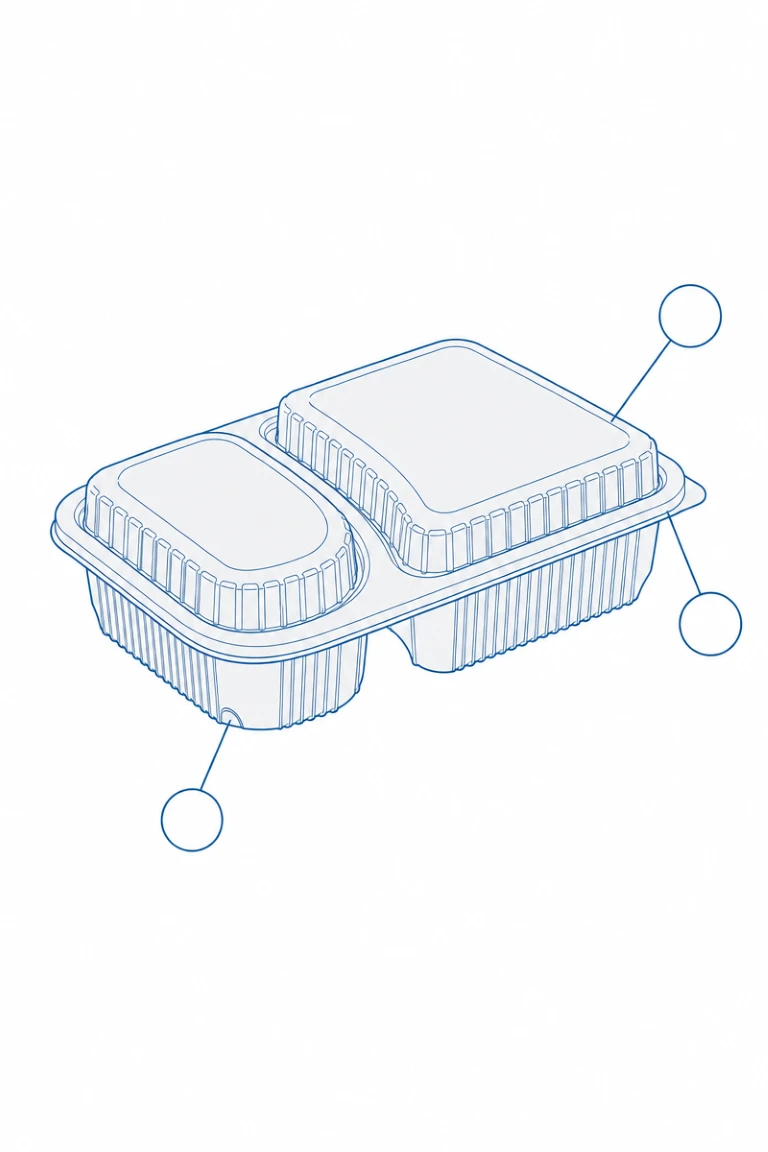
Most people check the wrong way - by guessing from thickness, or assuming "it held hot soup, so it's fine." Four checks that actually work:
Check 1 - the marking. Look on the base, not the lid or sleeve, for a microwave icon, wavy lines, or the words microwave safe. This is a manufacturer's declaration based on testing for a defined use - not a government-issued certificate - so its accuracy depends on the supplier standing behind it.
Check 2 - he resin code. The number in the triangle identifies resin family; it does not rate microwave suitability. The resin identification code, created by the plastics industry in 1988 and administered since 2008 under ASTM D7611/D7611M, was revised specifically to remove the recycling "chasing arrows" and correct the widespread misreading of resin codes as safety ratings.
Check 3 - the manufacturer's own instruction. The datasheet or marking governs, not assumptions about the resin family. If a supplier can't produce a heat rating or migration data for a specific SKU, treat it as not microwave safe.
Check 4 - condition. Warping, clouding, blistering, or an off odor after heating signal the end of a container's safe service life, even a correctly marked one.
The most common failure isn't the container at all - it's the lid. A base can carry a clear microwave-safe marking while a differently-resined lid carries none. Both parts need their own marking.
Which plastic resins are microwave safe - and which are not
What plastic number is microwave safe? Of the seven resin families, polypropylene (PP, code 5) is the workhorse of reheatable food-service packaging. Codes 1, 3, and 6 are the ones people most often microwave by mistake, usually because they physically resemble a "safe" container.
Why PP dominates: it holds its shape at reheating temperatures and resists the oils and acids in takeout food far better than PET or PS - heat stability plus grease resistance, which is why most microwave-rated bowls and clamshells are molded from it.
PP vs PET for to go containers is an honest trade-off, not a "good plastic, bad plastic" story. PET is clearer and cheaper for cold display - salad cups, bakery trays - while PP wins on heat resistance, grease resistance, and short-term reuse. PET isn't "toxic"; it simply isn't engineered for microwave heat load.
Worth correcting: not all PP is equal. A thin, low-grade PP clamshell and a heavy-wall PP soup container both carry code 5, but behave differently under heat because wall thickness, grade, and molding process all affect real performance. That's why the resin code alone never settles the question - only the specific container's own testing does.
What the research says about microwaving to go containers
Can you microwave plastic to go containers without releasing particles into your food? Not entirely - and a 2023 peer-reviewed study is why.
Researchers led by Kazi Albab Hussain at the University of Nebraska–Lincoln published Hussain et al. (2023), Environmental Science & Technology, 57(26), 9782–9792, testing how plastic containers and reusable pouches release microplastics and nanoplastics under microwaving, refrigeration, and room-temperature storage.
Microwaving produced the highest release by a wide margin. Some containers released up to 4.22 million microplastic and 2.11 billion nanoplastic particles per square centimeter within three minutes of microwave heating - measured directly, not estimated.
A finding that matters for sourcing: the polyethylene-based pouch released more particles than the polypropylene-based containers, meaning resin choice measurably changes the outcome.
Exposure modeling put the highest estimated daily intake at 20.3 ng/kg·day for infants drinking microwaved water and 22.1 ng/kg·day for toddlers eating microwaved dairy from PP containers - the youngest consumers carry the highest modeled exposure.
In vitro work, read precisely: at a 1000 μg/mL concentration, 76.70% and 77.18% of cultured kidney cells died after 48 and 72 hours. That's a laboratory-dish concentration used to study a mechanism - not a measurement of what happens in a human body.
What this research does not show matters just as much: it measured particle release and cell-level effects, not human health outcomes. The PubMed record (PMID 37343248) confirms the same scope, and the authors called for further research before drawing health-risk conclusions.
That caution lines up with the WHO's 2022 report on nano- and microplastic exposure, which recommended limiting exposure while evidence develops, and a commentary in The American Journal of Medicine urging general caution about heating food in plastic.

Safe reheating practices: a 7-point checklist
Transfer when in doubt.
1. Glass or ceramic is the lowest-release option - worth saying even as a packaging manufacturer.
Handle the lid separately.
2. Confirm it carries its own marking; if not, remove it and cover loosely so steam escapes.
Reheat in short bursts at reduced power
3. Stopping once hot - the study above found longer, full-power heating released the most particles.
Stir midway
4. to eliminate hot spots that concentrate heat in one section of the wall.
Avoid high-fat, high-oil, or acidic foods in thin plastic
5. - the same conditions used as food simulants in migration testing.
Retire the container
6. at the first sign of clouding, scratching, blistering, or odor.
Know the difference: microwave safe vs. microwaveable.
Microwaveable
7. often describes general suitability;
microwave safe is the specific claim tied to a tested, defined use. Insist on the second, in writing, for bulk orders.
The EU's Regulation (EU) No 10/2011 sets migration limits tested under conditions similar to steps 3 and 5 above - these aren't just kitchen habits, they track the same variables regulators test for.

Six common mistakes with takeout containers in the microwave
Microwaving an unmarked container "because it worked last time."
1. Different batches, suppliers, or lids change the outcome.
Microwaving the lid with the base.
2. The single most common failure - lids are rarely tested to the same standard.
Reusing a single-use container until it fails.
3. Repeated heat cycles mechanically age plastic: scratching, clouding, cracking.
Assuming foam clamshells are heat-rated
4. because they hold hot food at service temperature - confusing that with direct microwave energy in a sealed vessel.
Judging safety by resin code alone.
5. Code 5 identifies polypropylene; it doesn't certify that a specific product was tested for microwave use, a distinction the
itself was revised to clarify.
Heating dry or nearly empty containers
6. concentrating energy in the wall instead of the food.
For operators offering microwave safe to go containers for restaurants, the marking only protects customers if staff know it exists - training front-of-house teams to check for the symbol closes that gap.

How FDA and EU rules apply to microwave-safe to go containers
Are microwave safe to go containers FDA approved? Not in the way that phrase implies - there's no single "FDA microwave-safe certificate." The FDA authorizes food contact substances - the materials - through a Food Contact Notification, food additive regulation, or Threshold of Regulation exemption, and requires manufacturers to follow good manufacturing practice for the intended use. "FDA approved" on a product page is shorthand for that authorization, not a per-SKU certificate.
To verify a specific substance's authorization, the actual lookup path is FDA's inventory of effective food contact substance notifications.
On microwave use specifically: FDA hasn't issued a stand-alone regulation. The governing requirement is that packaging be suitable for its intended use under general GMP, 21 CFR 174.5, as regulatory counsel explains - meaning the burden sits with the manufacturer's own testing and documentation (see the sourcing checklist below).
In the EU, plastic food-contact materials fall under Regulation (EU) No 10/2011, setting composition rules and migration limits - the framework behind any "microwave suitable" claim for the EU market.
2026 update: the PFAS phase-out
In February 2024, FDA announced grease-proofing substances containing PFAS were no longer sold for US food-contact use, and in January 2025 determined 35 related notifications were no longer effective. This is precisely scoped: it concerns grease-proofing on paper and paperboard, not plastic resin. Buyers of fiber-based takeout items should confirm PFAS-free status directly, since several US states have added their own PFAS bans on separate timelines.

What to specify when sourcing microwave-safe to go containers
If you're buying to go containers in volume, the real question isn't "which container is safe" - it's "which container can I prove is safe." A microwave claim without paperwork is a liability in both the US and EU markets.
Eight specifications worth agreeing in writing before tooling or a bulk run:
|
Specify in writing |
Why it matters |
Evidence to request |
|
Resin grade and food-contact declaration |
Material basis of any heat claim |
Declaration of compliance |
|
Wall thickness |
Resists heat distortion and load |
Drawing plus measured sample |
|
Use-temperature rating |
Stated basis for the reheating claim |
Supplier test report |
|
Overall/specific migration testing |
Core food-safety requirement |
Third-party lab report |
|
Microwave suitability statement |
What the marking rests on |
Written declaration naming the use |
|
Lid material and rating |
Most common field failure |
Separate declaration per component |
|
Colorants and additives |
Must be independently authorized |
Additive compliance statement |
|
PFAS declaration |
Fiber-based items, state rules |
Supplier declaration or test |
Sample-testing sequence before scaling: request the declaration of compliance → run a full-power, three-minute trial with water and an oil-based simulant → inspect for deformation, clouding, odor → confirm the marking survives washing → only then move to bulk production.
Specify the lid as its own line item, with its own heat rating - lid failure generates returns even when the base performs correctly, one of the most avoidable mistakes on microwave safe to go containers wholesale orders.

Conclusion: choose containers you can reheat with confidence
To go containers are safe to microwave when three things line up: the marking on the specific item, the resin it's made from, and the container's own supporting evidence. Skip any one and you're guessing.
If you're buying rather than reheating, the takeaway is simple: ask for the declaration, test the sample, specify the lid separately. A supplier who produces that paperwork without hesitation is telling you something real about how the product was made.
[YANGRUI: confirm the specific reference/customer count you can stand behind. Founded in 2014, YANGRUI operates a 20,000㎡ manufacturing base with 20+ production lines and 100+ molds, serving customers across North America, Europe, and Australia.]
The honest answer is that plastic can be the right container and still not be the right one to reheat in - and the suppliers worth buying from are the ones who'll tell you that difference before you ask. Glass or ceramic remains the lowest-release option for reheating; we say that as a plastic packaging manufacturer because it's accurate, not convenient.
FAQ
A: Only if the container is labeled microwave safe. An unmarked takeout container should be transferred to a microwave-safe dish before reheating.
Q2: What plastic number is microwave safe?
A: Polypropylene (resin code 5) is used for most microwave-safe to go containers. Resin codes identify resin type, not microwave suitability - always confirm against the container's own marking.
Q3: Is it safe to microwave foam takeout containers?
A: No. Polystyrene foam (code 6) isn't designed for microwave reheating; it can soften, warp, and melt. Transfer the food first.
Q4: Can I microwave a to go container with the lid on?
A: Only if the lid carries its own microwave-safe marking. Many lids are PET or polystyrene, so removing the lid is the safer default.
Q5: How long can food stay in a to go container in the microwave?
A: Follow the manufacturer's instructions; as general practice, reheat in short bursts at reduced power and stop once hot.
Certificate Display


FDA Certification (SGS): YANGRUI take out containers are make from the safe & new material