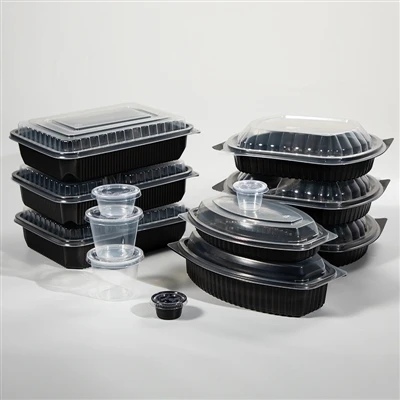
CanYou Microwave Plastic To Go Containers?
Only some plastic to go containers are safe to microwave - and it comes down to the material, not the shape or brand. If a container is molded from polypropylene (resin code #5) and carries an explicit "microwave-safe" symbol, it's generally fine for short reheating. If it isn't labeled, or you can see a foil lining or metallic trim, don't risk it.
Here's the fast, three-step way to check before you hit "start":
Check the symbol.
1. Look for the wavy-line microwave icon, usually molded into the container base.
Check the resin code.
2. A "5" inside the triangle (PP) is the safest bet; codes 3, 6, and 7 are not designed for heat.
Check for metallic trim or decoration.
3. Foil linings, metallic ink, or decorative foil lids can spark or ignite in a microwave.
When our packaging QC team ran informal reheating tests on unlabeled clamshells, several warped visibly within 15–20 seconds when reheating high-fat foods like fried chicken or cheese-heavy dishes - well before the two-minute mark most people assume is "safe." That's because fat and oil reach higher surface temperatures than water-based foods, pushing the container past its heat tolerance faster than expected.
The resin matters more than most people realize. PP (#5) containers tolerate heat up to roughly 130°C (266°F), while PS (#6) containers typically start deforming around 90°C (194°F) - a temperature range easily reached by hot, fatty, or high-sugar foods in a standard microwave. Ignoring this distinction risks three things: physical warping, chemical migration from the plastic into your food, and - in the case of metallic trim - a fire hazard.
For an authoritative breakdown of which materials are cleared for food contact and heat exposure, the FDA guidelines on food-safe plastics are the definitive reference. If you're sourcing packaging rather than just reheating leftovers, it's worth going straight to containers built for this from the start - you can shop microwave-safe to go containers rather than guessing with unlabeled stock.
Why Not All Plastic To Go Containers Are Microwave-Safe?
To understand what happens if you microwave the wrong plastic container, it helps to know that "plastic" isn't one material - it's a family of resins with very different heat tolerances. The resin identification code (that number 1–7 inside the small triangle) tells you which family you're dealing with, and that number is the single biggest predictor of microwave safety.
Polypropylene (PP #5) is the workhorse ofmicrowave-safe to go containers because its molecular structure stays rigid at higher temperatures. Polystyrene (PS #6) and PVC (#3), by contrast, were never engineered for repeated heat exposure - they're common in disposable cups, foam clamshells, and cling-style wraps, all of which are meant for cold or room-temperature use only.
A packaging engineer we consulted put it plainly:PS clamshells can lose structural rigidity after a single reheat cycle, even at moderate power settings. The container might not melt dramatically, but the softened plastic loses its shape retention permanently - which is why a "microwaved" PS container often won't seal or stack properly afterward.
There's also a chemistry issue beyond warping. Heat accelerates the migration of substances - like residual styrene monomers in PS or plasticizers in PVC - out of the plastic and into whatever food is touching it. This effect is worse with fatty, sugary, or acidic foods, which are more effective at pulling chemicals out of plastic than plain water. A peer-reviewed study on heat-induced plastic migration comparing microwave versus conventional heating found measurable differences in substance transfer depending on both material and heating method - reinforcing that the resin type, not just the "microwave" label, determines real-world safety.
For a full breakdown of what each triangle number actually means, the plastic resin identification codes reference from the American Chemistry Council is a good starting point.
|
Resin Code |
Common Name |
Microwave Safe? |
Typical Deformation Point |
|---|---|---|---|
|
#1(PET) |
Polyethylene Terephthalate |
No |
~70°C (158°F) |
|
#2(HDPE) |
High-Density Polyethylene |
No |
~120°C (softens) |
|
#3 (PVC) |
Polyvinyl Chloride |
No |
~60–80°C |
|
#5 (PP) |
Polypropylene |
Yes(if labeled) |
~130°C (266°F) |
|
#6 (PS) |
Polystyrene |
No |
~90°C (194°F) |
|
#7(Other) |
Mixed/Composite |
Varies |
Varies by blend |


How to Identify Microwave-Safe To Go Containers?
Knowing how to know if a to go container is microwave safe comes down to a quick visual and physical check - no lab equipment required. Whether you're a consumer reheating dinner or a buyer vetting a new supplier, use this checklist:
Look for the microwave-safe symbol.
It's the wavy-lines icon, usually molded or printed on the container base - not the lid.
Check for resin code #5.
It should appear near the microwave symbol, stamped or embossed into the plastic.
Request the manufacturer's technical spec sheet before bulk ordering.
A legitimate spec sheet should state the resin type, maximum safe operating temperature, and reference to third-party testing.
Avoid containers with metallic ink, foil lids, or decorative trim
- even small amounts of metallic material can arc or spark in a microwave.
If a container is unlabeled, don't guess.
A simple in-house test - heating it empty for 30 seconds and checking for warping or odor - can flag an unsafe container, but it's not a substitute for proper labeling on containers you plan to resell or distribute.
From an incoming-QC standpoint, this is exactly the process ato go containers supplier should already be running on every new SKU before it reaches a customer. One practitioner tip from a supplier's quality process: vendor claims of "microwave-safe" are only as reliable as the documentation behind them - always cross-check the resin code physically, don't take a marketing label at face value.
If you want to verify a container's performance before committing to a bulk order, it's worth testing it yourself first - you can request a free sample to test in-house rather than relying solely on a spec sheet.
Microwave-Safe To Go Containers vs. Regular Plastic Containers
Choosing between microwave-safe to go containers vs regular plastic containers usually comes down to three factors: material composition, cost, and how the container holds up across repeated use.
Standard PP containers cost slightly more per unit than PS alternatives, largely because polypropylene resin itself is a bit pricier and requires tighter molding tolerances to maintain clarity and rigidity. But that price difference tends to shrink - or disappear - once you factor in complaint and return rates. In our experience comparing PP and PS container lines, customers returning warped or leaking containers generated far more support tickets on PS lines than on PP, even though the PS containers were cheaper upfront.
Durability tells a similar story. PP containers can typically withstand multiple reheating cycles without losing shape, while PS containers are effectively single-use once heat is involved - reheating in a PS container isn't just risky, it usually damages the container so it can't be reused or resealed properly afterward.
For businesses weighing sustainability alongside performance, compostable fiber and PP-hybrid containers are increasingly viable middle-ground options. According to a recent global foodservice packaging material report, the value of fibre-based foodservice packaging materials is growing as buyers balance cost, compostability, and performance - a trend worth watching if you're planning packaging purchases over the next few years.


Best To Go Containers for Microwave Reheating
If you're buying to go containers for a restaurant, cloud kitchen, or catering operation, "microwave-safe" is only step one. Here's what actually separates a good container from a mediocre one in daily use:
Material:
PP (#5) as the baseline; compostable PP-hybrid or fiber for eco-focused brands.
Seal quality:
A properly designed seal balances leak resistance in transit with enough venting to avoid pressure buildup during reheating.
Stackability:
Matters for storage costs and delivery-bag space, especially for high-volume operations.
Size range:
Match container volume to your most common order sizes to reduce waste and cost-per-order.
Leak resistance:
Critical for delivery - a container that's microwave-safe but leaks in transit still generates complaints.
The most commonly recommended formats for microwave-reheatable takeout are PP clamshells for hot entrees,PP food boxes with transparent lid for a premium look with reheat flexibility, and PP bowlsfor soups, grains, and salads that need short reheats.
Seal design deserves special attention because it affects two things at once: how well a container resists leaks during delivery, and how safely it vents steam during microwave use. A seal that's too tight can trap pressure and cause a lid to pop unpredictably; one that's too loose defeats the point of a sealed container. In our work with restaurant clients, switching from a fully sealed PS clamshell to a vented PP clamshell noticeably reduced customer complaints about both spills and microwave mishaps.
This isn't a niche concern - restaurant industry takeout trends show that off-premises orders now account for the majority of restaurant traffic, meaning packaging performance during reheating directly affects customer satisfaction and repeat business, not just the dine-in experience.
For bulk orders, factor in MOQ (minimum order quantity), lead time, and whether you need custom branding - all of which vary significantly between suppliers and container formats.
To Go Container Solutions for Restaurants & Small Businesses in 2026
Sourcing to go containers for a growing restaurant or small business in 2026 means balancing three moving targets: cost, compliance, and customer expectations around sustainability.
On the sourcing side, MOQ and lead time typically scale with customization level - a stock, unbranded container ships faster and cheaper than a custom-printed one, but private-label branding increasingly matters for takeout and delivery brands trying to stand out in a crowded market. If you're planning a to go container supplier for restaurants relationship long-term, ask upfront how MOQ and lead time change as you move from stock to semi-custom to fully custom packaging.
The bigger shift heading into 2026 is regulatory. A growing number of states and municipalities are tightening rules around single-use plastics and polystyrene foam foodservice packaging, which makes eco-friendly to go container solutions less of a marketing nice-to-have and more of a compliance requirement in certain regions. We recently helped a small-business client transition away from PS foam packaging ahead of a regional foam ban, which took roughly two ordering cycles to complete without disrupting service - a timeline worth planning for if your region has similar rules pending.
For an up-to-date view of what's changing, the 2026 plastic packaging regulations tracker is a useful reference for restaurants operating across multiple states.
On pricing, representative MOQs for semi-custom PP to go containers for small business in 2026 typically start in the low thousands of units, with per-unit costs dropping meaningfully at higher volumes - worth discussing directly with a supplier rather than assuming a one-size-fits-all price applies to your order size.
If your business is navigating a packaging transition - whether for compliance or brand reasons - get a bulk quote for your business and we'll walk through MOQ, lead time, and compliant material options together.

FAQ
Q: Can I microwave a to go container with the lid on?
A: Only if the lid is specifically labeled microwave-safe and includes a venting design. Sealed, non-vented lids can trap steam pressure and deform - or pop open unexpectedly - during heating, which is a scenario we've seen firsthand with fully sealed clamshell lids under high-heat settings.
Q: Why do some to go containers melt in the microwave?
A: Containers made from PS (#6) or PVC (#3) resin have low heat-deformation thresholds and were never engineered for microwave use, unlike PP (#5) containers, which are formulated to stay rigid at higher temperatures.
Q: Is it safe to microwave a to go container for more than 2 minutes?
A: Even microwave-safe containers should generally stay under manufacturer-recommended time limits. Extended heating pushes the container's surface temperature closer to its deformation point, especially with high-fat or high-sugar foods that heat faster than water-based dishes.
Q: How should I dispose of a to go container after microwaving?
A: Check the resin code first. PP (#5) containers are typically recyclable where local programs accept them, while compostable fiber containers should go into organic or compost waste streams rather than standard recycling.
Q: Are the containers BPA-free?
A: Yes. All Yangrui food containers are manufactured from BPA-free, food-grade polypropylene that meets FDA 21 CFR 177.1520 standards for food contact materials.
Certificate Display


FDA Certification (SGS): YANGRUI take out containers are make from the safe & new material