Introduction
If you're sourcing disposable food containers for the first time - or switching suppliers - you'll eventually run into a question that has nothing to do with color, size, or price: how is this container actually made? Two manufacturing processes dominate the PP food packaging industry, thermoforming and injection molding, and they produce containers that look similar on a product page but behave very differently once they're loaded with hot food, stacked in a delivery bag, or run through a microwave.
We manufacture PP food containers using sheet extrusion and thermoforming on our own production lines, and we get versions of this question from buyers almost every week - usually right after they've received quotes from two suppliers with a confusing price gap. This guide breaks down what separates the two processes, where each one makes sense, and what to actually check before you commit to an order.
1. What's Actually Different Between the Two Processes
Thermoforming starts with a flat PP sheet. The sheet is heated until it's pliable, then pulled or pushed over a mold using vacuum or air pressure, cooled, and trimmed into individual containers. Picture stretching a sheet of plastic over a shape rather than shooting liquid plastic into it.
Injection molding starts with PP resin pellets, which are melted and injected under high pressure into a closed steel mold cavity. The plastic fills every corner of the mold in seconds, cools, and the part ejects as a finished piece.
The mechanical difference sounds minor, but it drives almost everything else that matters to a buyer: wall thickness consistency, tooling investment, minimum order quantity, and how fast a new mold can go from design to production.
2. Side-by-Side Comparison for Food Container Buyers
| Factor | Thermoforming | Injection Molding |
|---|---|---|
| Wall thickness | Variable - thins out at deep corners and stretch points | Uniform and precisely controlled across the whole part |
| Tooling cost | Lower; molds are simpler and faster to produce | Higher; steel molds require more machining and lead time |
| Typical order volume fit | Efficient across a wide volume range, including mid-size runs | Most cost-effective at very high volumes where tooling cost amortizes |
| Cycle time | Fast for thin-wall, high-speed runs | Fast per part, but mold complexity can extend cycle time |
| Design detail | Good for simple shapes: trays, clamshells, cups, lids | Better for parts needing fine detail, undercuts, or snap-fit features |
| Dimensional precision | Good enough for standard food container fit; tighter zones need process control | Tighter, more repeatable tolerances part-to-part |
| Best-fit container types | Hinged-lid clamshells, compartment trays, cups, bowls | Rigid tubs, jars, containers with complex lid mechanisms |
Neither process is universally "better" - they're optimized for different jobs. A 3-compartment takeout clamshell and a screw-top sauce jar have different structural needs, and the right process follows the part, not the other way around.

3. Which Process Fits Your Food Business?
You're likely better served by thermoformed PP containers if:
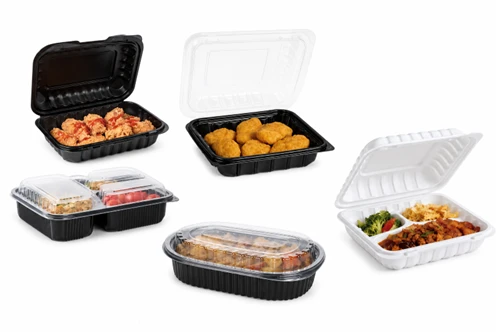
- You need hinged-lid clamshells, compartment trays, bowls, or cups for takeout, delivery, or meal prep
- You want to test a new container size or design without committing to expensive steel tooling
- Your order volumes are in the moderate-to-large range rather than multi-million-unit annual runs
- Fast tooling turnaround matters because you're launching a seasonal menu item or new packaging line
Injection-molded containers tend to be the stronger fit when:
- The container has complex geometry - screw threads, snap-fit lids, integrated handles
- You need extremely tight, repeatable wall thickness across a rigid container (e.g., a reusable tub)
- Your annual volume is high enough to justify a higher upfront tooling investment
- The container will be reused multiple times and needs maximum structural rigidity
For most restaurant, catering, and food delivery operators - the buyers we work with most often - thermoformed PP hits the sweet spot: strong enough to hold hot food without warping, light enough to keep freight costs down, and flexible enough that a custom mold doesn't require a six-figure tooling commitment.
4. What to Verify Before You Place an Order, Regardless of Process
- Food-contact compliance documentation. Ask for the specific FDA 21 CFR citation or CE/RoHS documentation for the resin grade used - not just a general "food-safe" claim.
- Actual tested heat range. A thermoformed container's practical heat resistance depends on wall thickness and resin grade as much as the base material. Ask what temperature range the supplier has actually tested, not the theoretical maximum for PP as a material.
- Carton packing count and weight. This affects your landed freight cost more than most buyers expect, especially for containers shipping into North America, the Middle East, or Australia where freight distances are long.
- MOQ for custom vs. stock designs. Stock thermoformed containers are usually easier to trial in smaller quantities; custom-printed or custom-tooled designs typically require a higher minimum to offset tooling and setup costs.
- Sample availability. A supplier confident in their process should be able to send physical samples for you to test - stacking, sealing, microwave behavior - before you commit to a production order.
5. Frequently Asked Questions
Are thermoformed PP containers as strong as injection-molded ones?
For hinged clamshells, trays, and cups - the shapes thermoforming is built for - well-designed thermoformed PP containers hold up reliably through normal foodservice handling: stacking, transit, reheating. Injection molding tends to win on raw rigidity for thick-walled or reusable containers, but that extra rigidity isn't necessary for most single-use takeout and delivery formats.
Why do injection-molded containers usually cost more per piece at low volumes?
Injection molds are more expensive and time-consuming to build than thermoforming molds. At low-to-moderate order volumes, that tooling cost is spread across fewer units, which raises the effective price per container. At very high volumes, the math flips and injection molding can become more cost-efficient per piece.
Can thermoformed containers go in the microwave?
Most food-grade thermoformed PP containers are microwave-safe, but the exact temperature tolerance depends on wall thickness and the specific resin grade used. Always confirm the tested heat range with your supplier rather than assuming all PP containers perform identically.
How long does it take to get a new mold made for a custom container design?
Thermoforming molds are generally faster to produce than injection molds because they don't require the same level of steel machining precision. Exact lead times vary by design complexity and mold size, so it's worth requesting a specific timeline from your supplier before finalizing artwork.
Is one process more eco-friendly than the other?
Process choice doesn't determine recyclability - that comes down to the resin itself. PP is classified as a recyclable plastic (resin code #5) whether the container was thermoformed or injection molded. If sustainability positioning matters for your brand, focus on resin selection, material weight, and end-of-life labeling rather than the forming process.
Do I need different container specs depending on whether food is hot or cold?
Yes, to some extent. Hot, oily, or steaming food puts more stress on wall thickness and lid seal design than cold items. If your menu includes a mix of hot entrees and cold sides, it's worth checking whether one container design across the board or two separate specs makes more sense for your operation.
What information should I send a supplier to get an accurate quote?
At minimum: target volume (capacity), whether the container needs a hinged or separate lid, compartment count if any, target order quantity, and your ship-to region (for freight and compliance planning). The more specific you are upfront, the faster you'll get a workable quote instead of a generic price range.


Conclusion
The thermoforming-vs-injection-molding decision isn't really about which process is "better" in the abstract - it's about matching the process to your container shape, your order volume, and how fast you need to move from design to shipped product. For most takeout, delivery, and meal-prep container needs, thermoformed PP delivers the right balance of strength, cost, and flexibility without demanding a heavy tooling investment up front.
As a manufacturer running our own sheet extrusion and thermoforming lines, we work through this exact decision with restaurant chains, distributors, and retail brands every week - matching container specs to real operating conditions rather than a spec sheet in isolation.
Not sure which process fits your next order? Send us your container specs for a tailored recommendation and quote →